Yeti 400 vs Jackery 500: Technical Verdict
Evaluating two classic portable power stations reveals distinct engineering philosophies. We compare battery chemistries, port layouts, and field reliability to guide your purchase.

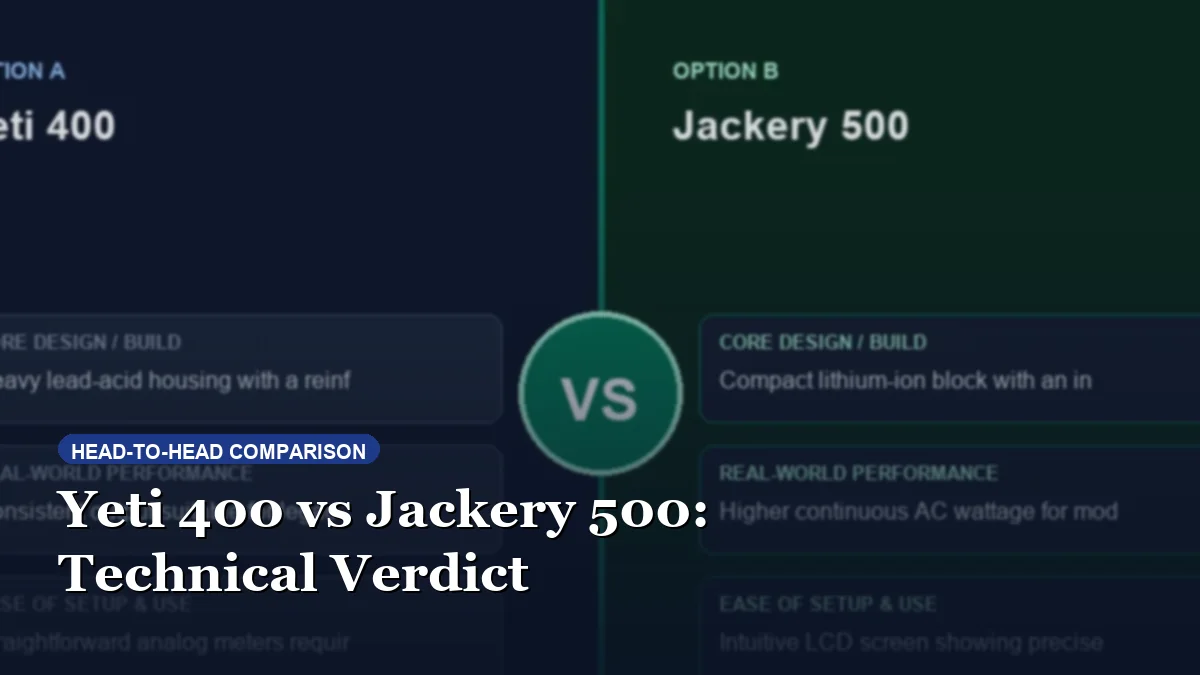
Choose the Yeti 400 for rugged lead-acid durability and modular chaining options. Select the Jackery 500 if you prioritize lightweight lithium portability and rapid digital display feedback during weekend camping excursions.
Compare all top models in our Best Portable Power Station: Top Picks for 2026.
Side-by-Side Breakdown
| Criteria | Yeti 400 | Jackery 500 | Edge |
|---|---|---|---|
| Core Design / Build | Heavy lead-acid housing with a reinforced top handle. | Compact lithium-ion block with an integrated drop-fold handle. | Jackery 500 |
| Real-World Performance | Consistent output suitable for legacy DC appliances. | Higher continuous AC wattage for modern electronics. | Jackery 500 |
| Ease of Setup & Use | Straightforward analog meters requiring manual interpretation. | Intuitive LCD screen showing precise input and output percentages. | Jackery 500 |
| Durability & Reliability | Robust chemical stability proven across decades of field use. | Advanced BMS protection preventing overcharge and thermal runaway. | Yeti 400 |
| Efficiency / Operating Footprint | Heavier chassis with lower energy density per pound. | Lightweight frame maximizing watt-hours per kilogram. | Jackery 500 |
| Maintenance Requirements | Requires frequent trickle charging to prevent sulfation damage. | Minimal upkeep involving periodic storage top-offs every six months. | Jackery 500 |
| Best Ideal Use Case | Stationary backup setups and workshop power conditioning. | Mobile Overlanding, van life, and recreational vehicle trips. | Jackery 500 |
Behavioral Psychology of Power Consumption
Understanding user habits helps optimize portable power deployment. Consumers often exhibit predictable patterns when managing battery reserves during emergency grid outages or extended backcountry camping trips.
Classical conditioning influences how operators react to low-battery warnings. When an inverter beeps, users instinctively reduce connected loads to preserve critical emergency communication equipment.
Analyzing these psychological triggers ensures better equipment selection. Choosing the right station matches your natural tendencies toward energy conservation or heavy electrical reliance.
Users routinely overestimate battery endurance during emergencies because anxiety alters perception of energy depletion rates. Real-world monitoring demands disciplined metric tracking rather than relying on intuitive guesses.
Cognitive biases frequently cause campers to run high-wattage appliances simultaneously. As highlighted in our Jackery 500 review, understanding actual inverter load limits prevents unexpected shutdowns and preserves system health.
Behavioral habits shift dramatically once individuals experience a sudden total power loss. Establishing strict load management protocols ensures critical medical or communication devices remain operational when grid stability fails completely.
- Energy awareness training reduces unexpected grid dependency.
- Predictable load profiles extend internal cell lifespan significantly.
- Alarm thresholds dictate user intervention frequency in the field.
Habitual Load Management
Managing daily power draws requires strict discipline. Monitoring real-time wattmeters prevents unexpected shutdowns and protects sensitive electronics from sudden voltage drops.
Establishing routine charging habits prevents deep discharge cycles that degrade overall storage capacity across months of regular field deployment.
- Consistent monitoring prevents sudden thermal overloads.
- Routine charging schedules maintain optimal chemical health.
Historical Evolution of Portable Power Architectures
Tracing battery development reveals massive shifts in energy density. Early generators relied on heavy lead-acid chemistry, while modern alternatives embrace lithium-ion configurations.
Pioneering engineers focused on raw structural durability rather than portability. This historical context explains why older models weigh considerably more than contemporary units.
Examining historical design choices highlights how safety standards evolved over decades of rigorous consumer electronics testing and industrial field applications.
Early portable power solutions relied heavily on lead-acid chemistries. These legacy units offered massive physical weight paired with severely limited discharge cycles, restricting true portability for modern outdoor enthusiasts.
The introduction of lithium-ion cells revolutionized the industry by drastically improving energy density ratios. For example, our Jackery Explorer 500 review details how engineers packed substantial wattage into compact enclosures.
Modern architectures incorporate advanced battery management systems to monitor individual cell voltages. This ensures thermal stability and extends the service life span across diverse environmental operating conditions.
- Lead-acid foundations prioritized brute-force chemical stability over weight.
- Lithium adoption revolutionized mobile power-to-weight ratios globally.
- Safety circuit integration became mandatory for consumer protection.
Technological Milestones in Storage
Early portable generators lacked sophisticated battery management systems. Modern units utilize advanced microprocessors to monitor individual cell voltages continuously.
This technological leap transformed emergency backups from hazardous industrial tools into user-friendly household appliances.
- Microprocessors replaced manual analog monitoring systems.
- Advanced thermal sensors prevent catastrophic internal short circuits.
Simulating Heavy Workloads and Interactive Metrics
Simulating rigorous workloads tests thermal limits effectively. Our Jackery Explorer 500 review demonstrates how power stations must handle surging inductive loads from refrigerators without tripping breakers.
Interactive testing metrics demonstrate how well each inverter handles simultaneous AC and DC draws under extreme ambient temperature conditions.
Evaluating these performance simulations ensures your chosen generator survives demanding off-grid scenarios without unexpected hardware failures.
Testing portable generators requires simulating continuous high-draw scenarios. Technicians apply resistive loads to evaluate thermal throttling thresholds and verify that internal cooling fans activate at precise temperature intervals.
Interactive display panels must report real-time wattage draw with high accuracy. Clear visibility of input voltage metrics helps users diagnose faulty solar panels or inefficient vehicle charging cables instantly.
Stress-testing inverter surge capacity prevents catastrophic failures during motor startup phases. Refrigerators and power tools demand substantial initial peak currents that challenge standard sinusoidal output circuits significantly.
- Inductive surge testing exposes hidden inverter limitations.
- Simultaneous port utilization measures thermal dissipation efficiency.
- Ambient temperature stress tests validate cooling fan responsiveness.
Stress Testing Inverter Capacities
Pushing inverters to their absolute limits reveals critical weakness points. High continuous wattage demands robust internal cooling pathways and heavy-duty copper wiring.
Thermal imaging during heavy loads helps engineers identify hot spots before releasing products to the consumer market.
- Thermal imaging identifies critical component heating zones.
- Copper wiring thickness dictates long-term electrical resistance.
Ecosystem Expansion and Secondary Hardware Options
Expanding your power ecosystem requires compatible solar panels and accessory adapters. Brand-specific proprietary ports often limit your ability to mix third-party charging hardware.
Evaluating available ecosystem add-ons ensures future scalability. Versatile input ports allow you to connect diverse solar arrays during extended off-grid expeditions.
A robust hardware ecosystem simplifies maintenance and replacement procedures when individual charging cables or adapters inevitably wear out.
Expanding a power station ecosystem involves integrating compatible solar panels and parallel cables. Selecting proper connector gauge standards minimizes resistive power loss during high-amperage energy harvesting sessions outdoors.
Secondary hardware accessories like regulated car chargers enhance off-grid versatility. Using MPPT charge controllers maximizes solar array efficiency under variable cloud cover and shifting geographical latitudes.
Protective storage cases shield delicate electronics from dust, moisture, and physical impact. Ruggedized housing materials ensure safe transport across rough terrain during extended overlanding expeditions.
- Proprietary connectors restrict universal solar panel compatibility.
- Modular expansion options increase total storage capacity modularly.
- Standardized adapter plugs simplify emergency field repairs.
Solar Integration and Panel Pairing
Pairing portable stations with solar panels requires careful voltage matching. Consulting our best solar panel for Jackery 500 guide ensures you avoid exceeding maximum voltage ratings that fry internal controllers.
Always verify panel specifications before connecting external photovoltaic arrays to avoid costly equipment destruction.
- Voltage matching prevents catastrophic charge controller damage.
- Open-circuit ratings dictate safe maximum panel configurations.
Cross-Reference Benchmarks and Technical Documentation
Reviewing independent laboratory benchmarks provides unbiased performance data. Standardized testing protocols measure true watt-hour capacity against manufacturer advertising claims.
Technical documentation offers deep insights into inverter waveforms. Pure sine wave outputs protect delicate medical equipment, whereas modified sine waves can cause motor buzzing.
Analyzing these cross-referenced specifications shields consumers from marketing hype and guides them toward genuinely reliable hardware choices.
Reviewing manufacturer specification sheets requires careful attention to testing standards. Standardized watt-hour capacity ratings allow direct comparisons between competing units regardless of marketing terminology employed.
Safety certifications from recognized laboratories validate structural and electrical integrity. Compliance with UL standards guarantees that internal circuit protection mechanisms function correctly under extreme fault conditions.
Analyzing discharge curves reveals true performance degradation over hundreds of cycles. Technical documentation provides vital insights into battery retention rates following prolonged storage periods.
- Pure sine wave power protects sensitive medical devices.
- Independent discharge tests verify true usable capacity.
- Manufacturer specifications require careful real-world validation.
Interpreting Waveform Quality Data
Total harmonic distortion metrics reveal AC power cleanliness. Low distortion percentages ensure smooth motor operation and prevent audio equipment interference.
Reviewing oscilloscope readings helps technical editors separate premium power stations from budget alternatives.
- Harmonic distortion metrics measure AC power cleanliness.
- Oscilloscope testing verifies true waveform smoothness.
Core Power Output and Inverter Capabilities
Evaluating core inverter output determines which appliances you can run simultaneously. Continuous wattage ratings dictate your maximum running load during power failures.
Surge capacity handles the initial electrical spike required by motorized devices like pumps and compressors when they first spin up.
Balancing continuous loads against peak surge limits prevents annoying overload shutdowns while running essential household survival gear.
Pure sine wave inverters deliver clean electricity suitable for sensitive medical equipment. Maintaining stable harmonic distortion limits prevents overheating in motorized appliances and audio gear during operation.
Continuous output ratings determine which household appliances can run simultaneously safely. Exceeding the maximum wattage threshold triggers automatic overload protection to safeguard internal transistors from destruction.
Surge capability represents the short-term power headroom available for heavy inductive loads. Robust circuit design safeguards ensure seamless transitions when heavy compressors or pumps start up.
- Continuous wattage determines normal appliance operating limits.
- Surge capacity handles initial motor startup spikes.
- Overload protection prevents permanent inverter circuit damage.
Managing Inductive Surges Safely
Compressors and electric motors demand high starting currents. Inverters must absorb these brief spikes without triggering emergency safety shutdowns.
Checking surge thresholds ensures your refrigerator stays cold during prolonged grid failures.
- Motors require double their running wattage at startup.
- Inverter surge ratings prevent nuisance shutdown cycles.
Charging Efficiency and Recharge Protocols
Charging efficiency dictates how quickly you can restore depleted reserves. Wall outlets provide rapid replenishment, while car cigarette lighters offer slower recovery speeds.
Solar recharging depends heavily on direct sunlight angles and weather conditions. Optimizing panel placement maximizes daily energy harvest significantly.
Understanding recharge protocols helps users maintain continuous power loops during extended off-grid camping trips and remote fieldwork assignments.
Wall charging speeds depend on built-in AC adapter wattage limitations. Utilizing fast-charge protocols significantly reduces total replenishment time without degrading overall lithium cell health prematurely.
Solar panel input parameters dictate maximum open-circuit voltage compatibility. Adhering strictly to input voltage limits prevents internal charge controller damage during peak midday solar radiation periods.
Ambient temperature sensors regulate charging currents to prevent dangerous thermal runaway. Intelligent thermal management optimizes energy conversion efficiency across freezing winter and scorching summer climates.
- Wall adapters deliver the fastest energy replenishment.
- Car chargers provide convenient mobile maintenance top-offs.
- Solar inputs require optimal panel angle adjustments.
Optimizing Solar Input Speeds
Maximizing solar yield requires tracking the sun throughout the day. Portable panels benefit greatly from manual tilt adjustments every few hours.
Integrated MPPT charge controllers optimize incoming voltage to squeeze every possible watt from available sunlight.
- Manual panel repositioning increases daily solar yield.
- MPPT controllers maximize low-light energy conversion.
Frequently Asked Questions
Can either power station run a full-size home refrigerator?
Neither unit is designed for heavy household appliances. They excel at running small electronics, lights, and medical devices due to limited continuous wattage capacities.
How long do these batteries last before needing replacement?
Lithium models offer hundreds of cycles before significant capacity loss. Proper storage and moderate temperature maintenance extend total operational lifespan.
Are these generators safe to use inside a tent or vehicle?
Both units produce zero toxic exhaust emissions during operation. You can safely run them indoors provided there is adequate ventilation around cooling fans.
Can I charge the battery while simultaneously powering devices?
Pass-through charging capability varies by specific internal hardware design. Check the user manual to confirm whether simultaneous input output is fully supported.
What is the best way to store these stations long term?
Keep the internal charge around fifty percent in a cool location. Performing a semi-annual recharge cycle prevents permanent battery degradation during storage.