Portable Power Station vs Inverter Generator
Choosing between chemical battery storage and liquid-fuel generation defines your off-grid readiness. Understanding core engineering mechanics ensures optimal power delivery for your specific application.

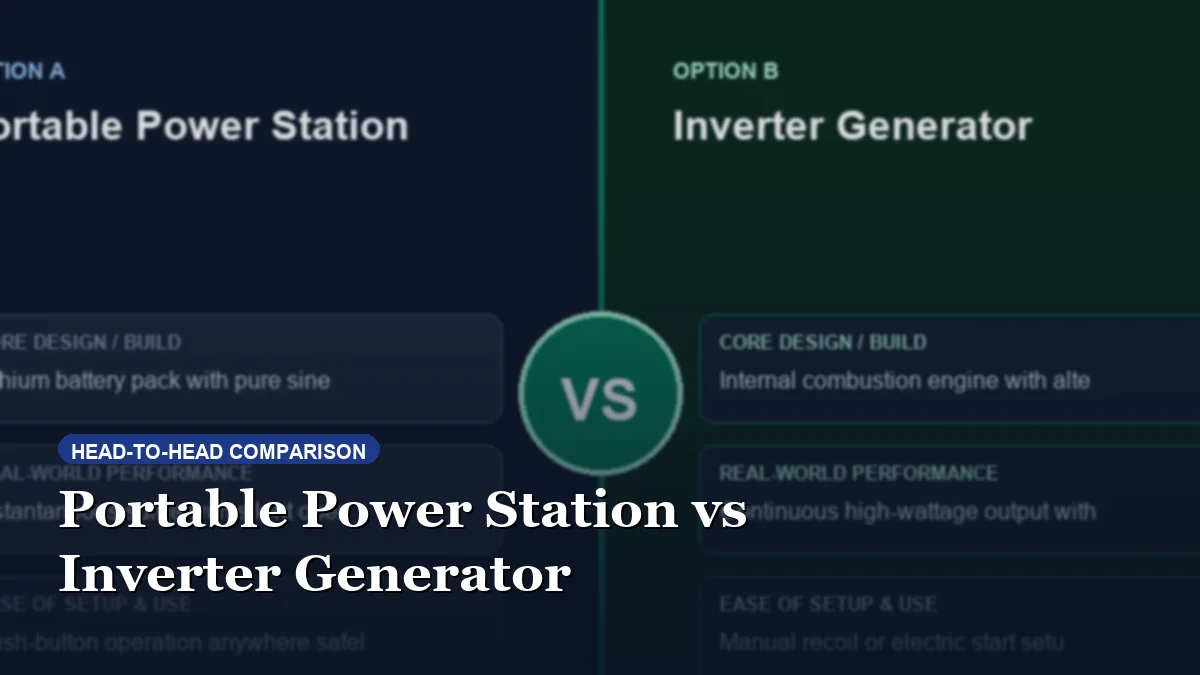
Select Side A for silent indoor operation and zero maintenance. Choose Side B for infinite runtime during extended grid failures using stored fossil fuels.
Compare all top models in our Best Portable Power Station: Top Picks for 2026.
Side-by-Side Breakdown
| Criteria | Portable Power Station | Inverter Generator | Edge |
|---|---|---|---|
| Core Design / Build | Lithium battery pack with pure sine inverter | Internal combustion engine with alternator | Side A |
| Real-World Performance | Instantaneous surge with silent operation | Continuous high-wattage output with noise | Side B |
| Ease of Setup & Use | Push-button operation anywhere safely | Manual recoil or electric start setup | Side A |
| Durability & Reliability | Solid-state electronics with cooling fans | Mechanical engine parts requiring servicing | Side B |
| Efficiency / Operating Footprint | Zero direct emissions and high efficiency | Fossil fuel combustion with carbon exhaust | Side A |
| Maintenance Requirements | Zero routine engine maintenance needed | Regular oil changes, filters, and fuel care | Side A |
| Best Ideal Use Case | Indoor emergency backup and mobile office | Remote job sites and multi-day outages | Side B |
Core Design and Engineering Differences
Modern power station architecture relies on advanced lithium chemistry modules paired with sophisticated battery management systems. These units convert stored direct current into clean alternating current waveforms.

Conversely, traditional generators utilize internal combustion engines fueled by gasoline, propane, or diesel. A mechanical alternator spins to generate raw alternating current before conditioning it through an inverter module.
Evaluating these foundational frameworks highlights the fundamental trade-off between electro-chemical storage density and liquid-fuel combustion capacity for emergency preparedness and recreational outings.
Modern units found in our best portable power station guide rely on solid-state lithium chemistry, housing battery management systems that monitor thermal thresholds without moving parts, contrasting sharply with complex combustion engines.
Inverter generators convert mechanical energy from fuel combustion into alternating current through an alternator and inverter module, which rectifies raw electricity into clean DC and inverts it back to stable AC.
Electrical architecture dictates the engineering trade-offs, where chemical storage prioritizes silent operation and instant circuit closure, whereas mechanical generation demands robust cooling fans, exhaust routing, and vibration dampening mounts.
- Solid-state lithium iron phosphate cell chemistry
- Microprocessor-controlled pure sine wave inversion
- Enclosed combustion engine with mechanical alternator
- Advanced thermal management via forced air cooling
Inverter Electronics and Waveform Quality
Pure sine wave output protects sensitive medical devices and microprocessors from electrical degradation. Both technologies deliver stable power, but battery systems achieve this without mechanical moving parts.
Advanced inverter microchips regulate voltage fluctuations tightly. This protects delicate appliances against harmonic distortion during high-draw startup cycles.
- Total harmonic distortion under three percent
- Protects sensitive laptops and medical equipment
Energy Storage Versus Fuel Conversion
Battery units store a finite kilowatt-hour capacity inside sealed enclosures. Generator systems convert external chemical fuel into electricity continuously as long as fuel remains available.
This distinction dictates your long-term energy strategy during prolonged blackouts or remote expeditions.
- Finite chemical storage capacity within housing
- Continuous generation via external fuel supply
Real-World Power Output and Performance
Delivering reliable wattage under heavy loads requires examining surge capabilities and sustained output limits. Chemical battery units provide instantaneous surge current for motor startup without voltage sag.
Liquid fuel systems excel at sustained heavy loads over many consecutive hours. However, they demand careful load management to prevent engine stalling during sudden demand spikes.
Assessing your typical appliance load profile helps determine whether instantaneous surge or extended runtimes matter most for your daily operational requirements.
Chemical storage units deliver immediate surge wattage constrained only by inverter peak limits, allowing them to start sensitive electronics instantaneously without voltage drops or initial mechanical lag times.
Fuel-driven generators sustain continuous heavy loads for days, provided you maintain adequate fuel reserves, whereas battery stations deplete their watt-hour capacity relative to the exact draw of connected appliances.
Total harmonic distortion remains exceptionally low on quality lithium units, ensuring safe power for medical devices, while generators require advanced inverter technology to achieve clean sine wave output under fluctuating loads.
- Instantaneous surge response from lithium cells
- Sustained high wattage output from combustion engines
- Voltage stability under heavy inductive loads
- Thermal throttling protection during peak usage
Handling Inductive Loads and Motor Startup
Refrigerators and air conditioners draw massive surge currents during compressor startup. Chemical power units leverage high discharge rates to handle these brief spikes effortlessly.
Combustion systems rely on mechanical momentum and engine governor response to compensate for sudden inductive load demands.
- High initial amperage draw handling
- Preventing compressor stalls during startup
Sustained Output Under Continuous Loads
Running high-draw heating elements for hours drains chemical storage rapidly. Combustion generators maintain output steadily as long as fuel is replenished in the tank.
Thermal limits dictate continuous runtime limits for both technology types in hot ambient environments.
- Extended runtime capability with fuel refills
- Thermal management during heavy continuous draws
Fuel Supply, Efficiency, and Operating Footprint
Operational footprints vary dramatically between chemical storage and fossil fuel combustion. Battery systems produce zero local emissions, allowing safe operation inside living spaces, tents, and enclosed garages.
Fossil fuel generators emit dangerous carbon monoxide and require strict outdoor placement with proper ventilation. They also demand careful fuel storage protocols involving volatile liquids.
Weighing environmental impact and logistical convenience reveals distinct advantages for users operating in residential neighborhoods or noise-restricted campsites.
Generators demand continuous liquid fuel or propane logistics, emitting carbon monoxide and operational noise that restricts indoor usage, whereas battery systems produce zero emissions and operate silently inside enclosed living spaces.
Thermal efficiency in combustion engines converts only a fraction of fuel, while systems featured in our best portable solar power generator review boast high round-trip efficiency for off-grid living.
The logistical footprint of carrying extra gasoline containers introduces safety hazards during extended outages, contrasted with recharging lithium units via renewable solar arrays or standard household utility circuits.
- Zero local emissions for indoor deployment
- Carbon monoxide exhaust requiring outdoor placement
- Quiet acoustic footprint under sixty decibels
- Noticeable engine noise during full-load operation
Acoustic Profiles and Noise Regulations
Operating noise levels impact comfort during extended outages or recreational camping trips. Chemical units operate nearly silently, emitting only faint cooling fan whispers under heavy loads.
Modern enclosed combustion generators feature sound-dampening enclosures, yet they still produce noticeable engine hums that may violate strict campground noise ordinances.
- Whisper-quiet fan operation for batteries
- Dampened engine noise around fifty decibels
Refueling Logistics and Fuel Storage Safety
Storing gasoline safely requires stabilizing additives and dedicated fire-rated containers. Recharging battery units simply requires plugging into wall outlets or portable solar panels.
Renewable solar recharging offers true energy independence during prolonged grid failures without relying on dwindling local fuel supplies.
- Gasoline stabilization and safe storage rules
- Solar recharging for off-grid independence
Maintenance, Longevity, and Mechanical Wear
Mechanical complexity directly influences long-term reliability and routine upkeep schedules. Combustion generators feature moving engine parts that require frequent oil changes, spark plug replacements, and carburetor cleaning.
Solid-state battery systems have zero moving parts, requiring practically no routine maintenance beyond periodic firmware updates and occasional ventilation dust cleaning.
Understanding lifecycle expectations helps calculate the true total cost of ownership over years of emergency preparedness and recreational deployment.
Internal combustion requires meticulous upkeep, including oil changes, spark plug replacements, carburetor cleaning, and periodic fuel stabilization to prevent varnish buildup in the small engine components during storage periods.
Lithium-ion and LiFePO4 chemistry eliminates mechanical friction, reducing routine maintenance to firmware updates and periodic capacity calibration cycles to ensure accurate state-of-charge tracking on digital display screens.
Component longevity is typically measured in thousands of charge cycles for batteries before dropping to eighty percent capacity, whereas generators count operating hours before major piston or valve rebuilds become necessary.
- Zero routine engine maintenance for batteries
- Regular oil changes and filter replacements
- Long operational life exceeding thousands of cycles
- Mechanical wear requiring eventual parts overhauls
Engine Servicing and Carburetor Maintenance
Stale gasoline gums up carburetor jets quickly during long periods of storage. Regular running and fuel stabilization prevent these frustrating mechanical failures before emergencies strike.
Checking oil levels before every startup prevents catastrophic engine seizures and extends mechanical lifespan significantly.
- Carburetor cleaning and fuel stabilization
- Pre-start oil level inspection protocols
Battery Degradation and Cycle Life Expectancy
Lithium iron phosphate cells maintain high capacity across thousands of complete charge cycles. Proper temperature management preserves internal cell integrity over many years of service.
Calendar aging affects all chemical storage, making periodic capacity testing essential for reliable emergency readiness.
- Thousands of charge cycles for modern cells
- Temperature-controlled storage preservation
Portability, Ergonomics, and Usability Factors
Transporting heavy power equipment safely demands ergonomic design and manageable weight distribution. Smaller chemical units feature integrated carrying handles and compact footprints for easy one-handed transport.
Combustion generators often require two-person lifting or integrated wheel kits due to heavy engine blocks and steel frames. Liquid fuel weight adds substantial bulk during transport.
Evaluating physical handling characteristics ensures you can deploy your chosen best portable power station for home backup quickly when unexpected utility outages strike your residential property.
Weight distribution in power stations utilizes dense battery packs, often featuring balanced dual carry handles or integrated trolley wheels to ease transportation across uneven terrain and tight campsites.
Generator ergonomics involve heavy steel roll cages, hot exhaust surfaces, and fluid handling requirements, making repositioning during operation hazardous due to burn risks and mechanical vibration fatigue.
User interfaces on modern electrical storage emphasize digital readouts, app connectivity, and dedicated port activation buttons, while generators rely on manual chokes, recoil cords, and pull-start mechanics for ignition.
- Ergonomic handles for balanced one-hand carrying
- Integrated wheels and frames for heavy generators
- Compact form factors fitting vehicle trunks easily
- Heavy fuel weight adding transport bulk
Weight Distribution and Lifting Ergonomics
Compact battery enclosures concentrate weight centrally over solid frames. This design simplifies loading into vehicle cargo areas without awkward strain.
Combustion generators distribute weight unevenly due to heavy alternator windings and steel fuel tanks.
- Centralized weight distribution design
- Balanced lifting points for safe transport
Starting Mechanisms and User Accessibility
Push-button electronic starts allow users of all physical strengths to activate battery power instantly. Electric-start generators ease operation, but manual pull cords remain necessary backups.
Cold weather conditions can complicate manual recoil starts on combustion engines significantly.
- Instantaneous push-button electronic activation
- Reliable backup electric start systems
Best Use Cases and Scenario Selection
Matching power equipment to your specific lifestyle ensures optimal satisfaction and preparedness. Urban apartment dwellers benefit from silent indoor battery operation without ventilation risks.
Remote homesteaders and contractors needing multi-day continuous runtime rely on fuel-burning generators to maintain productivity across remote work sites.
Analyzing your typical deployment scenarios guides your final purchasing decision between chemical storage and mechanical generation technologies.
Selecting the ideal equipment depends on your specific environment, favoring chemical storage for apartment balconies, RV van life, and emergency backup where indoor safety and quiet operation are paramount.
Extended grid failures spanning multiple weeks heavily favor fuel-based generators due to their ability to refuel indefinitely, provided you maintain a steady supply of gasoline or propane reserves nearby.
Remote off-grid cabins often require sustained heavy wattage from combustion engines, whereas digital nomads appreciate options highlighted in our best portable power station for camping roundup.
- Apartment living and indoor emergency backup
- Remote construction sites and multi-day outages
- Silent operation for backyard events
- Heavy-duty power for off-grid cabins
Residential Emergency Backup Scenarios
Keeping refrigerators running during short grid outages suits battery storage perfectly. They switch on instantly and require zero fuel management inside residential garages.
Extended multi-week regional blackouts demand liquid fuel generation to sustain heavy household loads continuously.
- Automatic transfer switch integration
- Sustained multi-week grid failure readiness
Recreational and Mobile Office Applications
Camping and tailgating benefit immensely from quiet, portable battery packs that power lights and electronics silently. Remote mobile offices require clean sine wave power for laptops.
Avoiding generator noise enhances outdoor enjoyment while maintaining essential modern conveniences.
- Silent campsite power for electronics
- Clean mobile office workstation support
Frequently Asked Questions
Can power stations run refrigerators during blackouts?
Yes, modern units handle refrigerators easily using pure sine wave technology. Larger capacities keep appliances running for multiple hours.
Why do generators require regular oil changes?
Internal combustion engines experience friction wear requiring clean oil. Fresh lubrication prevents engine damage during extended runtime sessions.
Are portable power stations safe to use indoors?
Battery units produce zero toxic emissions and operate safely indoors. Always keep fuel generators strictly outdoors to prevent carbon poisoning.
How long do lithium battery power stations last?
Quality lithium cells deliver thousands of cycles before noticeable degradation. Proper storage temperatures maximize long-term lifespan significantly.
Which option offers better long-term value?
Battery stations eliminate recurring fuel and maintenance expenses entirely. Fuel generators provide lower upfront costs for massive continuous wattage outputs.