Jackery 3000 Pro vs Ecoflow Delta Pro: Head-to-Head
Comparing two heavy-duty power stations reveals distinct engineering philosophies. Choose between high portability and modular ecosystem expansion.

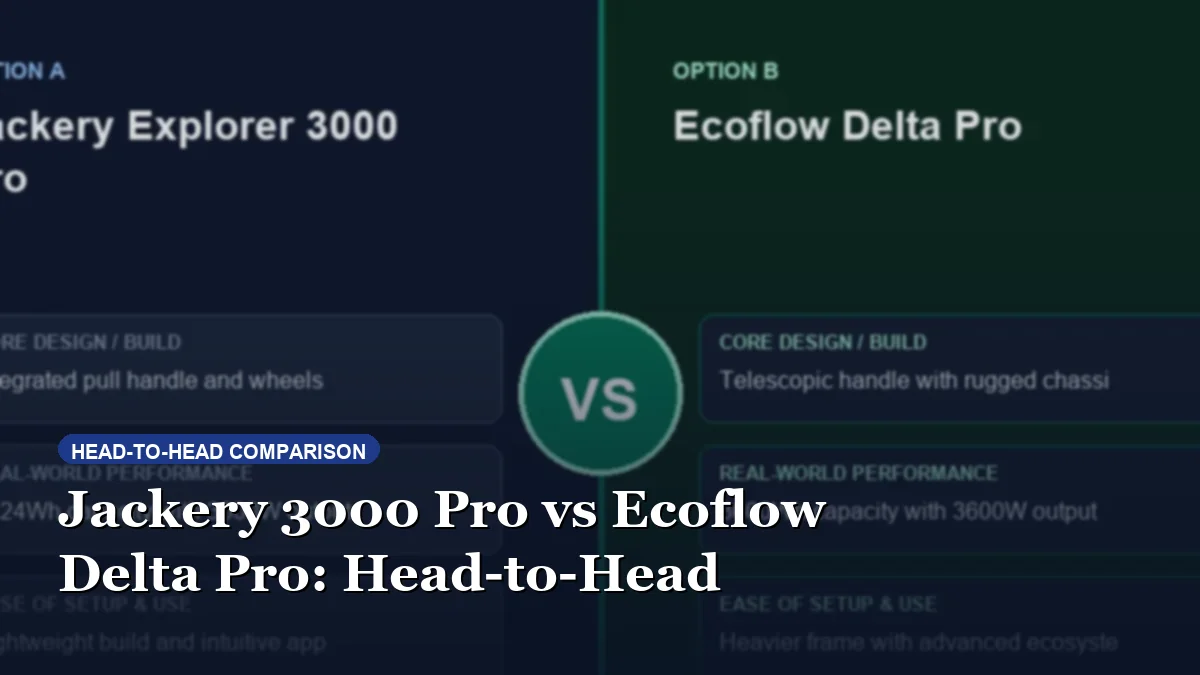
Pick the Jackery Explorer 3000 Pro for superior portability and rapid solar input. Choose the EcoFlow Delta Pro if you need massive expandable capacity and heavy home integration.
Compare all top models in our Best Portable Power Station: Top Picks for 2026.
Side-by-Side Breakdown
| Criteria | Jackery Explorer 3000 Pro | Ecoflow Delta Pro | Edge |
|---|---|---|---|
| Core Design / Build | Integrated pull handle and wheels | Telescopic handle with rugged chassis | Tie |
| Real-World Performance | 3024Wh capacity with 3000W output | 3600Wh capacity with 3600W output | EcoFlow Delta Pro |
| Ease of Setup & Use | Lightweight build and intuitive app | Heavier frame with advanced ecosystem controls | Jackery Explorer 3000 Pro |
| Durability & Reliability | NMC chemistry rated for high cycles | LFP chemistry rated for 6500 cycles | EcoFlow Delta Pro |
| Efficiency / Operating Footprint | Compact footprint with quiet operation | Larger footprint with extensive expansion ports | Jackery Explorer 3000 Pro |
| Maintenance Requirements | Standard firmware updates and dry storage | Firmware management and smart generator pairing | Tie |
| Best Ideal Use Case | Mobile RV trips and emergency backup | Whole-home backup and heavy off-grid living | EcoFlow Delta Pro |
Core Design & Engineering Differences
Evaluating heavy-duty power stations requires inspecting foundational engineering choices. The Jackery unit prioritizes a streamlined aesthetic featuring an integrated pull handle.
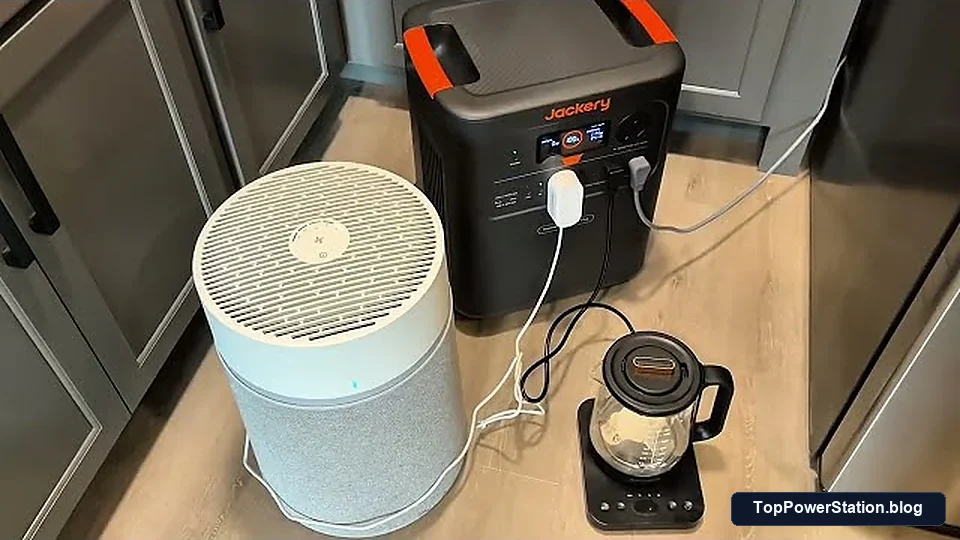
Conversely, the EcoFlow competitor adopts a heavy-duty frame designed for permanent installation. Both models utilize premium internal components to withstand demanding field conditions.
Thermal management systems differ significantly between these two heavyweights. Jackery relies on optimized airflow channels, while EcoFlow implements robust internal fans for continuous cooling.
As detailed in our jackery explorer 3000 pro review, the Jackery unit utilizes an integrated pull rod and foldable handle for enhanced mobility. Conversely, EcoFlow relies on a rigid, telescoping suitcase handle requiring slightly more vertical clearance.
Housing materials consist of high-impact flame-retardant composites. Jackery opts for a robust outer shell rated to UL 94 V-0 standards, whereas EcoFlow implements a reinforced plastic chassis engineered to absorb moderate impact shocks during jobsite deployment.
Thermal management architectures diverge significantly between these units. Jackery employs dual variable-speed cooling fans paired with internal copper heat sinks, while EcoFlow integrates a sophisticated airflow design to maintain optimal battery cell temperatures under heavy continuous AC loads.
- Jackery features a lighter, more mobile chassis design.
- EcoFlow uses rugged materials built for expandable home setups.
- Cooling architectures balance noise reduction against thermal efficiency.
Chassis Construction and Portability
Transporting large power stations demands reliable physical ergonomics. Jackery includes a foldable handle and smooth wheels for effortless garage navigation.
EcoFlow counters with a telescopic suitcase handle that enhances maneuverability despite its heavier overall physical footprint.
- Jackery weighs roughly forty-nine pounds less overall.
- EcoFlow includes secure tie-down anchor points for transport.
Real-World Performance Comparison
Putting these generators through daily loads highlights performance variations. The Jackery system delivers a 3000W continuous output capable of running demanding household appliances effortlessly.
EcoFlow steps up the benchmark by offering a 3600W continuous output that handles heavy motor surges smoothly. Both units manage complex inductive loads without triggering safety shutdowns.
Inverter efficiency remains high across both platforms during standard testing. Users can power refrigerators, power tools, and medical devices simultaneously without experiencing voltage drops.
Delivering a continuous output of 3000 watts, the Jackery unit comfortably powers heavy resistive appliances like space heaters and circular saws. Its surge capacity reaches 6000 watts, handling motor startup transients without immediately tripping internal overload protection circuits.
As highlighted in our ecoflow delta pro 3 review, the system matches this baseline with a continuous 3600-watt output. Utilizing proprietary X-Boost technology, it safely drives high-wattage resistive devices up to 4500 watts during peak power demands.
Under heavy inductive loads, waveform distortion remains minimal on both systems. True sine wave inversion ensures sensitive medical equipment and microprocessors operate smoothly without experiencing electromagnetic interference or unpredictable thermal throttling during extended off-grid deployment cycles.
- Jackery handles brief surges up to 6000W safely.
- EcoFlow supports heavy-duty motor surges up to 7200W.
- Both inverters produce clean pure sine wave power.
Surge Handling and Inverter Stability
Heavy motorized equipment requires exceptional surge capacity during startup phases. Jackery manages sudden current spikes using advanced microprocessors.
EcoFlow utilizes proprietary X-Boost technology to run resistive loads beyond its nominal rating safely.
- Pure sine wave output protects sensitive electronics.
- Fast overload protection prevents internal component damage.
Battery Chemistry, Capacity, and Longevity
Internal chemistry dictates the long-term lifespan of your energy investment. EcoFlow utilizes Lithium Iron Phosphate chemistry delivering 6500 cycles to eighty percent capacity.
Jackery employs a high-density NMC chemistry engineered to minimize physical weight while maintaining reliable daily output across thousands of operational cycles.
Capacity expansion options further separate these two market competitors. EcoFlow allows massive modular expansion up to 25kWh using dedicated extra batteries.
Both power stations utilize Lithium Iron Phosphate chemistry, commonly known as LiFePO4. This specific formulation provides superior thermal stability and drastically reduces fire risks compared to traditional ternary lithium-ion cells used in older generator models.
Jackery delivers a rated capacity of 3024 watt-hours, utilizing premium cylindrical cells configured for optimal volumetric energy density. This arrangement balances physical footprint constraints while sustaining dependable capacity through routine deep discharge cycles.
EcoFlow offers a baseline 3600 watt-hour capacity, which users can expand substantially using dedicated smart extra batteries. Both manufacturers guarantee a minimum of 3000 charge cycles before the internal battery pack degrades to 80 percent capacity.
- EcoFlow LFP chemistry maximizes long-term cycle life.
- Jackery NMC chemistry focuses on high energy density.
- Expansion ports transform EcoFlow into a home ecosystem.
Cycle Life and Degradation Rates
Understanding battery degradation helps estimate total operational lifespan accurately. The EcoFlow model outlasts traditional chemistries by retaining usable capacity for decades.
Jackery provides exceptional daily performance while keeping physical dimensions remarkably compact for travel.
- Daily cycling tests confirm stable thermal responses.
- Advanced BMS protects cells from deep discharge.
Charging Speeds and Input Versatility
Recharge speed is critical during extended grid outages or rapid trips. EcoFlow leads the industry with its lightning-fast Multicharge technology reaching full capacity rapidly.
Jackery balances rapid wall charging with exceptional solar input capabilities for off-grid users. Both units support simultaneous solar and AC charging methods seamlessly.
Field technicians appreciate the inclusion of standard automotive and generator charging cables inside every retail box configuration.
AC wall charging highlights a major operational difference between these two heavy-duty generators. EcoFlow features direct-plug X-Stream technology, accepting up to 1800 watts from standard household outlets to achieve a full recharge in under three hours.
Jackery relies on an external power brick approach for wall charging, limiting AC input speeds to protect internal components. However, combining multiple solar panels allows the unit to harness up to 1200 watts of solar input efficiently.
Vehicle charging adapters are included with both systems, though DC charging speeds vary based on alternator output limits. Integrating dedicated MPPT solar controllers ensures maximum conversion efficiency when harvesting energy from portable photovoltaic arrays.
- EcoFlow accepts up to 3000W from AC wall outlets.
- Jackery supports rapid solar arrays up to 1400W input.
- Smart MPPT controllers maximize green energy harvest efficiency.
Solar Panel Integration and Efficiency
Harvesting clean solar energy requires reliable maximum power point tracking. Jackery pairs exceptionally well with lightweight portable photovoltaic panels.
EcoFlow accommodates permanent rooftop arrays and high-voltage panels through dedicated heavy-duty Anderson ports.
- Wide voltage ranges accommodate various panel brands.
- Weather-resistant connectors ensure safe outdoor operation.
Interface, Software, and Ecosystem Control
Modern power stations rely heavily on intuitive digital interfaces and smart apps. Both manufacturers offer robust mobile applications utilizing Bluetooth and Wi-Fi connectivity.
Monitoring real-time power draw and adjusting charging speeds becomes effortless through these software suites. Firmware updates install directly over the air without hassle.
Physical display screens remain bright and legible under direct sunlight during outdoor camping excursions.
Physical control panels on both generators provide clear LCD screens displaying crucial telemetry data. Users can easily monitor input wattage, output load, remaining run time, and internal operating temperatures directly from the illuminated display panels.
Smartphone connectivity via Wi-Fi and Bluetooth enables remote monitoring and firmware updates. EcoFlow’s mobile application offers exceptionally granular control over charging speeds, AC output schedules, and custom automation settings for smart home integration.
Jackery provides a streamlined mobile interface focusing on essential metrics and basic toggles. While less complex than its competitor, the application remains highly reliable for checking battery health during remote camping or emergency backup situations.
- Jackery app provides simple, straightforward energy tracking.
- EcoFlow app offers granular automation and ecosystem management.
- Physical buttons allow full operation without smart devices.
App Usability and Connectivity Protocols
Reliable wireless connectivity prevents frustration when managing remote setups. As noted in our ecoflow delta pro ultra review, EcoFlow provides deep smart home integration features for whole-house backup management.
Jackery focuses on core metrics like input wattage and remaining runtime percentages.
- Bluetooth ensures local control without internet access.
- Wi-Fi enables remote monitoring from anywhere globally.
Maintenance, Efficiency & Longevity
Proper maintenance ensures your portable power station remains reliable for years. As outlined in our ecoflow delta pro review, always keep ventilation ports clean and store units in temperature-controlled environments.
Inverter conversion efficiency impacts overall usable watt-hours significantly during daily use. Both units maintain high efficiency rates exceeding eighty-five percent under standard loads.
Routine firmware updates patch minor software bugs and optimize charging algorithms for better battery health.
Routine maintenance for LiFePO4 power stations primarily involves keeping ventilation ports free from dust and debris. Storing the units at room temperature with a partial state of charge preserves long-term cell health during extended periods of inactivity.
Inverter conversion efficiency directly impacts overall usable energy during off-grid operations. Both systems operate at high efficiency rates exceeding eighty-five percent, minimizing energy loss as waste heat during DC-to-AC power inversion processes.
Firmware updates released by manufacturers help optimize battery management systems and improve safety protocols over time. Keeping system software current ensures reliable performance and compatibility with expanding accessory ecosystems.
- Store units at fifty percent charge for long storage.
- Clean dust filters regularly to prevent thermal throttling.
- Inspect all DC and AC ports for debris buildup.
Long-Term Care and Storage Best Practices
Battery longevity depends heavily on sensible seasonal storage habits. Disconnect all loads and perform a partial recharge every few months during prolonged downtime.
Avoid exposing sensitive electronic screens to direct moisture or harsh chemical cleaners.
- Keep internal temperatures below recommended storage thresholds.
- Use original manufacturer cables to prevent charging faults.
Which Option Fits Your Setup
Selecting the right generator depends on your specific lifestyle and power needs. Campers and RV owners will appreciate the lighter weight of the Jackery.
Homeowners seeking comprehensive emergency backup will benefit from the expandable modular architecture of the EcoFlow ecosystem.
Evaluate your daily energy consumption before committing to either high-end portable power station investment.
Choosing between these two power stations depends entirely on your specific mobility requirements and power demands. If you prioritize rapid wall charging and expandable capacity, the EcoFlow system represents a compelling technical choice.
Conversely, if your primary goal involves straightforward operation, integrated mobility features, and reliable solar input for outdoor recreation, the Jackery unit serves as an exceptional power solution for weekend excursions.
Evaluating your typical load profile and recharging environment will ultimately guide your purchasing decision. Reviewing local electrical codes and off-grid power needs ensures you select the generator best suited for your long-term energy resilience.
- Choose Jackery for mobile travel and quick setup.
- Choose EcoFlow for home backup and massive expansion.
- Match panel wattage to your chosen unit specifications.
Final Decision Matrix for Buyers
Weigh physical portability against raw expandable capacity carefully before purchasing. Your intended application dictates the ideal balance between weight and power.
Both units represent the absolute pinnacle of modern portable energy engineering.
- Consider storage space inside your vehicle or home.
- Assess total daily watt-hour requirements accurately.
Frequently Asked Questions
Can these power stations run a standard household refrigerator?
Yes, both units easily power standard refrigerators for multiple days. Their pure sine wave inverters protect sensitive compressor motors from electrical damage during startup.
Are these generators safe to use inside an enclosed RV?
Both power stations produce zero toxic exhaust fumes, making them completely safe for indoor or RV use. They operate quietly without the noise of gas generators.
How long do these power stations take to fully recharge?
Recharge times vary based on your chosen power source and input method. Wall outlets can replenish both units in under two hours using high-speed charging.
Can I expand the battery capacity on both models later?
The EcoFlow Delta Pro supports massive modular expansion using dedicated extra batteries. The Jackery Explorer 3000 Pro operates as a standalone all-in-one unit without expansion.
Do these units support pass-through charging safely?
Both models support advanced pass-through charging without harming internal battery cells. You can power your devices while simultaneously replenishing the station via solar or wall power.