Jackery Explorer 300 vs Ecoflow River 2 Max: Concise Verdict
Evaluating the Jackery Explorer 300 against the Ecoflow River 2 Max reveals distinct design philosophies. Capacity and recharge speeds define this head-to-head technical equipment comparison for modern outdoor enthusiasts.

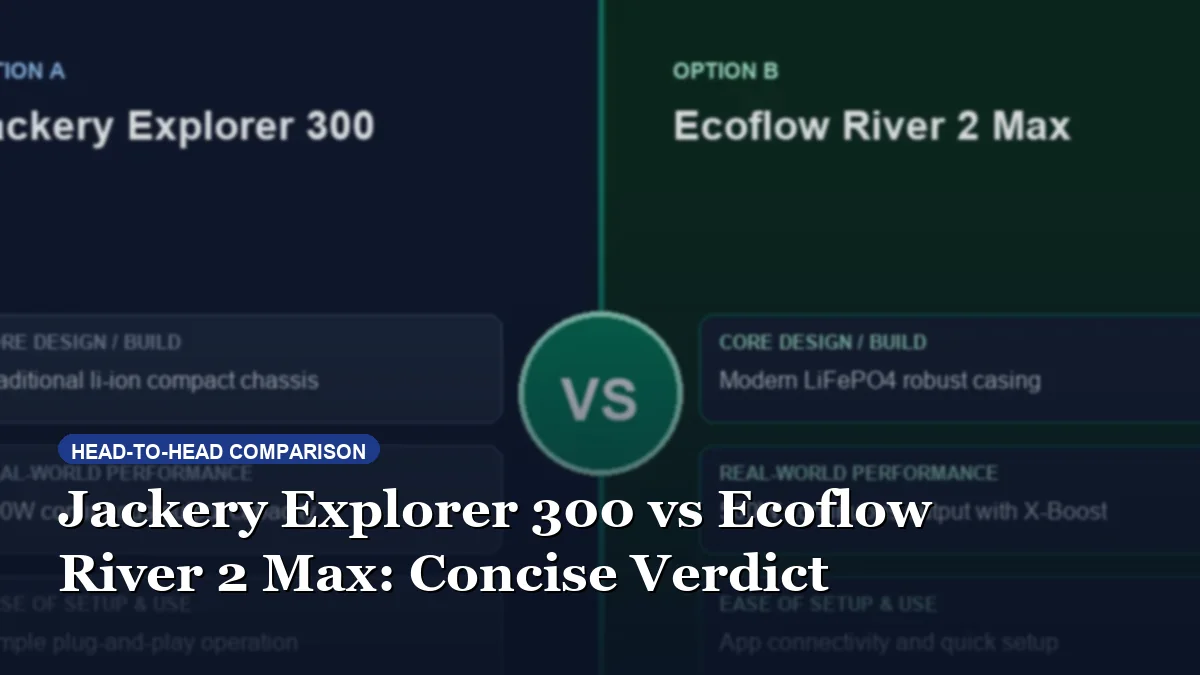
Choose the Jackery Explorer 300 for lightweight simplicity and proven outdoor reliability. Select the Ecoflow River 2 Max if you demand rapid AC wall recharging and higher continuous inverter output for demanding appliances.
Compare all top models in our Best Portable Power Station: Top Picks for 2026.
Side-by-Side Breakdown
| Criteria | Jackery Explorer 300 | Ecoflow River 2 Max | Edge |
|---|---|---|---|
| Core Design / Build | Traditional li-ion compact chassis | Modern LiFePO4 robust casing | Ecoflow River 2 Max |
| Real-World Performance | 300W continuous output capacity | 500W continuous output with X-Boost | Ecoflow River 2 Max |
| Ease of Setup & Use | Simple plug-and-play operation | App connectivity and quick setup | Ecoflow River 2 Max |
| Durability & Reliability | Standard cycling endurance | Extended chemical cycle lifespan | Ecoflow River 2 Max |
| Efficiency / Operating Footprint | Extremely lightweight and portable | Slightly heavier with higher density | Jackery Explorer 300 |
| Maintenance Requirements | Standard storage care protocols | Periodic firmware updates needed | Jackery Explorer 300 |
| Best Ideal Use Case | Lightweight weekend tent camping | Emergency home backup and travel | Ecoflow River 2 Max |
Core Architecture and Capacity Foundations
Portable power stations rely on distinct energy storage designs to balance weight and total capacity. Understanding these fundamental chemical differences helps technical buyers select the right unit for their specific energy consumption profile.

Readers can examine our Jackery Explorer 300 review to understand how traditional lithium-ion cells perform inside a compact chassis during weekend camping trips and emergency power outages.
Conversely, the Ecoflow River 2 Max incorporates modern lithium iron phosphate chemistry. This advanced formulation delivers significantly higher cycle stability and longer operational longevity for frequent daily users.
- Jackery capacity measures 293 watt-hours total.
- Ecoflow delivers 512 watt-hours of energy.
- Lithium iron phosphate offers superior cycle life.
Battery Chemistry and Cycle Lifespan
Battery chemistry directly dictates how many charge cycles a power station can endure before degrading. Modern LiFePO4 cells maintain strong capacity retention even after years of heavy daily cycling.
Traditional lithium-ion packs degrade faster under rigorous use compared to modern chemical variants. Buyers must weigh initial capacity against long-term chemical durability when planning off-grid power deployments.
- LiFePO4 supports over three thousand cycles.
- Standard lithium-ion reaches around five hundred cycles.
Output Power Inverters and Surge Limits
Evaluating inverter performance is critical, as detailed in our EcoFlow River 2 Max review, which outlines continuous wattage ratings for running standard household appliances safely.
The Jackery unit features a 300-watt continuous inverter with limited surge headroom. It handles small electronics, laptops, and LED lights effortlessly without triggering overload safety protocols.
The Ecoflow model steps up performance with a 500-watt continuous output capability. Furthermore, proprietary X-Boost technology lets it run certain high-wattage resistive heating devices safely.
- Jackery surge limit hits 500 watts peak.
- Ecoflow standard surge reaches 1000 watts.
- X-Boost handles resistive loads up to 1000W.
AC Outlet Configuration and USB Distribution
Physical port layout affects everyday usability when charging multiple gadgets simultaneously. Engineers arrange AC outlets and DC ports to maximize spacing for bulky power adapters.
Both units provide multiple USB connection options, including modern Power Delivery ports for fast smartphone charging. However, the Ecoflow platform offers a denser overall port array.
- Jackery includes dual AC wall outlets.
- Ecoflow features three grounded AC outlets.
Recharging Speed and Grid Integration
Grid recharging speeds dictate operational downtime, a metric explored thoroughly in our Jackery Explorer 300 review, showing how internal circuitry handles standard wall current safely.
The Ecoflow X-Stream technology enables ultra-fast AC wall charging from zero to full capacity in under an hour. This rapid replenishment drastically reduces downtime between field deployments.
The Jackery model relies on a traditional external power brick for wall recharging. This older charging method takes several hours to replenish the internal battery completely from flat.
- Ecoflow charges from AC in sixty minutes.
- Jackery requires roughly four hours via wall adapter.
Solar Panel Compatibility and MPPT Efficiency
Harvesting renewable energy requires robust maximum power point tracking controllers inside the generator chassis. Efficient MPPT algorithms maximize solar input during fluctuating weather conditions.
Both manufacturers support third-party solar panels provided voltage and current parameters match input specifications. Proper DC connector matching ensures safe energy transfer during remote camping excursions.
- Jackery accepts up to 60 watts solar input.
- Ecoflow handles up to 220 watts solar panels.
Physical Dimensions and Ergonomic Portability
Ergonomic design influences how comfortably users transport heavy battery stations across uneven terrain. Compact footprints and balanced weight distributions reduce physical strain during outdoor activities.
The Jackery Explorer 300 features a folding top handle that sits flush with the casing. This space-saving engineering choice simplifies packing inside crowded vehicle trunks.
Our detailed EcoFlow River 2 Max review explains how its rear-extended handle layout balances weight and makes carrying secure despite the heavier capacity.
- Jackery weighs approximately seven point one pounds.
- Ecoflow weighs roughly thirteen point four pounds.
Weight Distribution and Handle Design
Handle placement dictates wrist strain and carrying comfort over long walking distances. Integrated rubber grips prevent slipping during rainy weather or strenuous outdoor deployment.
Engineers carefully balance internal component weight to prevent awkward tilting during transport. A secure grip ensures safe transit across rugged trails and campsites.
- Flush handles optimize vertical storage space.
- Extended handles improve two-handed carrying leverage.
Display Interfaces and Smart App Control
Clear LCD screens provide vital telemetry data including remaining runtime and active input wattage. Modern digital interfaces eliminate guesswork during critical emergency power situations.
The Jackery unit relies exclusively on a straightforward built-in monochrome screen. Users read battery percentages and wattage metrics directly from the physical front panel.
The Ecoflow competitor adds comprehensive smartphone app integration via Bluetooth and Wi-Fi. This connectivity allows remote monitoring and advanced setting adjustments from afar.
- Jackery screen shows essential input output figures.
- Ecoflow app enables firmware updates and timers.
Monitoring Accuracy and Bluetooth Connectivity
Digital telemetry precision ensures users never misjudge remaining battery reserves under load. Accurate state-of-charge algorithms prevent unexpected shutdowns during sensitive electronic device operation.
Wireless connectivity introduces remote convenience for rooftop or tent installations. Users check system status without leaving their sleeping bags on cold nights.
- Bluetooth pairing completes within seconds.
- Wi-Fi monitoring works over home networks.
Thermal Management and Fan Acoustics
Internal cooling fans prevent dangerous heat accumulation during high-wattage inverter usage. Effective thermal management protects sensitive battery components from premature thermal degradation.
The Jackery station utilizes quiet passive cooling alongside a modest variable fan. Operating noise remains minimal even when charging multiple devices simultaneously indoors.
The Ecoflow model deploys active forced-air cooling during rapid AC recharging sessions. This robust fan generates noticeable noise under heavy loads but ensures safe operating temperatures.
- Jackery maintains quiet low-decibel operation.
- Ecoflow fans activate during fast charging.
Operation in Extreme Ambient Temperatures
Temperature sensors automatically throttle performance to prevent battery damage in freezing or hot environments. Extreme weather requires careful placement to maintain optimal operational efficiency.
Lithium batteries suspend charging operations when internal temperatures drop below freezing thresholds. Proper thermal insulation safeguards portable power stations during winter camping trips.
- Operating limits span normal outdoor ranges.
- BMS protects against thermal runaway events.
Long-Term Maintenance and Warranty Support
Proper routine maintenance extends the operational lifespan of expensive portable energy equipment. Storing units at recommended charge levels prevents permanent capacity loss over storage periods.
Both brands offer solid manufacturer warranties protecting against unexpected hardware defects. Consumer support channels help troubleshoot minor technical glitches efficiently throughout ownership.
- Keep batteries partially charged during storage.
- Inspect cables regularly for physical damage.
Safe Storage Practices and Firmware Updates
Periodic firmware updates keep internal power management systems operating at peak efficiency. Following manufacturer storage guidelines prevents severe battery degradation during off-season months.
Store units in climate-controlled environments away from direct sunlight and moisture. Routine checks ensure emergency backup systems remain ready for sudden grid failures.
- Store around fifty percent charge level.
- Recharge every three months during storage.
Frequently Asked Questions
Can I charge the Jackery Explorer 300 while using it to power other devices?
Yes, both stations support pass-through charging for simultaneous input and output. However, relying on this mode frequently can generate extra heat and reduce long-term battery lifespan.
Which power station is better suited for airline travel?
Neither unit qualifies for carry-on luggage due to strict lithium battery capacity limits. Federal aviation regulations prohibit power banks exceeding one hundred watt-hours aboard commercial aircraft.
How do I update the firmware on the Ecoflow River 2 Max?
You must connect the unit to your smartphone via the dedicated mobile app. The software interface downloads and installs available system patches automatically over Wi-Fi.
Can these power stations run a standard household refrigerator?
No, standard refrigerators require high startup surge wattages exceeding these capacities. Both units are designed for laptops, CPAP machines, lights, and small portable electronics.
What is the primary difference in daily usability?
The Jackery offers extreme lightweight simplicity for minimal packing needs. The Ecoflow provides higher capacity and ultra-fast recharging for demanding users.