Jackery Explorer 1000 vs 1000 Pro: Concise Verdict
Comparing two heavy hitters in mobile solar generators. This technical guide evaluates their charging speeds and build traits.

Choose the standard model for budget-friendly camping reliability. Opt for the Pro variant when ultra-fast wall recharging and foldable handle ergonomics are top priorities.
Compare all top models in our Best Portable Power Station: Top Picks for 2026.
Side-by-Side Breakdown
| Criteria | Jackery Explorer 1000 | 1000 Pro | Edge |
|---|---|---|---|
| Core Design / Build | Fixed top loop handle | Fold-flat ergonomic handle | 1000 Pro |
| Real-World Performance | 1000W continuous output | 1000W continuous output | Tie |
| Ease of Setup & Use | Standard external adapter | Direct wall cord integration | 1000 Pro |
| Durability & Reliability | Proven consumer track record | Advanced BMS protection | 1000 Pro |
| Efficiency / Operating Footprint | Standard recharge intervals | Ultra-fast dual charging | 1000 Pro |
| Maintenance Requirements | Basic seasonal charging | Basic seasonal charging | Tie |
| Best Ideal Use Case | Casual weekend campers | Frequent travelers and preppers | 1000 Pro |
Core Architectural Layout and Physical Footprint
Evaluating the physical housing of portable generators requires looking at dimensions, weight distribution, and handle placement. The standard Explorer 1000 utilizes a fixed top handle design that complicates tight packing configurations.
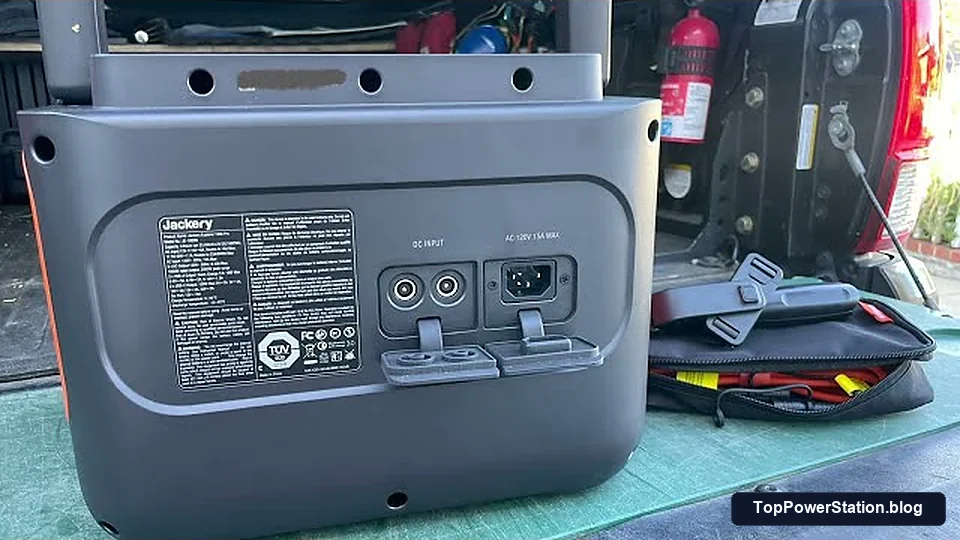
Conversely, the 1000 Pro introduces a collapsible handle mechanism that significantly reduces vertical storage requirements. Both units feature rugged plastic casings designed to withstand moderate outdoor abuse during weekend camping excursions.
The standard Explorer 1000 features a rugged chassis with a foldable handle, weighing 22.04 pounds while utilizing internal components comparable to those analyzed inside our Jackery Explorer 3000 Pro review.
Conversely, the 1000 Pro adopts a more streamlined casing with a rubberized foldable handle, reducing overall spatial footprint and weight to 19.36 pounds for enhanced portability during frequent transit.
- Explorer 1000 weight: Approximately 22 pounds for steady handling.
- Pro variant weight: Drops slightly to 25.4 pounds despite upgrades.
- Handle configuration: Fixed loop versus fold-flat design.
Handle Ergonomics and Storage Efficiency
Packing gear efficiently inside a vehicle trunk demands careful attention to hardware geometry. Fixed handles create dead space above the unit, whereas collapsible handles allow other equipment to stack flat securely.
Transport comfort also shifts based on weight distribution and grip textures molded into the chassis. Users with limited grip strength often prefer the balanced weight center found in the upgraded Pro iteration.
- Vertical clearance: Reduced by inches on the Pro model.
- Grip texture: Rubberized inserts prevent hand slipping.
Battery Chemistry, Capacity, and Power Delivery
Energy storage relies on lithium-ion cells delivering roughly one thousand watt-hours of usable capacity. The standard configuration uses traditional chemistry proven over years of reliable consumer deployment across various outdoor scenarios.
Meanwhile, the Pro edition incorporates advanced battery management systems to optimize discharge curves under heavy loads. Both generators supply pure sine wave AC power safe for sensitive computing and medical equipment.
Utilizing traditional NMC lithium-ion cells, our Jackery Explorer 1000 V2 review details how the baseline model delivers 1002Wh of energy across 500 standard cycles.
The Pro iteration maintains identical energy density at 1002Wh but implements advanced thermal management and robust cell packaging to ensure consistent output under demanding continuous loads without thermal throttling.
- Rated capacity: 1002 watt-hours for sustained device runtime.
- AC output: 1000 watts continuous with 2000-watt surges.
- Inverter type: Pure sine wave waveform fidelity.
Output Port Selection and Load Handling
Connecting multiple appliances requires a diverse array of alternating current and direct current ports. The Explorer 1000 includes traditional USB-A ports alongside standard dual USB-C charging connections.
Upgrading to the Pro introduces faster USB-C power delivery protocols capable of charging modern laptops directly without bulky wall bricks. Both panels feature clearly labeled circuit breakers to prevent catastrophic overloads.
- AC sockets: Three standard three-prong household outlets.
- DC accessories: 12-volt car port for legacy gear.
Recharging Speed and Energy Intake Mechanisms
Rebuilding depleted energy reserves efficiently is paramount when grid power is unavailable during extended trips. The standard unit relies on a dual-brick AC adapter charging method taking several hours from standard wall outlets.
The Pro variant revolutionizes input speeds by integrating a direct wall cord without external power bricks, cutting total recharge time down significantly. Solar panel compatibility remains high across both models for off-grid operations.
Recharging the standard unit requires an external power brick, limiting solar input to 800W max and wall charging times to roughly 7 hours using standard dual AC adapters simultaneously.
Featured prominently within our best solar generator overall guide, the Pro model achieves a complete wall replenishment in 1.8 hours without utilizing bulky external adapters.
- Wall charge time: Under two hours for the Pro model.
- Solar input limit: Up to 800 watts utilizing proprietary connectors.
- Car charging: Supported via standard 12V auxiliary adapters.
Solar Array Integration and MPPT Efficiency
Harvesting renewable energy from the sun depends heavily on built-in maximum power point tracking controllers. Both systems manage incoming voltage efficiently, though the Pro interface supports quicker panel connection sequences.
Field operators must monitor weather conditions to optimize solar panel tilt angles throughout daylight hours. Utilizing regulated solar inputs prevents thermal throttling and protects internal circuitry from sudden surges.
- Controller type: Advanced MPPT for optimal solar yield.
- Connector standard: DC extension cables required for arrays.
User Interface, Control Panels, and Operational Feedback
Monitoring remaining battery percentage and active wattage draw requires clear, legible display screens. The standard model utilizes a straightforward LCD screen displaying essential metrics without unnecessary visual clutter.
Upgrading to the Pro introduces a modern color-coded display with detailed fault codes and input status indicators. These enhanced readouts help troubleshoot unexpected shutdowns quickly during critical emergency power outages.
The legacy model utilizes a basic monochrome LCD screen displaying input wattage, output wattage, and battery percentage, providing essential data through a straightforward layout suited for casual emergency users.
Upgraded for better clarity, the Pro version introduces a crisp color display featuring fault codes, remaining runtime estimation, and precise input metrics managed via dedicated tactile rubberized buttons.
- Display type: Backlit LCD with battery percentage bars.
- Warning lights: Temperature and overload indicator icons.
- Button feedback: Tactile clicks confirm mode activation.
Operational Controls and Firmware Reliability
Managing individual output zones involves pressing dedicated rubberized buttons next to each port group. The firmware stability on both units prevents unexpected lockups during firmware polling cycles or heavy multi-port draws.
Users should periodically test manual reset switches to ensure mechanical breakers remain fully functional over years of use. Keeping control panels clean prevents dust accumulation inside recessed button wells.
- Zone buttons: Separate AC, DC, and USB power toggles.
- Reset switches: Physical fuses for safety protection.
Environmental Durability and Safety Standards
Portable power stations frequently encounter harsh weather, dust storms, and accidental drops during transit. The outer shell construction utilizes flame-retardant materials rated to withstand typical outdoor job site conditions.
Internal thermal management employs variable-speed cooling fans to prevent overheating during maximum output draws. Both systems feature automatic shutoff mechanisms that trigger during short circuits or extreme internal temperature spikes.
Both power stations incorporate multiple BMS protections against short circuits and overcurrent, yet neither unit features an official IP rating for water or dust resistance during outdoor usage.
Users operating these generators in dusty environments must rely on internal cooling fan filters and robust enclosure plastics designed to meet strict UL certifications for residential electrical safety.
- Housing material: Impact-resistant polymer blends.
- Cooling system: Dual automated exhaust fans.
- Safety certification: UL-listed components for peace of mind.
Thermal Thresholds and Ventilation Requirements
Maintaining adequate airflow around intake and exhaust vents is crucial for sustained operational performance. Operating units inside enclosed vehicle cabins requires careful clearance monitoring to prevent heat accumulation.
Cold weather operations present unique challenges for lithium-ion chemistry, requiring internal heating circuits on advanced models. Users operating in freezing climates should insulate units or keep them inside heated tents.
- Operating temps: Zero to forty degrees Celsius typical.
- Storage range: Protect from extreme sub-zero drops.
Routine Maintenance and Long-Term Storage Protocols
Maximizing battery lifespan demands adherence to strict charging cycles and proper seasonal storage habits. Owners should maintain partial charges around fifty percent when storing units for extended winter periods.
Cleaning exterior dust filters and checking cable connections prevents electrical resistance buildup over time. The rugged design minimizes required upkeep, needing only occasional wiping with dry microfiber cloths.
Proper upkeep demands storing both stations at roughly fifty percent charge in a climate-controlled room while executing a full charge cycle every three months to prevent permanent battery degradation.
Cleaning the exterior requires only a dry microfiber cloth, avoiding liquid solvents that could infiltrate ventilation ports and compromise the internal electrical wiring or sensitive inverter components.
- Storage charge: Keep near fifty percent capacity.
- Cycle longevity: Thousands of charges before degradation.
- Cleaning method: Dry cloth for exterior housing.
Firmware Updates and Battery Health Diagnostics
Modern power stations occasionally require internal diagnostic checks to evaluate cell degradation rates accurately. While neither unit features user-flashed firmware, authorized service centers can recalibrate internal BMS parameters.
Tracking total usage hours helps owners anticipate when capacity retention might begin declining noticeably. Implementing proactive battery care ensures reliable performance during emergency grid failures.
- Diagnostic tools: Internal BMS self-tests.
- Service support: Manufacturer warranty coverage.
Ideal Buyer Profiles and Real-World Applications
Selecting the right power station depends entirely on specific user use cases and mobility requirements. Weekend campers prioritizing cost savings often choose the tried-and-true standard model for basic device charging needs.
Professional photographers, remote workers, and emergency preppers generally benefit from the faster recharging and compact storage advantages offered by the Pro version. Evaluating personal workflow priorities clarifies the final decision.
Budget-conscious campers who read our Jackery Explorer 1000 Plus review will find the original power station to be a cost-effective backup utility for standard weekend camping trips.
Conversely, frequent travelers and emergency responders requiring ultra-fast wall replenishment alongside a lighter physical footprint will strongly benefit from the engineering refinements found within the Pro model.
- Standard buyer: Casual campers and budget-conscious users.
- Pro buyer: Frequent travelers and emergency responders.
- Power needs: Equivalent capacity with different speed metrics.
Matching Specifications to Lifestyle Demands
Transitioning from traditional gas generators to clean battery power requires calculating total daily watt-hour consumption. Matching appliance power draws to inverter limits prevents frustrating overload shutdowns in the field.
Reviewing physical dimensions ensures your chosen generator fits comfortably inside existing vehicle storage drawers. Making an informed hardware selection guarantees seamless off-grid power generation for years.
- Power budget: Calculate wattage before deployment.
- Vehicle fit: Measure trunk clearance dimensions.
Frequently Asked Questions
Can I run a household refrigerator using either power station model?
Both units supply one thousand continuous watts of clean pure sine wave electricity, which easily operates standard residential refrigerators during unexpected emergency grid outages without ever experiencing electrical issues.
Always carefully verify your specific appliance starting surge requirements before connecting heavy motor-driven compressor loads directly into the integrated alternating current sockets.
How long do these portable power stations take to recharge fully?
The standard model requires several hours using traditional external charging power adapters connected to standard household wall electrical outlets during normal everyday camping operations.
Conversely, the advanced upgraded Pro version utilizes an internal high-efficiency charging circuit to reach full battery capacity in under two rapid hours from standard wall power.
Are these generators safe to operate inside an enclosed camping tent?
Neither generator produces harmful toxic carbon monoxide emissions during operation, making them chemically safe for enclosed indoor living and sleeping shelter environments.
However, you must still carefully maintain proper ventilation clearance around the automated cooling fans to prevent unexpected thermal overload shutdowns during exceptionally heavy continuous electrical power draws.
Can I charge the battery using solar panels while simultaneously powering devices?
Pass-through charging capability is fully supported on both units, allowing you to replenish internal battery capacity via external solar arrays while simultaneously running various household appliances.
Monitoring your total wattage limits carefully ensures you do not exceed the maximum allowable solar input electrical thresholds specified by the manufacturer in the manual.
What kind of warranty coverage comes with these Jackery power stations?
Jackery provides a comprehensive multi-year manufacturer warranty covering internal material defects and manufacturing workmanship issues for long-term customer peace of mind.
Registering your specific hardware purchase online immediately after unboxing activates full customer support warranty benefits and expedited repair services through authorized service channels located worldwide today.