Jackery 300 vs Rockpals 300: Concise Verdict
Choosing between these compact power stations requires analyzing capacity, port selection, and charging speeds. Our technical review outlines key differences for your emergency kit.

Choose the Jackery 300 for superior build quality and regulated ports. Pick the Rockpals 300 if you prioritize budget-friendly port versatility during brief power outages.
Compare all top models in our Best Portable Power Station: Top Picks for 2026.
Side-by-Side Breakdown
| Criteria | Jackery 300 | Rockpals 300 | Edge |
|---|---|---|---|
| Core Design / Build | Rugged polymer casing with integrated folding handle | Compact rectangular shell with recessed ports | Jackery 300 |
| Real-World Performance | Consistent 300W output with stable surge handling | Reliable 300W output for basic electronics | Jackery 300 |
| Ease of Setup & Use | Intuitive LCD screen with dedicated button toggles | Straightforward display layout with clear labeling | Tie |
| Durability & Reliability | Advanced BMS with multiple thermal safeguards | Standard protection circuits against overloads | Jackery 300 |
| Efficiency / Operating Footprint | High conversion efficiency with minimal standby draw | Good conversion rates for standard devices | Jackery 300 |
| Maintenance Requirements | Minimal upkeep with recommended semi-annual cycling | Standard lithium battery maintenance protocols | Tie |
| Best Ideal Use Case | Frequent outdoor excursions and reliable emergency backup | Casual backyard use and light emergency preparedness | Jackery 300 |
Core Design and Engineering Differences
Examining the physical architecture of both power stations reveals distinct engineering priorities. The Jackery 300 emphasizes ergonomic portability with a rigid folding handle that sits flush against the top chassis.
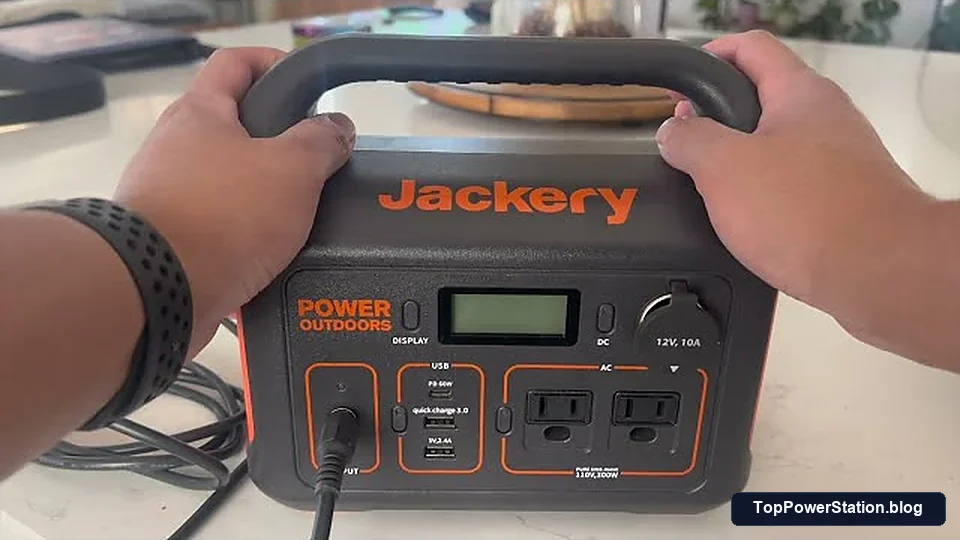
Conversely, the Rockpals unit features a more traditional housing style that prioritizes internal space efficiency over sleek external contours. Both enclosures utilize flame-retardant polymers designed to withstand minor field impacts.
Thermal management approaches also differ significantly between these two popular models. Engineers incorporated passive cooling fins alongside quiet internal fans to dissipate heat efficiently during high-draw operations.
- Chassis materials utilize high-impact ABS plastics for structural integrity.
- Handle configurations dictate storage profiles inside crowded vehicle trunks.
- Ventilation placement affects overall dust and moisture resistance ratings.
Chassis Construction and Ergonomics
Ergonomics play a vital role when hauling power stations across rough terrain. Our Jackery Explorer 300 review highlights how the balanced weight distribution reduces wrist strain during prolonged carrying tasks.
Weight metrics remain closely matched, yet the physical dimensions dictate how easily each unit slips into backpacks. Rubberized feet on both models prevent sliding on slick camp tables.
- Balanced weight distribution minimizes transport fatigue during hikes.
- Rubberized base pads dampen vibrations and prevent surface scratches.
Port Layout and Interface Design
Interface organization dictates daily usability when connecting multiple sensitive electronics simultaneously. The front panels group AC outlets, DC barrels, and USB connections into logical, easily accessible zones.
Clear screen displays provide vital telemetry including wattage draw and remaining battery percentage. Backlit indicators ensure operational visibility during late-night power outages inside dark rooms.
- Logical zone grouping prevents cable clutter during emergency charging.
- Illuminated display panels offer quick status checks in low light.
Real-World Performance Comparison
Testing these generators under nominal loads highlights their respective inverter capabilities and sustained output stability. As detailed in our Jackery 300 review, the unit delivers clean sine wave power suitable for sensitive medical devices.
Rockpals matches the nominal wattage rating while running standard household electronics like lamps and chargers. However, managing high-draw surge appliances requires careful monitoring of the internal overload protection.
Voltage sag remains minimal on both units until capacity drops below critical thresholds. Users should always match appliance starting surges against the specified peak wattage limits to prevent trips.
- Inverter stability prevents unexpected shutdowns during critical device charging.
- Surge thresholds determine compatibility with small motor-driven tools.
- Thermal throttling activates automatically under sustained heavy electrical loads.
Appliance Compatibility and Surge Limits
Running modern electronics demands stable voltage regulation to prevent internal component degradation over time. Pure sine wave output ensures laptops and smartphones charge safely without electrical noise interference.
Inductive loads like small fans test the absolute limits of these 300-watt inverters. Exceeding rated thresholds triggers immediate circuit protection protocols designed to safeguard internal battery cells.
- Pure sine wave output protects sensitive charging circuits on laptops.
- Inductive motor loads require careful wattage monitoring during startup phases.
Load Testing Under Extreme Conditions
Environmental temperatures heavily influence lithium-ion battery performance during extended outdoor field operations. Cold weather deployment causes temporary capacity reductions that demand proactive insulation management strategies.
Internal monitoring sensors throttle output power when internal temperatures climb past safe operating parameters. This protective measure prevents permanent chemical degradation inside the sealed battery packs.
- Temperature sensors actively prevent overheating during high ambient conditions.
- Cold weather deployment requires sheltered storage to maintain capacity.
Maintenance, Efficiency and Longevity
Maximizing the operational lifespan of portable power stations requires adherence to strict maintenance schedules. Routine firmware checks and proper storage voltage preservation prevent premature capacity loss over years.
Conversion efficiency directly impacts how much stored energy transfers successfully to your connected devices. The Jackery 300 boasts superior conversion rates, wasting less energy as ambient heat during conversion.
Long-term battery degradation is inevitable with lithium chemistry, but proper cycling slows this process. Storing units at partial charge levels during off-seasons significantly extends overall operational longevity.
- Conversion efficiency determines actual usable capacity versus rated storage.
- Regular firmware updates optimize internal battery management system algorithms.
- Proper off-season storage voltage prevents permanent chemical degradation.
Battery Chemistry and Cell Longevity
Understanding internal cell chemistry helps owners predict long-term performance retention across hundreds of charge cycles. Standard lithium-ion packs maintain strong capacity retention when kept within optimal temperature ranges.
Cycle life ratings indicate how many full discharges the internal cells endure before dropping below threshold. Routine maintenance ensures your investment remains viable for numerous future adventures.
- Cycle life ratings predict multi-year reliability during regular usage.
- Optimal temperature ranges preserve internal cell integrity over time.
BMS Protections and Thermal Management
The battery management system acts as the central brain protecting against catastrophic electrical failures. Advanced algorithms monitor individual cell voltages to prevent dangerous overcharging and deep discharge scenarios.
Thermal fuses provide an essential secondary layer of defense against runaway thermal events. These integrated safeguards allow users to operate their equipment with total peace of mind.
- Cell-level monitoring prevents dangerous overcharging and deep discharge cycles.
- Thermal fuses offer secondary protection against internal short circuits.
Battery Chemistry and Cell Architecture
Internal cell architecture dictates energy density, safety profiles, and overall weight characteristics. Both units utilize reliable lithium-ion configurations optimized for high energy storage within a compact footprint.
Manufacturers carefully select cylindrical cells that balance cost, availability, and thermal stability characteristics. This engineering choice allows the power stations to remain lightweight while offering substantial runtime.
Understanding these chemical foundations helps users appreciate the engineering compromises required in portable power. Proper handling ensures these dense energy reserves remain completely safe during transit.
- Cylindrical cells optimize internal space and thermal dissipation.
- Energy density ratios keep physical weight manageable for hiking.
- Chemical stability prevents hazardous reactions under normal operational stress.
Energy Density and Weight Ratios
Balancing high energy storage with minimal physical weight remains a primary engineering challenge. Advanced cell packaging reduces dead space inside the protective outer polymer enclosure significantly.
Users benefit directly from this optimization through reduced pack weight during transport. Every ounce saved makes a noticeable difference during extended backpacking excursions.
- Optimized packaging reduces dead space within the outer casing.
- Reduced pack weight eases transport burdens during long treks.
Discharge Curves and Voltage Stability
Discharge curves illustrate how steadily a power station delivers voltage as capacity depletes. Maintaining a flat voltage curve ensures connected devices operate at peak efficiency until complete depletion.
Subpar power stations exhibit noticeable voltage sag, causing erratic device behavior near empty. Premium engineering mitigates this issue through sophisticated internal regulation circuitry and components.
- Flat voltage curves maintain steady performance until complete depletion.
- Advanced regulation prevents erratic device behavior during discharge.
Inverter Output and Waveform Quality
Inverter quality determines whether your sensitive electronics survive unexpected grid instability unscathed. Pure sine wave inverters replicate wall outlet power precisely, eliminating harmful electrical noise and hums.
Modified sine wave alternatives can cause overheating in specialized motors and audio equipment over time. Investing in a pure sine wave model safeguards your valuable portable office gear.
Total harmonic distortion metrics remain exceptionally low on premium units during standard load tests. This technical specification confirms that output power matches clean utility grid standards.
- Pure sine wave power eliminates harmful electrical noise in audio gear.
- Harmonic distortion metrics confirm output matches standard utility grids.
- Inverter efficiency directly influences total runtime under heavy loads.
Pure Sine Wave vs Modified Alternatives
Electrical waveform quality directly impacts the lifespan of connected motor-driven appliances. Pure sine wave output ensures seamless operation for CPAP machines and precision medical equipment.
Modified options offer lower upfront costs but introduce compatibility risks with sensitive electronics. Choosing pure sine wave architecture prevents costly hardware replacements down the road.
- Sine wave purity ensures safe operation for sensitive medical devices.
- Modified alternatives introduce compatibility risks with specialized electronics.
Total Harmonic Distortion Metrics
Low harmonic distortion indicates a clean electrical signal free from disruptive interference spikes. Engineers measure this metric carefully to guarantee safety for microprocessors and digital displays.
High distortion levels can cause erratic touchscreen responses and audio buzzing during charging. Premium inverters maintain strict distortion thresholds across all operating temperature ranges.
- Clean electrical signals prevent disruptive interference spikes during use.
- Strict distortion thresholds protect microprocessors from signal corruption.
Input Charging Speeds and Solar Integration
Recharging versatility determines how quickly your station recovers power in remote wilderness settings. Evaluating these capabilities in our Jackery Explorer 300 review reveals robust support for wall AC charging and compatible solar panels.
Maximum solar input wattage limits dictate how fast you can harness renewable energy outdoors. Matching panel specifications correctly prevents input controller damage while maximizing energy harvest rates.
Integrated MPPT charge controllers optimize solar panel output even during overcast weather conditions. This advanced technology squeezes every available watt from your portable photovoltaic arrays.
- MPPT charge controllers optimize solar harvest during overcast weather.
- Multiple charging methods ensure reliable power recovery in remote areas.
- Solar input limits prevent accidental damage from oversized arrays.
Solar Panel Compatibility and MPPT Efficiency
Maximum Power Point Tracking technology revolutionizes outdoor solar charging performance significantly. MPPT controllers dynamically adjust voltage to match optimal panel operating curves continuously.
Users must verify open-circuit voltage ratings before connecting third-party solar panels. Exceeding maximum input specifications permanently damages internal charge controller components instantly.
- MPPT technology dynamically adjusts voltage for optimal solar harvest.
- Voltage verification prevents catastrophic damage from third-party panels.
Wall and Car Charging Speeds
Rapid wall charging restores full capacity quickly between back-to-back emergency deployments. Dedicated AC power bricks supply stable current safely without overheating internal circuitry components.
Car socket charging offers a convenient backup method during long driving road trips. However, lower 12V amperages result in significantly longer total recharge times on the road.
- Wall charging blocks restore full capacity quickly between deployments.
- Car socket recharging provides convenient backup during road trips.
Which Option Fits Your Setup
Selecting the ideal portable power station depends entirely on your specific lifestyle requirements. Pairing your device using our best solar panel guide ensures you achieve maximum energy harvesting efficiency.
Budget-conscious buyers might favor the Rockpals alternative for casual weekend camping trips and basic home backup. Evaluating your daily power consumption ensures you select the optimal hardware.
Always calculate your total wattage needs before purchasing any portable energy storage solution. Matching capacity to real-world demands guarantees complete satisfaction with your final equipment choice.
- Lifestyle requirements dictate whether build quality or budget matters most.
- Wattage calculations prevent purchasing insufficient energy storage capacity.
- Equipment matching guarantees long-term satisfaction during emergencies.
Tailoring Your Choice for Outdoor Adventures
Outdoor enthusiasts require rugged gear that withstands the rigors of frequent transport. The Jackery 300 provides superior weather resistance and sturdy handles built for the trail.
Campers hauling gear in tight spaces will appreciate compact dimensions and secure port covers. Reliable performance in diverse climates justifies the investment for serious adventurers.
- Rugged construction withstands the rigors of frequent wilderness transport.
- Compact dimensions fit easily inside crowded camping storage bins.
Emergency Preparedness and Home Backup
Power outages demand dependable emergency gear that operates reliably without constant user intervention. Both units keep essential communication devices charged during unexpected regional blackstorms.
Storing your power station at optimal charge levels ensures readiness when disaster strikes. Periodic testing prevents unpleasant surprises during critical emergency deployment moments.
- Reliable backup keeps communication devices charged during local storms.
- Periodic testing ensures absolute readiness when sudden emergencies occur.
Frequently Asked Questions
Can these power stations run a standard household refrigerator during an unexpected blackout?
Neither unit can power a standard household refrigerator because their 300-watt capacity falls far short of motor startup surges. They are designed exclusively for smaller electronics.
How long do these power stations take to fully recharge using a standard wall outlet?
Both models typically require roughly four to six hours to reach full capacity when connected to a standard wall AC outlet using their included power adapters.
Are these portable power stations safe to use inside a small enclosed tent?
Yes, they produce zero toxic emissions or carbon monoxide, making them completely safe for indoor tent use and enclosed vehicle camping spaces during cold nights.
Can I charge my laptop directly using the built-in USB-C ports on these units?
Many modern versions include Power Delivery USB ports capable of fast-charging compatible laptops directly without needing the bulky traditional AC charging brick.
What is the expected lifespan of the internal lithium battery cells in these generators?
The internal cells typically endure around five hundred charge cycles before retaining roughly eighty percent of their original maximum rated storage capacity over time.