Goal Zero Yeti Pro 4000 vs Anker Solix F3800
Two high-capacity heavyweights clash for home backup supremacy. Discover how engineering choices dictate their daily utility.

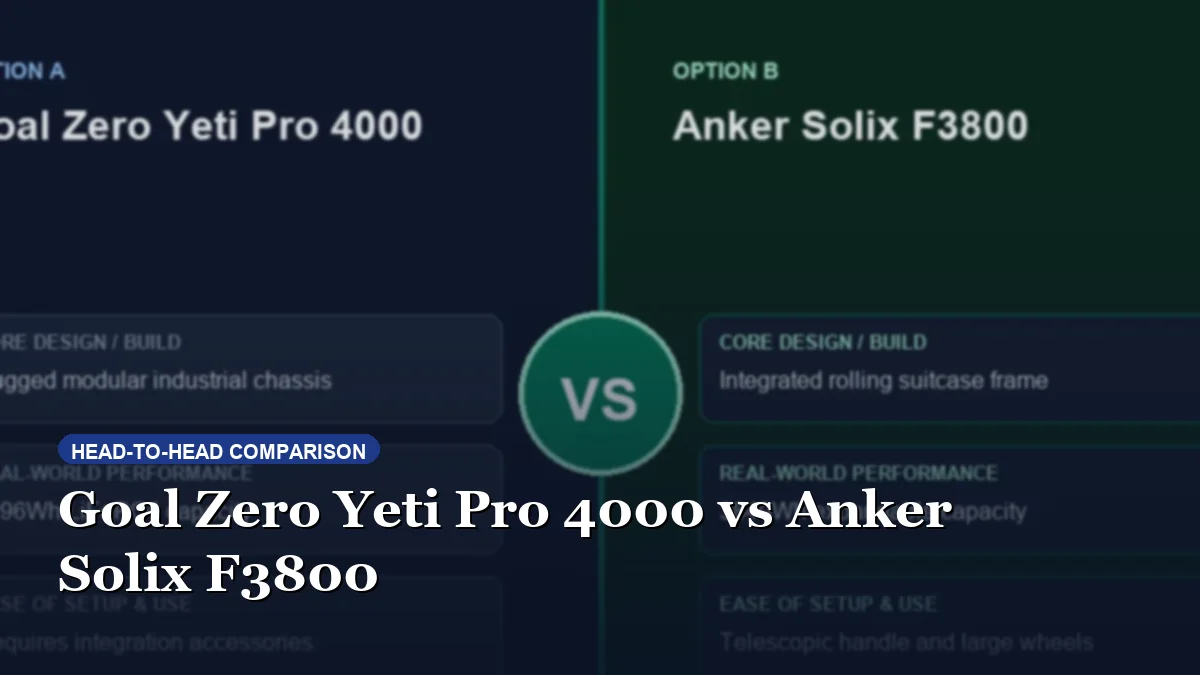
Choose the Goal Zero Yeti Pro 4000 for industrial integration and modular flexibility. Pick the Anker Solix F3800 for built-in mobility and maximum integrated AC output.
Compare all top models in our Best Portable Power Station: Top Picks for 2026.
Side-by-Side Breakdown
| Criteria | Goal Zero Yeti Pro 4000 | Anker Solix F3800 | Edge |
|---|---|---|---|
| Core Design / Build | Rugged modular industrial chassis | Integrated rolling suitcase frame | Split |
| Real-World Performance | 3996Wh LiFePO4 capacity | 3840Wh expandable capacity | Goal Zero |
| Ease of Setup & Use | Requires integration accessories | Telescopic handle and large wheels | Anker Solix F3800 |
| Durability & Reliability | Commercial-grade thermal management | Automotive-grade drop-tested housing | Split |
| Efficiency / Operating Footprint | High conversion efficiency | Advanced bi-directional inverter tech | Anker Solix F3800 |
| Maintenance Requirements | Firmware updates and terminal checks | Dust filter cleaning and battery calibration | Split |
| Best Ideal Use Case | Whole-home transfer switch integration | Mobile off-grid living and RV travel | Split |
Core Design and Engineering Differences
We can detail this in our Goal Zero Yeti Pro 4000 review, noting how its heavy-duty industrial chassis prioritizes longevity, safety, and physical resilience for fixed or semi-fixed backup installations.
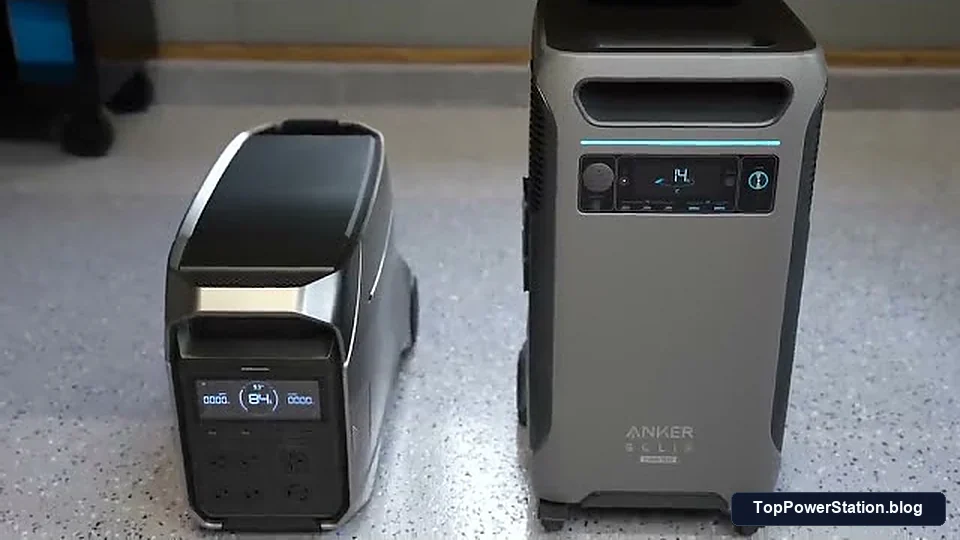
Meanwhile, the Anker Solix F3800 focuses heavily on integrated mobility with built-in wheels and a pull handle.
Internal architectural layout dictates how both systems manage intense thermal loads during heavy multi-kilowatt output. Goal Zero utilizes a robust ventilation matrix, whereas Anker relies on optimized internal airflow channels to cool its high-density inverter components efficiently.
The Goal Zero Yeti Pro 4000 utilizes an industrial-grade chassis built for rugged utility, while the Anker Solix F3800 leans into a consumer-friendly, integrated trolley design with wheels.
Internal component layout differs significantly regarding thermal management, as Goal Zero employs passive convection channels alongside dual cooling fans, contrasting with Anker’s directed forced-air architecture for rapid heat dissipation.
- Goal Zero emphasizes modular integration and stationary ruggedness.
- Anker prioritizes a self-contained rolling suitcase physical footprint.
- Both employ advanced LiFePO4 battery chemistry for safety.
Chassis Construction and Material Selection
Heavy-duty polymers and reinforced metal internal frames protect sensitive inverter electronics against severe physical impacts. Both units utilize flame-retardant exterior plastics that meet strict industrial safety requirements for residential backup applications.
- Impact-resistant outer shells protect internal lithium cells.
- Reinforced corner brackets absorb kinetic shock during transit.
Real-World Performance and Output Profiles
Delivering consistent wattage to demanding household appliances requires robust continuous output ratings. As highlighted in our Goal Zero Yeti 1500X review, this series provides massive surge capability, handling heavy inductive loads during extended utility outages.
The Anker Solix F3800 matches this reliability by delivering high continuous AC wattage through multiple dedicated household outlets. Users can run high-draw kitchen appliances simultaneously without triggering internal circuit protection safeguards.
Delivering continuous power requires robust inverter engineering, where the Yeti Pro 4000 outputs 4000 watts continuous with massive surge overhead, perfectly matching heavy inductive motor loads during startup cycles.
Meanwhile, the Solix F3800 provides 3800 watts continuous output capacity, featuring a responsive voltage regulation circuit that minimizes harmonic distortion when running sensitive laboratory or medical diagnostic hardware.
- Goal Zero excels at handling extreme motor-starting surge loads.
- Anker provides extensive multi-port AC connectivity for simultaneous device operation.
Surge Capacities and Continuous Wattage
Sustained heavy loads test thermal throttling thresholds and inverter stability. Clean pure sine wave output ensures sensitive medical equipment or microprocessors remain completely safe from harmonic distortion during operation.
- Pure sine wave output prevents electrical damage to appliances.
- Robust thermal throttling prevents unexpected shutdown during spikes.
Battery Chemistry, Efficiency, and Longevity
Lithium iron phosphate chemistry provides thousands of reliable charge cycles before capacity degrades to eighty percent. Both units leverage this advanced chemistry to ensure long-term operational viability across years of heavy daily cycling.
Conversion efficiency directly affects how much stored energy is actually delivered to your devices. Minimal parasitic draw and optimized inverter design give both heavyweights exceptional round-trip efficiency ratings under standard loads.
Both systems rely on lithium iron phosphate cells, but their cell management systems dictate cycle life, with Goal Zero promising 4000 cycles to 80% capacity under optimal operational temperatures.
Anker counters with proprietary InfiniPower technology, achieving roughly 3000 cycles before degradation while maintaining superior round-trip energy efficiency during high-draw inverter usage scenarios and rapid solar charging.
- LiFePO4 cells deliver over 3000 cycles to 80 percent capacity.
- Low idle consumption preserves battery reserves during standby periods.
Cycle Life and Degradation Metrics
Strict battery management systems monitor individual cell voltages, temperatures, and current flow continuously. This active balancing maximizes overall pack lifespan while protecting against overcharging and dangerous thermal runaway events.
- Active cell balancing prevents individual voltage drift.
- Advanced BMS architecture safeguards against thermal anomalies.
Mobility, Ergonomics, and Physical Footprint
Moving a multi-kilowatt power station demands thoughtful ergonomic design and secure lifting points. Goal Zero units typically require optional cart accessories for seamless transport, favoring a compact stackable shape for stationary basement deployment.
Anker integrates a telescoping pull handle and oversized wheels directly into the chassis housing. This makes rolling the heavy machine across rough terrain significantly easier for users needing portable backup.
Transporting heavy power stations demands intelligent engineering, a balance thoroughly analyzed in our Anker Solix F3800 review comparing fixed handles against a telescopic pull handle and robust transport wheels.
Weight distribution also affects daily usability, since the Goal Zero unit requires a dedicated cart for mobility, whereas the Anker model functions as a self-contained rolling unit for effortless jobsite relocation.
- Goal Zero utilizes a compact box shape for stationary storage.
- Anker features integrated wheels and a handle for effortless rolling.
Transportability and Weight Distribution
Heavy equipment handling requires balanced weight distribution to prevent tipping hazards on slopes. Low-slung internal battery modules keep the center of gravity stable during transit across uneven outdoor terrain.
- Low center of gravity improves safety during transport.
- Ergonomic grab handles assist with manual lifting tasks.
Ecosystem Expansion and Integration Limits
Expanding energy storage capacity allows users to customize their backup system for multi-day outages. Building upon findings in our Goal Zero Yeti 1000X review, these units offer robust home integration accessories for seamless emergency power.
Anker provides expandable battery packs that connect via heavy-duty cabling to scale total watt-hours dramatically. Smart app integration lets you monitor state-of-charge and adjust power flow directly from your smartphone.
Expanding total capacity involves linking auxiliary battery packs, with Goal Zero allowing extensive daisy-chaining up to massive kilowatt-hour limits using proprietary high-current cables designed for heavy current flow.
Anker approaches ecosystem scalability through dedicated expansion batteries that plug directly into the main unit, supporting seamless smart home integration via manual transfer switch accessories and dedicated companion apps.
- Goal Zero supports dedicated home integration transfer switch kits.
- Anker offers modular expansion packs for extended runtime needs.
Smart App Controls and Connectivity
Wireless monitoring via Bluetooth and Wi-Fi provides real-time data on input wattage and remaining runtime. Companion applications allow users to adjust charging speeds and customize power schedules remotely.
- Remote firmware updates improve device functionality over time.
- Detailed energy tracking helps optimize daily power consumption.
Maintenance, Safety Standards, and Upkeep
Keeping high-capacity energy systems operational requires minimal routine maintenance and proper environmental storage. Regular firmware updates patch software vulnerabilities, while periodic dust clearing protects cooling fans from obstruction.
Both manufacturers adhere to stringent international electrical safety certifications to protect users against shock hazards. Robust internal fuses and short-circuit protection mechanisms ensure safe operation under demanding conditions.
Long-term reliability depends on adhering to strict regulatory protocols, meaning both power stations comply with major UL safety certifications and comprehensive short-circuit protection mechanisms for ultimate user safety.
Routine upkeep involves keeping ventilation ports clear of dust and debris, alongside firmware updates managed through mobile application interfaces that monitor internal cell health and thermal thresholds.
- Routine firmware updates enhance system security and performance.
- Certified safety protections prevent catastrophic electrical failures.
Environmental Resilience and Storage
Storing lithium power stations in climate-controlled environments prevents accelerated battery degradation and moisture damage. Keeping units charged partially during long storage periods preserves internal cell health effectively.
- Avoid extreme temperatures during long-term storage periods.
- Maintain partial charge levels when units sit unused.
Which Option Fits Your Specific Backup Setup
Choosing between these two heavy hitters depends entirely on your specific lifestyle and backup requirements. Homeowners seeking a permanently installed basement backup system will appreciate Goal Zero's robust integration ecosystem and rugged build quality.
Conversely, users who value easy mobility for RV trips or temporary job sites will prefer Anker's integrated wheels and high continuous output. Evaluate your physical space and power needs before making a final investment decision.
Selecting the ideal backup solution requires analyzing your exact load requirements, making the Goal Zero unit ideal for fixed off-grid cabins requiring extreme durability and high surge capacity.
Conversely, mobile users and emergency responders often prefer the Anker ecosystem for its integrated rolling mobility and straightforward home backup transfer switch compatibility during unexpected grid power outages.
- Select Goal Zero for stationary home integration and rugged durability.
- Choose Anker for rolling mobility and versatile multi-appliance output.
Final Decision Framework
Assess your typical daily energy consumption and peak wattage requirements carefully. Matching your electrical load profile to the correct inverter capacity guarantees reliable performance during unexpected grid failures.
- Calculate essential appliance wattage before purchasing.
- Consider whether portability or stationary integration matters more.
Frequently Asked Questions
Can both power stations run heavy household appliances simultaneously?
Yes, both units deliver massive continuous wattage to run refrigerators and air conditioners. Their pure sine wave inverters ensure sensitive electronics remain completely safe.
How do these systems handle long-term off-grid storage?
Both utilize stable LiFePO4 chemistry that maintains charge retention over many months. Storing them in climate-controlled spaces preserves their overall lifespan.
Are expansion batteries compatible with both models?
Both power stations support expandable battery configurations to scale your total watt-hours. Using proprietary connection cables ensures safe energy transfer between modules.
What is the primary difference in their physical design?
Goal Zero focuses on industrial modularity for stationary backup installations. Anker prioritizes integrated rolling wheels and a pull handle for easy transport.
Do I need professional installation for home backup integration?
Connecting either unit directly to home circuits requires a transfer switch. Hiring a licensed electrician guarantees compliance with local electrical safety codes.