Expandable vs Non Expandable Power Station Guide
Choosing between expandable and non-expandable portable power stations defines your off-grid energy capacity. This technical guide contrasts modular architectures against all-in-one units to optimize your backup power strategy.

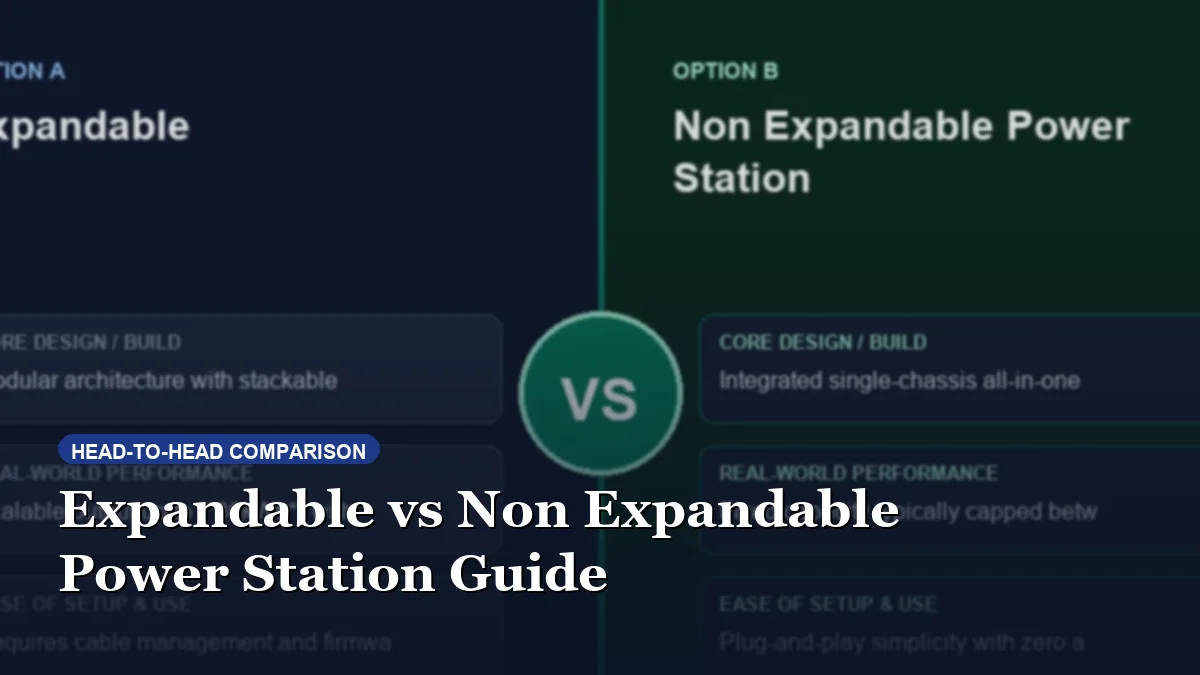
Choose Expandable units for stationary home backup and heavy off-grid loads requiring modular capacity, while selecting Non Expandable Power Stations for mobile camping, quick deployments, and simplified all-in-one portability.
Compare all top models in our Best Portable Power Station: Top Picks for 2026.
Side-by-Side Breakdown
| Criteria | Expandable | Non Expandable Power Station | Edge |
|---|---|---|---|
| Core Design / Build | Modular architecture with stackable expansion battery ports. | Integrated single-chassis all-in-one enclosure. | Modular (A) for scale / Integrated (B) for ruggedness |
| Real-World Performance | Scalable output up to 30kWh with multi-unit pairing. | Fixed capacity typically capped between 1kWh and 3kWh. | Expandable |
| Ease of Setup & Use | Requires cable management and firmware synchronization. | Plug-and-play simplicity with zero assembly steps. | Non Expandable |
| Durability & Reliability | Multiple connection points introduce potential wear vectors. | Fewer internal harnesses improve physical ruggedness. | Non Expandable |
| Efficiency / Operating Footprint | Higher idle draw due to larger inverters and management systems. | Optimized standby consumption for single-battery topology. | Non Expandable |
| Maintenance Requirements | Requires balanced firmware updates across multiple battery modules. | Single monolithic battery pack simplifies long-term care. | Non Expandable |
| Best Ideal Use Case | Whole-home emergency backup and extended cabin living. | Weekend camping, tailgating, and mobile workstation power. | Tie (Application Dependent) |
Core Design and Engineering Architecture
Modular portable power stations rely on an expandable design philosophy that separates the main inverter console from auxiliary battery packs. This decoupling allows engineers to scale watt-hour ratings independently from maximum surge output limits.

Conversely, non-expandable power stations utilize a unified monoblock chassis where the battery management system, inverter circuitry, and LiFePO4 cells reside within one sealed housing. This engineering approach eliminates external high-current umbilical cables entirely.
Understanding these foundational layout differences helps technicians evaluate thermal dissipation pathways, enclosure ingress protection ratings, and overall spatial footprints across varying deployment scenarios and mobile operating environments.
- Expandable systems use specialized high-current DC bus connectors for stacking battery modules.
- Non-expandable units feature internal busbars soldered directly to the primary PCB.
- Chassis weight distribution favors single-unit designs for quick physical handling.
Inverter Topology and Busbar Configuration
Expandable power stations incorporate heavy-duty bidirectional inverters capable of synchronizing voltage across chained auxiliary units. Their internal busbars must handle massive amperage surges during heavy inductive motor startup cycles.
Traditional non-expandable models optimize their fixed inverter boards for specific peak wattage thresholds without multi-unit handshake protocols. This simpler electronic topology reduces component failure points during long-term continuous operation.
- Bidirectional inverter firmware manages voltage phase matching across expansion cables.
- Fixed systems bypass complex communication protocols to lower standby power consumption.
Enclosure Thermal Dynamics and Ingress Protection
Managing heat dissipation across stacked modular battery cases requires sophisticated forced-air cooling channels and multi-zone temperature sensors. These active thermal safeguards prevent localized hot spots during high-amperage charging sessions.
Monolithic non-expandable units often achieve better dust and moisture resistance seals because they lack vulnerable external expansion ports. Fewer physical cutouts mean simpler weatherproofing for outdoor emergency applications.
- Auxiliary battery expansion ports require protective rubber gaskets against moisture ingress.
- Monoblock enclosures streamline internal airflow paths for quieter fan operation.
Real-World Performance and Capacity Scaling
When evaluating real-world runtime capacity, expandable power stations offer unmatched versatility by scaling from baseline kilowatt-hours up to substantial multi-kilowatt-hour residential reserves. Users can dynamically add chemistry-matched battery packs as energy demands grow.
Non-expandable alternatives deliver reliable, predictable performance within their factory-sealed capacity boundaries. While you cannot add extra runtime later, these units eliminate the voltage drop risks associated with long external connection cables.
Field tests demonstrate that modular units excel during prolonged grid outages by sustaining heavy household appliances for days, whereas fixed units prioritize rapid deployment and consistent output for targeted mobile tasks.
- Expandable units support continuous heavy loads by distributing current across multiple packs.
- Fixed units maintain steady output profiles until reaching low-voltage cutoff thresholds.
- Voltage sag is notably minimized in integrated monoblock designs under heavy loads.
Load Handling and Surge Capacities
High surge capabilities are essential when powering inductive loads like well pumps or refrigerator compressors. Expandable architectures leverage combined battery discharge rates to supply massive initial startup amperage safely.
Non-expandable stations rely on dedicated internal capacitors and single-pack discharge limits to handle transient surges. They perform exceptionally well for sensitive electronics despite lacking modular headroom.
- Multi-pack systems share high discharge loads to reduce individual cell thermal stress.
- Fixed units use optimized internal capacitors for instantaneous surge response.
Scalability Limits and Voltage Matching
Connecting multiple expansion batteries introduces specific voltage matching requirements managed by advanced firmware protocols. Manufacturers strictly limit maximum stackable counts to prevent catastrophic busbar overloads during rapid discharge.
Non-expandable stations bypass these synchronization challenges entirely since their internal cell strings are permanently balanced at the factory. This guarantees predictable runtime degradation over thousands of charge cycles.
- Firmware handshakes verify pack voltage parity before allowing high-current output.
- Factory-balanced cells eliminate user error during initial deployment and setup.
Ease of Setup, Portability, and Ergonomics
Ergonomic design plays a decisive role during emergency deployments. Reviewing modular systems inside our best portable power station for home backup recommendations ensures you choose units with secure handle placements and reliable daily utility.
Expandable systems trade immediate portability for long-term capacity, requiring users to transport heavy main consoles and separate battery modules independently. Setting up a modular ecosystem demands careful physical positioning and cable management.
Weighing the physical burden of moving heavy equipment against the necessity of high capacity is essential for field operators, tailgaters, and homeowners preparing for unpredictable seasonal storm outages.
- Single-unit stations feature integrated folding handles for comfortable one-person carries.
- Modular expansion stacks often require two people or dedicated hand trucks to relocate.
- Cable routing between expansion packs demands clear floor space and organization.
Weight Distribution and Handle Engineering
Ergonomic handle placement on non-expandable generators centers the unit's gravity for effortless lifting and loading into vehicles. This thoughtful mechanical engineering reduces strain during frequent transit cycles.
Modular systems divide weight unevenly between the heavy inverter base and secondary battery bricks. Users must lift each component separately, mitigating injury risks during vehicle loading.
- Balanced center-of-gravity design prevents wrist fatigue on monoblock units.
- Separate modular components keep individual lifting weights below ergonomic safety limits.
Cable Management and Deployment Speed
Rapid deployment is critical during sudden blackouts when every second counts for essential medical devices. Non-expandable stations operate instantly via plug-and-play outlets without requiring auxiliary cable attachments.
Expandable setups require securing heavy-duty DC interconnect cables and verifying digital handshake lights before power flows. This extra configuration step introduces potential failure points during high-stress emergencies.
- Plug-and-play architecture enables instantaneous emergency power restoration.
- Locking DC power cables prevent accidental disconnections in busy utility rooms.
Durability, Reliability, and Failure Modes
Long-term reliability hinges on component simplicity and mechanical ruggedness under harsh environmental conditions. Non-expandable power stations feature fewer external connection ports, reducing dust and moisture vulnerability significantly.
Expandable configurations incorporate specialized high-amperage data and power ports that experience repeated mechanical wear during assembly and disassembly. Maintaining clean contact pins is vital to prevent resistive heating issues.
Field technicians must inspect modular umbilical cables regularly for fraying or pin corrosion, whereas monoblock units generally demand only basic exterior cleaning and firmware health checks.
- Fewer physical connection ports improve overall environmental resistance ratings.
- Modular port contacts require periodic inspection for oxidation and debris buildup.
- Sealed monoblock housings protect internal electronics from accidental liquid spills.
Connector Wear and Pin Oxidation Risks
High-current DC expansion connectors endure significant electrical and mechanical stress whenever modules are rearranged. Over time, micro-arcs can oxidize contact surfaces, increasing electrical resistance and thermal output.
Integrated units internalize all high-amperage connections, shielding them from atmospheric oxidation and physical abuse. This design choice dramatically enhances baseline reliability across multi-year lifespans.
- Gold-plated contact pins mitigate corrosion risks in humid storage environments.
- Internalized busbars eliminate user contact with high-voltage DC circuits.
Firmware Synchronization and System Errors
Modular ecosystems depend entirely on flawless software synchronization between the master inverter and slave battery packs. Outdated firmware on a single auxiliary unit can trigger system lockout errors during critical tasks.
Non-expandable stations run streamlined firmware architectures dedicated solely to a single battery assembly. This reduced code complexity minimizes unexpected software glitches during long storage periods.
- Centralized companion apps help track individual module firmware update cycles.
- Standalone units require minimal software maintenance after initial factory setup.
Efficiency, Standby Draw, and Operating Footprint
Energy efficiency directly impacts how long your stored power lasts off-grid. Inspecting options featured in our best portable power station for camping selection reveals units featuring minimal parasitic draw and optimal internal management circuitry.
Expandable power stations maintain active communication loops across all connected battery modules, resulting in a slightly higher baseline parasitic draw. This continuous overhead energy loss is the trade-off for modular scalability.
Evaluating physical space requirements is equally important for domestic installations where floor area is limited. Monoblock units occupy minimal square footage compared to sprawling multi-module power towers.
- Simpler management boards reduce parasitic idle consumption in fixed stations.
- Constant module polling increases standby power draw in expandable configurations.
- Vertical stacking kits help minimize the floor footprint of modular battery towers.
Parasitic Idle Draw and BMS Overhead
Battery management systems consume minor amounts of electricity to monitor cell health, temperatures, and state-of-charge metrics continuously. Expandable units multiply this overhead across every attached auxiliary module.
Monolithic power stations limit BMS overhead to a single primary board, conserving precious watt-hours during extended storage. This efficiency advantage benefits users relying on solar trickle charging.
- Active Bluetooth and Wi-Fi modules add to overall standby energy consumption.
- Deep sleep modes help mitigate parasitic drain during prolonged off-season storage.
Spatial Footprint and Storage Considerations
Finding suitable storage space for bulky power equipment can challenge apartment dwellers and vehicle campers alike. Fixed units slide easily into tight vehicle trunks or hall closets without disassembly.
Modular power towers require dedicated vertical clearance and stable flooring to support heavy stacked configurations safely. Proper ventilation clearance around all connected units remains mandatory.
- Compact monoblock footprints fit seamlessly under standard RV dinette seats.
- Modular towers need secure anchoring brackets in earthquake-prone geographic regions.
Maintenance, Battery Chemistry, and Longevity
Modern portable power stations rely heavily on LiFePO4 chemistry to guarantee thousands of deep discharge cycles before capacity degradation occurs. Both expandable and fixed units benefit from this robust, thermally stable battery technology.
Maintaining an expandable system involves monitoring individual battery health metrics through companion apps to ensure balanced aging across modules. Mixing old and new battery packs can restrict overall system performance.
Non-expandable units simplify long-term ownership because the entire energy storage system ages uniformly as a single monolithic block. Proper storage voltage management remains the primary user responsibility.
- LiFePO4 cells deliver exceptional cycle life exceeding three thousand charge events.
- Uneven aging across modular packs can trigger premature low-voltage warnings.
- Monolithic units ensure uniform thermal and electrical aging across all internal cells.
Cell Balancing and State-of-Health Monitoring
Advanced battery management software continuously balances internal cell voltages to maximize usable capacity and prevent premature thermal runaway. Modular units must synchronize these balancing routines across separate physical enclosures.
Fixed stations execute streamlined balancing algorithms within a single sealed compartment, ensuring consistent internal resistance metrics over years of regular charging cycles.
- Automatic cell balancing prevents voltage divergence during high-drain operations.
- Companion apps display individual module health metrics for proactive troubleshooting.
Long-Term Degradation and Replacement Protocols
When an auxiliary battery pack finally degrades in a modular system, users can replace just that single component rather than buying an entirely new power station. This modular circularity reduces long-term operational costs.
When a non-expandable unit reaches its end-of-life capacity threshold, the entire appliance must be retired or recycled. This lack of component-level replaceability increases long-term hardware replacement expenses.
- Modular replacement lowers lifetime ownership costs for heavy power users.
- Whole-unit recycling is required when monoblock internal cells finally degrade.
Determining the Right Power Station for Your Setup
Evaluating your daily energy consumption and mobility habits helps identify the right equipment tier. Our best portable power station guide highlights top models balancing capacity, safety protections, and long-term reliability.
Outdoor enthusiasts, remote workers, and mobile photographers will find non-expandable power stations far more practical for their day-to-day transport and rapid deployment requirements. Understanding your exact load profile prevents costly over-purchasing.
Careful technical assessment of your peak wattage demands, charging speeds, and spatial constraints ensures you invest in a reliable power solution tailored perfectly to your lifestyle.
- Assess your daily kilowatt-hour consumption before choosing an architecture style.
- Factor in vehicle payload limits if portability is a primary operational priority.
- Match your solar panel array output to the maximum charging specs of your station.
Evaluating Home Backup Versus Mobile Use Cases
Stationary home backup applications demand massive energy reserves capable of running refrigerators, lights, and medical gear for multiple days. Expandable systems excel in these static residential environments.
Mobile use cases prioritize lightweight maneuverability, quick vehicle charging, and rugged durability over massive capacity expansion. Integrated monoblock units dominate this active outdoor sector.
- Home backup installations benefit from permanent transfer switch integration.
- Mobile setups require rapid solar panel deployment and compact vehicle storage.
Budget Allocation and Future-Proofing Strategy
Future-proofing your home energy infrastructure often requires higher initial capital. Alternatively, consult our best budget power station guide if you need affordable monoblock units that deliver reliable off-grid functionality without unnecessary modular overhead.
Budget-conscious buyers seeking reliable, maintenance-free power for occasional trips or short outages will find non-expandable units offer unbeatable value and straightforward operational simplicity.
- Modular scaling allows phased financial investments in backup capacity.
- Fixed units deliver maximum core performance per dollar spent upfront.
Frequently Asked Questions
Can I mix different battery capacities on an expandable power station?
Manufacturers strongly advise against mixing mismatched battery sizes or older chemistries within modular stacks. Doing so risks uneven voltage discharging and potential firmware synchronization errors during heavy loads.
Are non-expandable power stations safer than modular expandable units?
Both designs offer high safety standards when utilizing stable LiFePO4 chemistry. Non-expandable units feature fewer external connection points, which inherently reduces environmental wear vulnerabilities over time.
How much standby power do expandable systems waste?
Expandable systems experience slightly higher parasitic idle draw due to constant module polling. This continuous communication overhead maintains system-wide voltage balance across all connected battery bricks.
Can I charge expandable power stations faster with extra batteries?
Adding expansion batteries usually increases the total allowable solar and AC input wattage capacity. This scalability enables rapid high-speed recharging during extended emergency power outages.
Which option works better for full-time RV living?
Expandable power stations suit large motorhomes requiring massive residential energy reserves. Smaller camper vans benefit from the space-saving footprint of integrated non-expandable models.