EcoFlow Delta Pro vs Bluetti AC300
Choosing between these heavy-duty power stations requires balancing all-in-one mobility with modular flexibility. This technical guide evaluates their engineering, performance, and everyday utility.

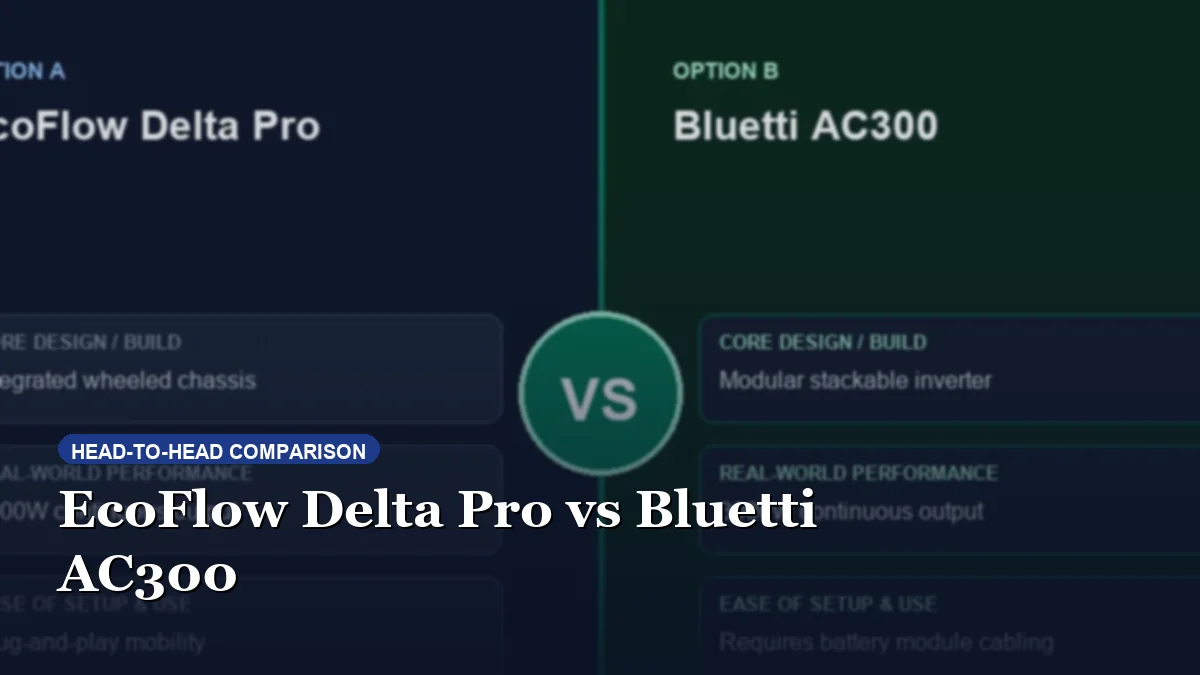
Choose the EcoFlow Delta Pro if you value integrated wheels and all-in-one portability. Select the Bluetti AC300 if you prefer a modular, expandable battery setup that reduces heavy lifting.
Compare all top models in our Best Portable Power Station: Top Picks for 2026.
Side-by-Side Breakdown
| Criteria | EcoFlow Delta Pro | Bluetti AC300 | Edge |
|---|---|---|---|
| Core Design / Build | Integrated wheeled chassis | Modular stackable inverter | Split |
| Real-World Performance | 3600W continuous output | 3000W continuous output | EcoFlow Delta Pro |
| Ease of Setup & Use | Plug-and-play mobility | Requires battery module cabling | EcoFlow Delta Pro |
| Durability & Reliability | Robust LFP cell structure | Industrial-grade modular build | Split |
| Efficiency / Operating Footprint | High inverter conversion rate | Efficient modular energy routing | EcoFlow Delta Pro |
| Maintenance Requirements | Standard firmware and dusting | Module connector checks and updates | Split |
| Best Ideal Use Case | Rapid mobile emergency backup | Stationary home integration scaling | Split |
Core Design and Engineering Architecture
Modern heavy-duty power stations rely on distinct structural philosophies to manage massive electrical loads. Understanding these fundamental mechanical differences helps users select equipment that aligns with their specific installation space and deployment needs.
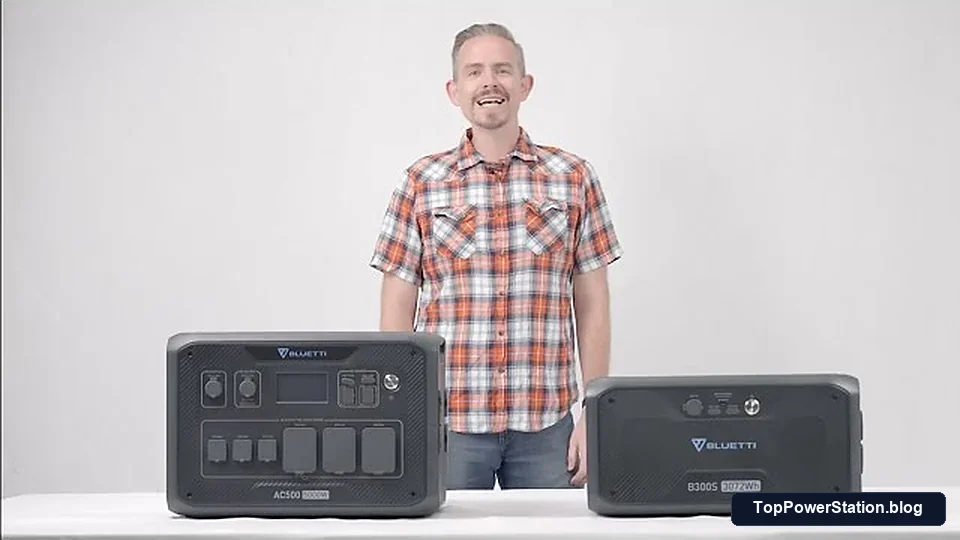
The EcoFlow Delta Pro utilizes an integrated monocoque shell housing the inverter and battery cells, pairing cleanly with choices from our recommended solar panels roundup to eliminate external DC interconnect cables.
Conversely, the Bluetti AC300 adopts a modular design philosophy that separates the heavy inverter head unit from the external B300 battery packs. This architectural split significantly reduces the single-lift weight during transport and installation.
- EcoFlow uses an integrated internal battery housing structure.
- Bluetti relies on a detachable inverter head and external battery modules.
- Modular builds reduce individual component lifting weights for safety.
Modular versus All-in-One Form Factors
Modular configurations allow users to stack capacity incrementally without moving an oversized single unit. However, external high-current DC cables introduce additional connection points that require periodic physical inspection.
Integrated systems provide superior environmental protection against dust and moisture ingress by sealing core electronics inside one chassis. Maintenance technicians often prefer this streamlined approach for simplified field troubleshooting routines.
- Integrated units seal electronics against environmental dust effectively.
- Modular setups require secure high-current DC umbilical connections.
Inverter Output and Electrical Performance
Delivering stable alternating current under heavy inductive loads is a primary benchmark for industrial-grade portable generators. Both units employ advanced pure sine wave inverters designed to protect sensitive household electronics and motorized appliances.
The EcoFlow Delta Pro features a robust 3600W continuous output rating capable of handling demanding heavy-duty household appliances simultaneously. Its proprietary X-Boost mode can also drive high-wattage resistive heating elements safely.
The Bluetti AC300 delivers a respectable 3000W continuous output from its pure sine wave inverter architecture. While slightly lower than its competitor, this capacity effortlessly supports standard refrigerators, well pumps, and medical devices.
- EcoFlow supplies 3600 watts of continuous AC power output.
- Bluetti provides 3000 watts of continuous AC power output.
- Both systems utilize clean pure sine wave inverter technology.
Surge Capacities and Continuous Loads
Handling motor startup surges without tripping internal circuit breakers is critical for off-grid living and emergency preparedness. Both generators manage transient electrical spikes efficiently through sophisticated digital signal processors.
Users must monitor cumulative running wattages closely to prevent thermal throttling during extended high-load operations in warm ambient environments. Proper ventilation around cooling fans ensures optimal inverter efficiency.
- Transient surges require robust digital processor management.
- Thermal throttling protection prevents internal component degradation.
Battery Chemistry and Long-Term Longevity
Advanced energy storage relies on lithium iron phosphate chemistry to deliver thousands of safe charge cycles. This chemical formulation resists thermal runaway and maintains exceptional capacity retention over years of service.
Building on insights from our EcoFlow Delta Pro Ultra review, the EcoFlow Delta Pro integrates premium LFP cells rated for 3500 cycles to 80% capacity, ensuring decades of reliable backup cycling.
The Bluetti AC300 utilizes matching LFP battery modules engineered for over 3500 life cycles before reaching the degradation threshold. Users benefit from long-term operational consistency without experiencing rapid capacity fade.
- Both systems utilize lithium iron phosphate battery chemistry.
- Cell longevity exceeds 3500 cycles before major capacity loss.
- Thermal management systems protect cells during rapid cycling.
Cycle Life and Thermal Management
Internal temperature sensors regulate active cooling fans to maintain ideal operating thresholds during high-amp charging phases. Effective thermal management directly preserves internal cell health and prevents premature aging.
Battery management systems continuously balance individual cell voltages to maximize overall pack efficiency and operational safety during intense power draws.
- Active cooling fans regulate internal operational temperatures.
- Battery management systems balance individual cell voltages.
Charging Capabilities and Grid Integration
Rapid recharging capabilities minimize downtime during rolling blackouts or limited solar weather windows. These power stations support multiple simultaneous charging inputs to restore full energy reserves quickly.
As detailed in our EcoFlow Delta Pro review, the EcoFlow Delta Pro supports blazing-fast multicharge input speeds combining AC wall power, solar arrays, and smart generators to ensure rapid emergency turnaround times.
The Bluetti AC300 accepts massive solar input arrays and dual AC charging sources to achieve swift energy replenishment. Its flexible architecture adapts seamlessly to diverse off-grid power generation setups.
- EcoFlow features exceptionally fast multi-source charging speeds.
- Bluetti supports high-wattage solar array input configurations.
- Dual charging methods drastically reduce total downtime duration.
Solar Input Limits and AC Recharging Speeds
Harnessing renewable energy requires compatible open-circuit voltage ranges on integrated Maximum Power Point Tracking charge controllers. Exceeding these calibrated voltage limits can permanently damage internal charging circuitry.
Standard wall outlet recharging speeds utilize advanced internal rectification to pull maximum allowable amperage safely from standard household electrical circuits.
- MPPT charge controllers optimize incoming renewable solar power.
- Wall outlet charging respects standard household circuit amp limits.
Portability, Ergonomics, and Physical Footprint
Physical dimensions and weight distribution dictate how easily these heavy energy storage systems traverse rugged terrain or tight indoor spaces. Ergonomic design elements significantly improve user safety during transport tasks.
The EcoFlow Delta Pro includes a telescoping pull handle and robust integrated wheels that mimic standard luggage mobility. This built-in hardware allows single users to relocate the heavy chassis across flat surfaces.
The Bluetti AC300 separates its components, meaning the inverter and battery modules are lifted individually. This modular approach avoids heavy rolling chassis weight but requires multiple trips for complete transport.
- EcoFlow features built-in wheels and a retractable pull handle.
- Bluetti relies on modular lifting with separate battery packs.
- Weight distribution impacts overall transport safety for users.
Wheels, Handles, and Weight Distribution
Navigating stairs or rough gravel surfaces with an all-in-one unit requires careful lifting teamwork despite integrated wheels. Modular systems simplify stair transport by allowing users to carry lighter individual pieces.
Ergonomic handle placement reduces physical strain on wrists and lower backs during loading into vehicle cargo areas for mobile camping trips.
- Stair transport demands careful lifting strategies for heavy units.
- Ergonomic handles reduce physical strain during vehicle loading.
Software Ecosystem and Remote Monitoring
Modern power stations incorporate digital connectivity features for comprehensive remote oversight and firmware updates via smartphones. Dedicated applications provide real-time telemetry data regarding power flows and temperatures.
The EcoFlow Delta Pro app offers granular control over charging speeds, AC output schedules, and quiet charging modes. Wi-Fi and Bluetooth connectivity ensure seamless remote management from anywhere.
The Bluetti AC300 utilizes a responsive mobile application for monitoring input wattages, output loads, and battery health percentages. Wireless protocols maintain stable connections during routine residential monitoring tasks.
- EcoFlow app provides detailed charging speed customization.
- Bluetti app displays real-time input and output telemetry.
- Wireless connectivity enables remote firmware update installations.
App Connectivity and Firmware Reliability
Regular over-the-air firmware updates refine internal charging algorithms and resolve minor software bugs without requiring hardware servicing. Stable wireless pairing ensures users maintain continuous visibility over critical backup power reserves.
Local Bluetooth redundancy allows direct device management even during unexpected internet service provider outages.
- Over-the-air updates refine internal charging algorithms.
- Local Bluetooth ensures control during internet outages.
Maintenance Requirements and System Upkeep
Proper routine upkeep guarantees optimal efficiency and extends the operational lifespan of heavy-duty portable power equipment significantly. Preventative maintenance routines focus on ventilation cleanliness and connection integrity.
The EcoFlow Delta Pro requires periodic inspection of external cooling vents to prevent dust accumulation from obstructing airflow. Keeping intake fans clean prevents unnecessary thermal shutdown events.
The Bluetti AC300 demands regular checks of its heavy-duty modular DC cabling and terminal connection points. Ensuring secure screw terminals prevents electrical resistance heating during maximum load operations.
- Cooling vents require periodic dusting for optimal airflow.
- Modular DC cables need routine terminal security inspections.
- Preventative upkeep prevents unexpected thermal shutdown events.
Dust Filters and Firmware Management
Cleaning integrated dust screens prevents particulate matter from settling on sensitive inverter circuit boards over extended operational periods. Routine software checks ensure optimal battery management system performance.
Keeping system firmware updated protects against emerging operational anomalies and maximizes overall electrical conversion efficiency.
- Cleaning dust screens protects internal circuit boards.
- Routine software checks maintain peak operational efficiency.
Choosing the Right Power Station for Your Setup
Selecting the ideal heavy-duty power station depends on your specific mobility requirements, installation space, and power consumption profile. Evaluating these personal operational priorities ensures long-term satisfaction with your investment.
The EcoFlow Delta Pro excels in scenarios requiring rapid deployment, as highlighted in our EcoFlow Delta Pro 3 review, featuring all-in-one mobility without complex cable connections and integrated transport wheels.
The Bluetti AC300 serves stationary home backup installations best where modular capacity expansion is desired. Its lighter individual components simplify initial setup within restricted utility spaces.
- Assess mobility needs versus stationary home backup integration.
- Consider weight lifting limits when planning installation locations.
- Match continuous output ratings to your peak appliance demands.
Matching Specs to Off-Grid Demands
Calculating your exact daily kilowatt-hour consumption prevents sizing mistakes when choosing between these heavy-duty platforms. Consulting appliance nameplates ensures continuous inverter capacity remains safely above peak loads.
Proper system matching guarantees reliable emergency power availability during extended grid outages.
- Calculate daily kilowatt-hour consumption before purchasing.
- Consult appliance nameplates to verify peak load compatibility.
Frequently Asked Questions
Can both power stations connect to home transfer switches?
Yes, both units integrate with home transfer switches using appropriate adapter cables. This setup delivers seamless backup power to critical household circuits during sudden grid outages.
How do their physical weights differ during transport?
The EcoFlow Delta Pro weighs significantly more as a single unit but includes built-in wheels. The Bluetti AC300 separates its inverter and batteries into lighter modular pieces.
Are the battery expansion options compatible with third-party cells?
No, both manufacturers require proprietary expansion batteries designed specifically for their respective inverter models. Using unauthorized third-party batteries voids warranties and risks severe electrical damage.
What type of maintenance do these LFP batteries require?
These systems require minimal maintenance beyond keeping cooling vents clean and updating firmware. Storing them at partial charge in temperature-controlled environments preserves overall cell health.
Can I charge these generators using standard solar panels?
Yes, both stations feature integrated MPPT charge controllers compatible with most third-party solar panels. You must verify that array open-circuit voltages stay within manufacturer limits.