EcoFlow Delta Mini vs Jackery 1000: Technical Clash
This technical comparison pits the fast-charging EcoFlow Delta Mini against the reliable Jackery 1000 to determine optimal buyer fit.

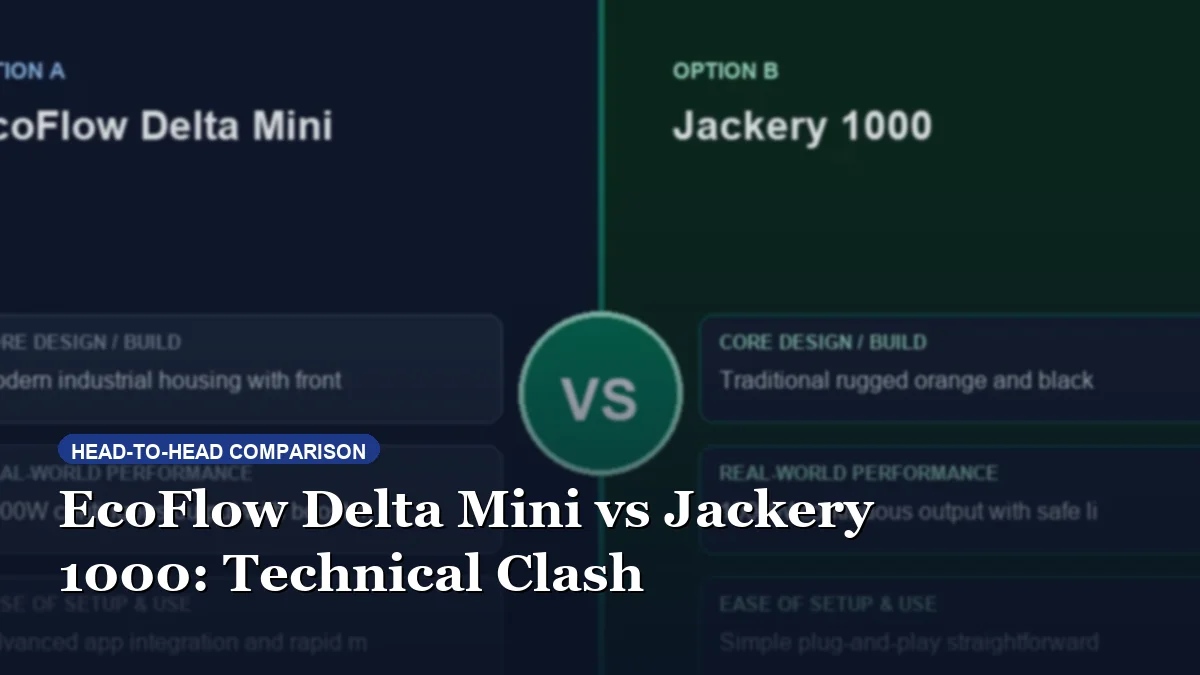
Choose the EcoFlow Delta Mini for rapid wall charging and heavy surge capacity, or select the Jackery 1000 for rugged simplicity and classic reliability.
Compare all top models in our Best Portable Power Station: Top Picks for 2026.
Side-by-Side Breakdown
| Criteria | EcoFlow Delta Mini | Jackery 1000 | Edge |
|---|---|---|---|
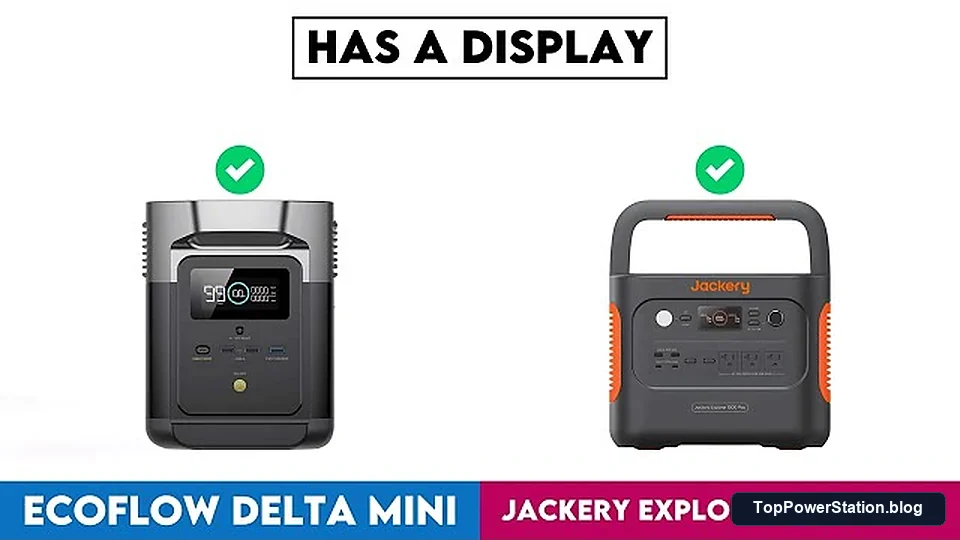
| Core Design / Build | Modern industrial housing with front screen | Traditional rugged orange and black shell | EcoFlow Delta Mini |
| Real-World Performance | 1400W continuous output with boost mode | 1000W continuous output with safe limits | EcoFlow Delta Mini |
| Ease of Setup & Use | Advanced app integration and rapid menus | Simple plug-and-play straightforward layout | Jackery 1000 |
| Durability & Reliability | NCM chemistry rated for frequent cycles | Standard lithium battery with BMS safety | Jackery 1000 |
| Efficiency / Operating Footprint | High power conversion with fan cooling | Efficient passive draw with quiet fans | Jackery 1000 |
| Maintenance Requirements | Regular firmware updates and cool storage | Minimal upkeep with standard storage rules | Jackery 1000 |
| Best Ideal Use Case | Emergency backup and fast-charging needs | Weekend camping and standard appliances | EcoFlow Delta Mini |
Core Design and Engineering Architecture
Examining the underlying engineering reveals stark differences in how each manufacturer approaches portable power station design. The EcoFlow unit emphasizes raw technological capability.
Conversely, the competitor focuses on straightforward usability and enduring field reliability. Both units target outdoor enthusiasts, yet their internal layouts reflect completely different engineering priorities.
Understanding these foundational choices helps technicians determine which system best withstands rigorous daily usage and environmental exposure during demanding off-grid adventures.
- EcoFlow architecture prioritizes rapid power conversion.
- Jackery build emphasizes classic structural simplicity.
- Thermal profiles differ across both enclosure designs.
Inverter Topology and AC Output Architecture
The inverter topology dictates how cleanly each station delivers alternating current to sensitive electronics. EcoFlow utilizes a proprietary circuit design that pushes high wattage effortlessly.
Jackery relies on a more conservative pure sine wave inverter focused on steady stability. Users plugging in medical equipment or laptops will notice distinct behavioral differences.
- Pure sine wave output protects sensitive electronics.
- Surge thresholds vary significantly under heavy loads.
Chassis Ergonomics and Thermal Management Profiles
Effective thermal management prevents overheating during high-draw operations. The EcoFlow enclosure uses active cooling fans paired with internal aluminum heat sinks to dissipate thermal energy quickly.
The Jackery chassis relies on optimized ventilation paths to maintain safe operating temperatures. Both systems manage heat well, but active fans engage sooner on the EcoFlow.
- Active cooling fans manage high internal temperatures.
- Ventilation placement impacts outdoor dust resistance.
Battery Chemistry and Cycle Life Engineering
Battery chemistry dictates overall longevity, weight distribution, and discharge efficiency under stress. These two power stations utilize proven lithium formulations engineered for thousands of hours.
Evaluating capacity retention over time highlights why chemistry choice matters for long-term investments. Chemical degradation occurs naturally, but proper internal battery management systems mitigate capacity loss.
Buyers must weigh immediate power delivery against long-term degradation rates when selecting their primary off-grid energy storage device for regular deployment.
- Lithium chemistry defines overall cycle lifespan.
- Internal BMS protects cells from critical failure.
NCM vs Traditional Lithium-Ion Performance Metrics
Nickel manganese cobalt chemistry enables higher energy density within a smaller footprint. This allows the EcoFlow unit to pack substantial capacity into a noticeably lighter frame.
Traditional lithium-ion cells inside the Jackery offer predictable discharge curves and robust chemical stability. Technicians appreciate the predictable voltage drop observed during heavy appliance usage.
- Energy density favors the EcoFlow chemistry.
- Voltage stability remains high across both units.
Capacity Retention Under High Draw Conditions
Drawing high amperage causes internal resistance and thermal buildup inside heavy-duty units. As noted in our EcoFlow Delta Pro 3 review, advanced models maintain stable output near upper wattage limits.
Jackery regulates heavy draws strictly to protect its cells from premature degradation. This conservative approach preserves battery health over hundreds of standard charge cycles.
- Internal resistance generates measurable heat.
- Capacity retention drops under sustained heavy loads.
Charging Speeds and Power Input Capabilities
Recharge speed is often the deciding factor for users facing frequent grid outages or tight travel schedules. EcoFlow revolutionized this category with ultra-fast AC grid charging.
Meanwhile, traditional brands employ measured charging speeds designed to maximize longevity over many years. Our Jackery Explorer 1000 V2 review evaluates how this balanced approach protects battery health.
Solar input capabilities also vary, requiring users to match compatible panel voltages and connector types carefully before heading into remote backcountry environments.
- AC grid charging speeds vary dramatically.
- Solar panel compatibility requires precise matching.
AC Grid Charging and X-Stream Technology
EcoFlow utilizes advanced internal circuitry to pull high wattage directly from standard wall outlets. This eliminates bulky external charging bricks and slashes total replenishment time.
The Jackery model uses a traditional power brick adapter to regulate incoming alternating current safely. While slower, this method reduces internal heat generation significantly during charging.
- X-Stream technology enables rapid wall charging.
- External bricks reduce internal thermal stress.
Solar Integration and MPPT Controller Specs
Maximum power point tracking controllers optimize incoming energy from portable solar arrays. Both stations feature integrated MPPT technology to harvest maximum sunlight efficiently.
Checking voltage limits is essential to prevent damaging the internal charge controllers when connecting third-party solar panels in series or parallel configurations.
- MPPT efficiency maximizes solar harvest.
- Voltage limits protect internal charge controllers.
Real-World Appliance Compatibility Profiles
Testing power stations with real appliances reveals how they handle everyday household tools and outdoor gear. Motors, heating elements, and compressors present unique electrical challenges.
Understanding surge requirements prevents unexpected shutdowns when starting refrigerators, power tools, or kitchen blenders. Both units handle moderate loads with ease.
However, their behavior under maximum load diverges due to differing inverter software programming and built-in safety protection limits.
- Appliance compatibility depends on surge limits.
- Motor loads require robust inverter engineering.
Handling Heavy Inductive Loads via Surge Protocols
Inductive loads like circular saws or sump pumps require high starting wattage momentarily. The EcoFlow features a special mode that allows it to run larger devices safely.
Jackery strictly enforces its continuous wattage rating to prevent circuit overloads. Devices exceeding this threshold will trigger an immediate safety shutdown to protect users.
- Surge protocols manage heavy motor starts.
- Safety shutdowns prevent permanent inverter damage.
Simultaneous Multi-Port Power Delivery Metrics
Powering multiple devices at once tests the efficiency of internal power distribution rails. Both stations distribute wattage across USB ports, DC sockets, and AC outlets simultaneously.
Monitoring the digital display helps users track total output and remaining runtime accurately while charging phones, laptops, and lights concurrently.
- Multi-port output tests internal power rails.
- Digital displays provide real-time metrics.
Portability, Weight, and Transport Ergonomics
Transporting a portable power station requires careful consideration of weight, handle design, and physical dimensions. Carrying heavy gear across campsites demands ergonomic housing.
The EcoFlow features a compact form factor with a rear-mounted handle that optimizes packing efficiency in vehicles. Its sleek profile fits easily into tight storage spaces.
Jackery utilizes a top-folding handle design that makes lifting and carrying feel balanced and natural. Both designs cater effectively to mobile users.
- Weight distribution affects carrying comfort.
- Handle design impacts vehicle packing efficiency.
Footprint Efficiency in Mobile Living Spaces
Maximizing available space inside vans, RVs, and tents is crucial for comfort. The rectangular footprint of the EcoFlow slides neatly against vehicle walls without wasting space.
Jackery units feature a boxy shape that stacks well with other gear inside storage bins. Evaluating your specific cargo layout will guide your choice.
- Spatial footprint determines vehicle fit.
- Stackability helps organize camping gear.
Handle Design and Ruggedized Shell Construction
Rugged outer shells protect delicate internal components from accidental drops and impacts. The hard plastic composites used on both models withstand outdoor abuse remarkably well.
Fixed handles versus folding handles represent a classic design compromise between packing convenience and lifting leverage during transport.
- Shell composites resist impact damage.
- Handle placement dictates lifting leverage.
Maintenance, Efficiency, and Longevity
Maintaining your power station properly ensures reliable performance during emergencies and outdoor trips. Regular firmware checks and clean storage practices preserve battery health.
Standby power drain is another critical metric to monitor when storing units fully charged. Both systems feature low quiescent draw, but internal computers consume minor power.
Proper maintenance routines prevent unexpected capacity loss and extend the usable service life of your investment significantly over the years.
- Routine maintenance preserves battery capacity.
- Standby drain requires periodic recharging.
Standby Drain Rates and BMS Protections
Internal battery management systems monitor cell voltage, temperature, and current flow continuously. This prevents catastrophic failures during high-draw operations and storage.
Leaving units plugged in or powered on in standby mode drains energy slowly. Users should disconnect auxiliary loads and store units at optimal charge levels.
- BMS protections prevent catastrophic failures.
- Standby drain requires periodic top-off charges.
Firmware Management and Long-Term Servicing
Modern portable units often feature companion smartphone apps for remote monitoring and updates. Our detailed EcoFlow Delta 2 review highlights how wireless connectivity successfully refines device performance over time.
Jackery focuses on offline simplicity with dedicated hardware buttons and clear screens. This avoids software bugs but limits post-purchase feature additions.
- App connectivity enables firmware updates.
- Offline operation ensures simple reliability.
Application Suitability and Final Setup Selection
Selecting the right portable power station depends heavily on your specific lifestyle, power needs, and budget. High-demand users require rapid charging and robust surge handling.
Casual campers often prioritize straightforward operation, lightweight builds, and proven reliability above all else. Matching your use case ensures complete satisfaction.
Reviewing these final technical distinctions empowers you to make an informed purchasing decision tailored precisely to your off-grid energy requirements.
- Use case analysis guides final selection.
- Power demands dictate battery capacity needs.
Choosing the EcoFlow for High-Demand Gadgets
Tech enthusiasts running multiple laptops, cameras, and drones benefit greatly from EcoFlow speed. Its rapid recharging keeps workflow interruptions to an absolute minimum.
Emergency preparedness planners also appreciate rapid wall replenishment times during grid outages. As detailed in our EcoFlow Delta Pro Ultra review, high-capacity systems ensure uninterrupted household backup.
- Rapid recharging minimizes downtime.
- High wattage output supports demanding electronics.
Selecting the Jackery for Simple Outdoor Trips
Weekend campers needing reliable power for lights, phones, and small coolers will love Jackery simplicity. Its intuitive design requires zero technical learning curve.
Families heading into remote areas appreciate the rugged dependability and straightforward user interface during leisure activities.
- Intuitive design requires no setup.
- Reliable operation supports basic camping gear.
Frequently Asked Questions
Which power station charges faster from a standard wall outlet?
The EcoFlow Delta Mini charges significantly faster thanks to its advanced X-Stream technology. It reaches full capacity in under two hours.
Can both power stations run sensitive medical equipment?
Yes, both units produce a clean pure sine wave output that safely powers CPAP machines and sensitive electronics without distortion.
What is the primary difference in battery chemistry between these two models?
The EcoFlow uses NCM chemistry for higher energy density, while the Jackery relies on traditional lithium-ion cells focused on stability.
Do I need special solar panels to recharge these power stations?
You can use most third-party solar panels as long as you match the voltage and connector limits specified by each manufacturer.
Which unit is better suited for emergency home backup use?
The EcoFlow Delta Mini is better for backups due to its faster wall charging speed and higher surge output capacity.