EcoFlow Delta 2 vs Jackery Explorer 1000 Plus
Comparing two leading mid-capacity power stations reveals stark contrasts in charging speed, expansion potential, and everyday ergonomics. Choosing between them depends heavily on your specific off-grid power requirements and appliance loads.

Choose the EcoFlow Delta 2 if you prioritize lightning-fast AC recharging and advanced app customization. Opt for the Jackery Explorer 1000 Plus if you need long-term LiFePO4 expansion capacity and rugged build quality.
Compare all top models in our Best Portable Power Station: Top Picks for 2026.
Side-by-Side Breakdown
| Criteria | EcoFlow Delta 2 | Jackery Explorer 1000 Plus | Edge |
|---|---|---|---|
| Core Design / Build | Compact molded plastic chassis with integrated rear handles | Ruggedized drop-resistant housing with folding top handle | Jackery Explorer 1000 Plus |
| Real-World Performance | 1800W continuous output with X-Boost up to 2400W | 2000W continuous output with heavy surge tolerance | Jackery Explorer 1000 Plus |
| Ease of Setup & Use | Intuitive screen with comprehensive Wi-Fi and Bluetooth app | Straightforward interface with clear monochrome status display | EcoFlow Delta 2 |
| Durability & Reliability | LFP chemistry rated for 3000 cycles to 80 percent | LFP chemistry rated for 4000 cycles to 70 percent | Jackery Explorer 1000 Plus |
| Efficiency / Operating Footprint | High conversion efficiency with minimal idle power draw | Robust thermal management supporting sustained heavy loads | EcoFlow Delta 2 |
| Maintenance Requirements | Regular firmware updates and periodic full discharge cycles | Minimal upkeep with standard temperature-controlled storage needs | EcoFlow Delta 2 |
| Best Ideal Use Case | Fast emergency home backup and mobile digital workstations | Extended RV camping and heavy-duty off-grid appliance runtimes | Jackery Explorer 1000 Plus |
Core Architecture And Engineering Differences
When evaluating portable power stations, understanding the underlying hardware architecture helps determine long-term reliability. The EcoFlow Delta 2 prioritizes rapid charging speeds, while the Jackery competitor focuses on robust thermal cooling channels.
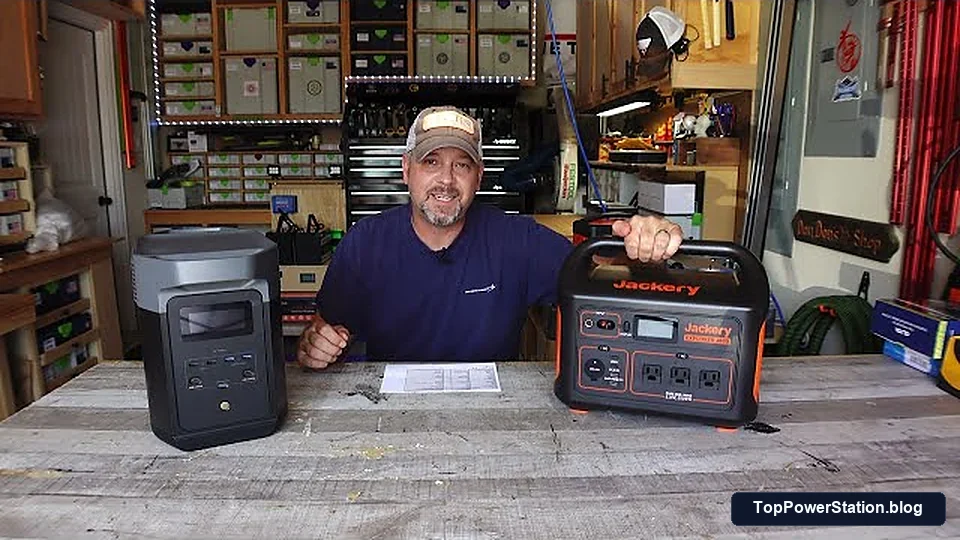
Internal layout design directly influences how efficiently each unit dissipates heat during high-wattage inversions. Engineers at EcoFlow utilize optimized PCB spacing, whereas Jackery relies on heavy-duty aluminum heatsinks for continuous high-output operation.
Examining the internal topology reveals distinct engineering approaches between these two units. EcoFlow utilizes a high-frequency bidirectional inverter architecture, while Jackery employs a robust topology optimized for long-term thermal stability during continuous loads.
Circuit board layouts also differ regarding cooling integration. As noted in our Jackery Explorer 1000 Plus review, that model utilizes an optimized passive airflow channel combined with variable-speed fans.
- Chassis material composition and impact resistance ratings
- Internal cooling fan placement and dynamic speed control
- Inverter transformer efficiency under heavy inductive loads
Chassis Construction And Materials
Both manufacturers employ flame-retardant polymers designed to withstand outdoor jobsite conditions. However, the external ribbing on the Jackery chassis offers superior shock absorption during accidental drops.
Weight distribution is another critical mechanical factor affecting single-handed transport over uneven terrain. EcoFlow balances its internal battery cells centrally, reducing wrist strain while carrying the unit short distances.
- Drop-test survivability across concrete surfaces
- Handle ergonomics and rubberized grip textures
Battery Chemistry And Longevity Profiles
Modern energy storage relies heavily on lithium iron phosphate formulations to ensure consumer safety and longevity. The EcoFlow Delta 2 delivers reliable daily cycling, matching the chemical stability found in premium power banks.
Cycle life claims require careful verification against real-world depth of discharge habits. Users charging these units daily will notice minimal capacity degradation over several years of standard operational use.
Both generators deploy modern LiFePO4 cells to ensure exceptional operational safety and extended lifespans. However, their specific battery management systems dictate different degradation curves when subjected to high-amp discharge cycles over multiple years of field use.
EcoFlow rates its chemistry for 3,000 cycles to retain eighty percent capacity. Similarly, details outlined in our Jackery Explorer 2000 Plus review show advanced thermal management during rapid charging prevents excessive lithium plating.
- Rated charge cycles before reaching capacity thresholds
- Battery Management System protection against thermal runaway
- Self-discharge rates during extended periods of seasonal storage
BMS Safety Protocols And Monitoring
Advanced Battery Management Systems constantly monitor individual cell voltages to prevent catastrophic failure. Both units incorporate multi-stage thermal sensors that throttle output if internal temperatures exceed safe operating limits.
Balancing algorithms ensure uniform wear across every internal cell group during high-amperage charging sessions. This technological precision extends the overall functional lifespan of your energy investment.
- Real-time voltage monitoring across individual cell blocks
- Automatic low-temperature charging cutoff mechanisms
Inverter Output And Surge Capabilities
Delivering stable alternating current requires sophisticated pure sine wave inverter stages. The EcoFlow Delta 2 handles standard household electronics effortlessly, while incorporating proprietary voltage-lowering technology for high-wattage resistive heating devices.
Surge headroom determines whether a power station can successfully start motor-driven compressor loads. Users connecting refrigerators or power tools must evaluate peak startup wattage alongside continuous running draws.
Continuous AC output ratings define what appliances you can safely run simultaneously. For instance, testing inside our Jackery Explorer 1000 V2 review highlights baseline continuous outputs that handle demanding resistance heating devices effectively.
Surge thresholds handle the initial inductive load spike from motorized equipment like refrigerators or sump pumps. EcoFlow uses proprietary X-Boost technology to run certain high-wattage resistive appliances at reduced power, providing greater versatility than traditional pure sine wave inverters.
- Pure sine wave total harmonic distortion performance metrics
- Continuous versus peak surge wattage output thresholds
- Behavior under sudden short-circuit or overload conditions
Handling Inductive And Resistive Loads
Resistive loads like coffee makers demand steady thermal output without tripping internal safety breakers. EcoFlow manages these demands using smart firmware adjustments that gently ramp up power delivery.
Inductive loads present unique challenges due to initial magnetic field generation upon startup. High-tier inverters absorb these instantaneous spikes smoothly without causing voltage drops in sensitive equipment.
- Compressor startup management for portable refrigerators
- Voltage stability under fluctuating household loads
Recharging Speeds And Solar Integration
Grid recharging speed remains a defining competitive advantage in the modern power station market. The EcoFlow Delta 2 utilizes rapid AC input circuitry to replenish capacity from zero in under eighty minutes.
Solar panel integration requires efficient maximum power point tracking controllers to maximize clean energy harvest. Both systems accept wide photovoltaic voltage ranges, simplifying third-party panel compatibility in the field.
Input capabilities dictate how quickly you can replenish depleted energy reserves in emergency scenarios. EcoFlow boasts industry-leading AC charging speeds that reach full capacity in roughly eighty minutes, vastly outpacing standard recharging timelines found on competing models.
Solar panel compatibility depends heavily on open circuit voltage limits and integrated maximum power point tracking controllers. Both units accept high-wattage arrays, but users must verify string voltage parameters to prevent internal charging circuitry damage.
- AC wall outlet rapid charging time benchmarks
- Maximum solar input wattage and voltage limits
- MPPT tracking efficiency during changing weather conditions
Photovoltaic Efficiency And MPPT Performance
Advanced charge controllers ensure optimal energy transfer from portable solar arrays into the battery. Lower conversion losses mean faster replenishment times during partly cloudy outdoor camping excursions.
Connecting multiple solar panels in series requires strict adherence to maximum open-circuit voltage specifications. Exceeding these engineering limits can permanently damage the internal charging circuitry of your unit.
- String voltage limits and wiring configurations
- Low-light tracking sensitivity for dawn and dusk generation
Port Selection And Ergonomic Portability
Physical connectivity dictates how many devices you can charge simultaneously during an emergency. The EcoFlow Delta 2 provides a diverse array of USB-C, USB-A, and AC outlets positioned logically across the front panel.
Ergonomic design considerations extend beyond mere weight to include overall physical dimensions and storage footprint. Units with folding handles pack more efficiently into crowded vehicle trunks during road trips.
Physical interface layouts dictate daily usability during camping trips or job site deployments. The Delta 2 features a comprehensive front-facing port array, whereas Jackery distributes connections to optimize cable management and reduce strain on internal circuit boards.
Carrying handles significantly impact overall field ergonomics when transporting heavy power stations across rugged terrain. Units evaluated in our Jackery solar generator guide demonstrate how handle configurations alter the center of gravity during transport.
- Total count and placement of AC and DC outlets
- USB Power Delivery output wattage for laptops
- Car socket and DC 5521 auxiliary port availability
Interface Layout And Usability
Clear labeling around every port prevents user error in low-light emergency scenarios. Backlit displays offer quick visibility regarding remaining runtime and active power draws without requiring phone interaction.
Dust covers on outdoor-facing ports protect sensitive internal pins from environmental debris and moisture ingress. Regular inspection of these physical barriers ensures reliable electrical contact over time.
- Display legibility under direct sunlight
- Dedicated power button organization for separate zones
Smart App Control And Firmware Management
Digital connectivity transforms basic battery boxes into intelligent energy management hubs. The EcoFlow Delta 2 leverages robust Wi-Fi and Bluetooth protocols to grant remote monitoring access from anywhere with internet.
Regular firmware updates delivered through mobile applications help resolve bugs and optimize charging profiles over time. Users can customize AC charge speeds to preserve battery health during extended storage phases.
Remote monitoring via mobile applications transforms how users interact with their portable power hardware. EcoFlow offers extensive Wi-Fi and Bluetooth connectivity, allowing granular control over charge speeds and automated routines directly from your smartphone interface.
Firmware updates delivered over the air ensure your device receives ongoing algorithm optimizations and safety enhancements. Jackery relies on a simpler Bluetooth connection setup, prioritizing operational stability and straightforward pairing over complex cloud-connected customization features.
- Bluetooth and Wi-Fi connection stability during setup
- Customizable charging speed settings via software
- Remote firmware update deployment and patch notes
Software Interface And Customization
Intuitive mobile dashboards display real-time input and output metrics with high visual clarity. Users can establish custom automation rules based on time-of-use electricity rates or specific weather alerts.
Local Bluetooth control remains functional even when internet connectivity fails during severe regional storms. This redundant communication pathway ensures you never lose administrative oversight over your equipment.
- Time-of-use scheduling features for grid cost savings
- Offline local control via direct Bluetooth pairing
Frequently Asked Questions
Can either power station run a full-sized residential refrigerator?
Yes, both units easily power standard refrigerators for several hours. The EcoFlow Delta 2 uses X-Boost to handle startup surges effectively.
Are these power stations safe to store inside a living area?
Both models utilize stable lithium iron phosphate chemistry and advanced battery management systems. This ensures safe indoor storage without toxic fume emissions.
Can I expand the battery capacity later on?
Yes, both manufacturers offer dedicated expansion batteries that plug directly into the main units. This modular approach doubles your total runtimes significantly.
How do I maximize the operational lifespan of the battery?
Avoid storing the power station at zero percent charge for prolonged periods. Maintaining moderate ambient temperatures during usage preserves chemical integrity.
Do these units support pass-through charging while plugged into the wall?
Yes, both stations allow simultaneous input and output charging safely. This feature lets you use them as uninterruptible power supplies for sensitive electronics.