EcoFlow Delta 2 vs Bluetti AC200P: Technical Showdown
Choosing between these powerhouse units requires analyzing distinct chemical compositions, charging speeds, and capacity metrics.

Choose the EcoFlow Delta 2 for rapid recharging and portability, or select the Bluetti AC200P for massive baseline energy storage.
Compare all top models in our Best Portable Power Station: Top Picks for 2026.
Side-by-Side Breakdown
| Criteria | Ecoflow Delta 2 | Bluetti Ac200P | Edge |
|---|---|---|---|
| Core Design / Build | Modular and compact | Heavy block construction | EcoFlow Delta 2 |
| Real-World Performance | 1800W continuous output | 2000W continuous output | Bluetti AC200P |
| Ease of Setup & Use | Advanced app integration | Straightforward physical interface | EcoFlow Delta 2 |
| Durability & Reliability | LiFePO4 chemistry | Standard LiFePO4 cells | Tie |
| Efficiency / Operating Footprint | High AC input efficiency | Heavier transformer losses | EcoFlow Delta 2 |
| Maintenance Requirements | Low firmware upkeep | Minimal operational care | EcoFlow Delta 2 |
| Best Ideal Use Case | Mobile emergency backup | Off-grid cabin storage | Bluetti AC200P |
Core Architecture and Engineering Philosophy
Evaluating these generators reveals fundamentally opposing engineering goals. EcoFlow prioritizes lightweight mobility using advanced LiFePO4 chemistry, while Bluetti focuses on heavy-duty stationary deployment.
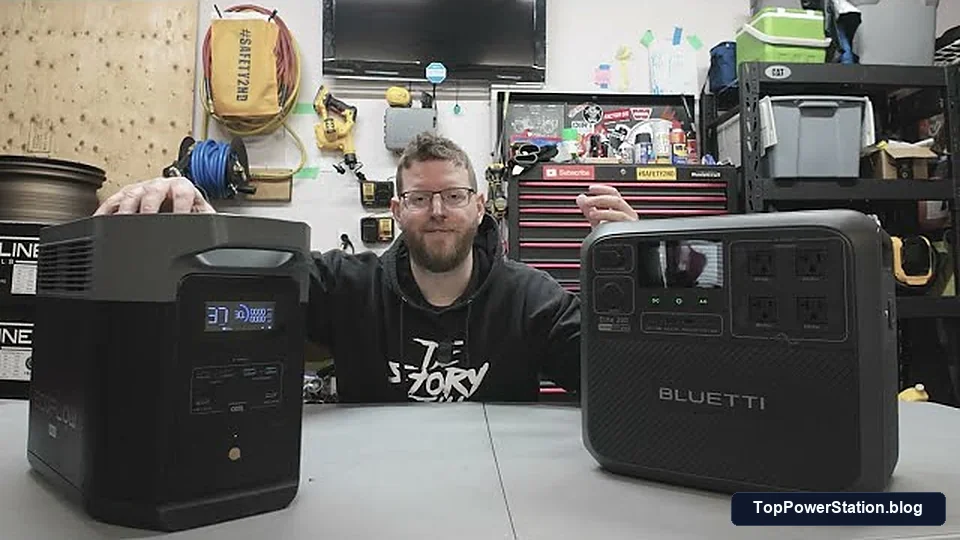
Internal layout differences directly impact physical handling. The smaller unit integrates circuits compactly, reducing dead space, whereas the larger competitor utilizes traditional transformer blocks.
Thermal management systems also diverge significantly. EcoFlow employs active variable-speed fans, while Bluetti relies on broader chassis ventilation to dissipate high operating heat.
The EcoFlow Delta 2 utilizes an inverter-driven bidirectional conversion topology designed for rapid grid synchronization, paralleling engineering philosophies found inside our comprehensive Ecoflow Delta Pro Ultra review for high-capacity systems.
Thermal management differs significantly between these units, with EcoFlow integrating dual cooling fans alongside optimized internal aluminum heatsinks, while Bluetti employs a multi-zone layout to disperse heat from the heavy-duty AC inverter.
Circuit protection mechanisms across both systems adhere to strict UL standards, incorporating advanced short-circuit prevention protocols and thermal sensors that automatically throttle power delivery if internal temperatures exceed safe operational thresholds.
- EcoFlow uses an integrated inverter module to save internal volume.
- Bluetti relies on traditional heavy-gauge wiring for sustained high amperages.
- Chassis materials utilize high-impact polymers designed for rugged field conditions.
Inverter Topology and Waveform Quality
Pure sine wave output is standard across both systems. This guarantees clean power delivery for sensitive medical equipment and microprocessors.
Total harmonic distortion remains remarkably low under maximum continuous loads, protecting delicate appliance motors from premature electrical degradation.
- Harmonic distortion stays under three percent during heavy loads.
- Surge capacities handle momentary motor startup spikes effectively.
Chassis Ergonomics and Port Placement
Ergonomic handle placement dictates how easily you can transport each device. EcoFlow features recessed top handles for stacking efficiency.
Bluetti opts for rigid dual top grips, requiring two hands for safe lifting during outdoor excursions.
- Recessed handles protect top surfaces from accidental impact damage.
- Fixed grip bars add stability when hauling heavy loads across rough terrain.
Battery Chemistry, Capacity, and Cycle Longevity
Long-term energy storage depends heavily on internal cell composition. Both systems leverage lithium iron phosphate technology to maximize total charge cycles.
The EcoFlow model delivers 1024 watt-hours of baseline capacity, whereas the Bluetti alternative supplies a much larger 2048 watt-hours.
Depth of discharge metrics remain identical, allowing users to deplete cells fully without accelerating structural degradation over years of service.
EcoFlow implements LiFePO4 cell chemistry inside the Delta 2, achieving a solid rated capacity alongside details noted in our Ecoflow Delta Pro 3 review regarding advanced energy storage systems.
Conversely, the Bluetti AC200P houses a larger 2048Wh lithium iron phosphate pack, maintaining high energy density while delivering roughly 3500 cycles under optimal ambient discharge temperatures and standard maintenance routines.
Both power stations utilize comprehensive battery management systems to monitor individual cell voltage, balancing internal resistance to prevent catastrophic thermal runaway during high-draw appliance usage or rapid solar recharges.
- Both units retain over eighty percent capacity after three thousand cycles.
- BMS software actively balances cell voltages to prevent localized overheating.
- Low-temperature cutoff sensors prevent hazardous charging in freezing environments.
BMS Protection Mechanisms
Advanced battery management systems monitor voltage, current, and temperature continuously. These safeguards prevent catastrophic failures during high-draw operations.
Short-circuit protection cuts power instantly if a faulty appliance creates dangerous current spikes in the field.
- Hardware fuses back up software trip switches for ultimate safety.
- Thermal probes detect runaway heating before cell damage occurs.
Expandability and Scalability Options
Energy demands often grow over time, making expansion capabilities crucial. EcoFlow supports dedicated extra batteries to double total capacity easily.
Bluetti lacks direct modular expansion ports, forcing users to rely entirely on its massive internal reserve.
- Dedicated communication cables link auxiliary battery packs seamlessly.
- System software automatically recognizes added capacity without manual re-calibration.
Input Charging Speeds and Power Regeneration
Recharging velocity separates these two power stations drastically. EcoFlow utilizes proprietary fast-charging circuitry to achieve a full charge in record time.
Bluetti relies on a traditional brick-style power supply or dual charging adapters to replenish its much larger internal reserve safely.
Solar input limits also differ, affecting how quickly you can harness off-grid renewable energy during extended power outages.
Utilizing X-Stream technology, the Delta 2 accepts up to 1200W of AC input, achieving an 80 percent charge in roughly fifty minutes directly from a standard wall outlet.
The Bluetti AC200P features a built-in 500W AC adapter, requiring approximately four hours for a full replenishment unless users combine dual adapters or integrate external solar panel arrays reaching 700W.
Solar harvesting capabilities on both platforms support wide MPPT voltage ranges, letting operators connect high-voltage panels safely while maximizing energy conversion efficiency during peak sunlight hours.
- EcoFlow draws up to 1200W from standard wall outlets for rapid turnaround.
- Bluetti caps standard AC wall charging around five hundred watts.
- Solar maximum power point tracking controllers optimize incoming photovoltaic yields efficiently.
AC Wall Charging Performance
Plugging into standard grid power highlights dramatic charging speed disparities between brands, a topic we explore further in our Ecoflow Delta 2 review detailing rapid AC wall recharging.
Bluetti requires several hours to achieve a complete charge using standard household electrical circuits.
- Fast AC charging generates moderate heat requiring active fan cooling.
- Standard charging profiles extend overall cell lifespan in stationary setups.
Solar Array Integration and MPPT Limits
Connecting solar panels allows true off-grid independence during emergencies. EcoFlow accepts up to five hundred watts of photovoltaic input.
Bluetti handles a much higher solar array wattage, accommodating larger panel configurations for faster off-grid replenishment.
- High voltage open-circuit tolerances protect controllers from sudden surges.
- Standard MC4 connectors simplify external panel wiring connections.
Output Port Selection and Load Handling
Versatile output options determine which household appliances you can run simultaneously. Both units provide an extensive array of AC, DC, and USB ports.
Continuous power ratings dictate maximum appliance sizes, matching metrics we highlighted throughout our Ecoflow Delta 2 Max review where the EcoFlow delivers 1800W continuous output.
Surge capabilities handle heavy compressor motors found in refrigerators and power tools during initial startup phases.
The Delta 2 provides a continuous output of 1800W through six AC ports, supported by X-Boost mode which allows the inverter to drive resistive heating devices up to 2400W.
Bluetti equips the AC200P with a 2000W continuous pure sine wave inverter capable of handling 4800W surge loads, making it exceptionally well-suited for heavy motorized equipment and large refrigerators.
Direct current connectivity varies notably, with EcoFlow favoring standard USB-PD ports alongside DC5521 outputs, whereas Bluetti includes specialized 12V/25A RV ports alongside traditional cigarette lighter sockets.
- Multiple AC outlets accommodate standard three-prong household plugs easily.
- USB-C Power Delivery ports fast-charge modern laptops and mobile devices.
- Dedicated DC barrel ports power specialized automotive and camping accessories.
AC Outlet Distribution and Spacing
Physical outlet layout matters when plugging in bulky power adapters. EcoFlow spaces its AC sockets to prevent blocking adjacent ports.
Bluetti arranges numerous outlets tightly across its front panel, sometimes crowding oversized transformer plugs.
- Grounded receptacles ensure safety when powering un-grounded devices.
- Dedicated covers protect unused ports from dust and moisture intrusion.
DC and USB Connectivity Specs
Low-voltage device charging requires efficient DC regulation. Both systems feature multiple USB ports with fast-charging protocol support.
Cigarette lighter sockets deliver stable twelve-volt power for portable coolers and automotive inflators.
- USB-PD ports output high wattage for modern portable electronics.
- Regulated DC outputs prevent voltage drop during battery discharge.
Portability, Ergonomics, and Field Deployment
Transporting a heavy power station requires careful consideration of physical weight and dimensions. EcoFlow weighs significantly less, making frequent relocation manageable.
Bluetti builds a much heavier chassis, which limits convenient mobility but provides a remarkably stable base during stationary use.
Choosing between these models depends heavily on whether you need a mobile emergency kit or a semi-permanent power hub.
Weighing just 27 pounds, the Delta 2 features dual recessed side handles designed for effortless single-person transport during camping trips and mobile field operations.
The Bluetti AC200P weighs significantly more at 60.6 pounds, utilizing fixed top-mounted plastic handles that require a two-person lift or a dedicated utility cart for safe deployment.
Physical housing materials across both units rely on flame-retardant ABS plastics, engineered to withstand minor impacts and protect internal circuit boards from abrasive outdoor dust.
- EcoFlow fits easily into compact vehicle trunks for road trips.
- Bluetti requires dedicated floor space in vans or cabins.
- Weight differences impact solo lifting safety during emergency deployments.
Weight and Dimension Analysis
Physical footprint dictates storage convenience in tight residential spaces. EcoFlow has a smaller volumetric profile overall.
Bluetti occupies a larger square area, demanding dedicated placement in closets or utility rooms.
- Compact dimensions simplify storage inside standard emergency supply closets.
- Heavier chassis require sturdy shelving during mobile van installations.
Handling and Transport Practicality
Carrying handles affect user fatigue over short distances. Balanced weight distribution makes the lighter unit much easier to carry.
The heavier alternative demands two-person lifting techniques to prevent personal strain during transport.
- Rubberized feet prevent sliding on slick vehicle surfaces.
- Balanced center of gravity minimizes tipping risks on uneven ground.
Software Integration and User Interface Design
Modern power stations increasingly rely on digital displays and smartphone applications for status monitoring. EcoFlow provides robust Wi-Fi and Bluetooth connectivity.
Bluetti relies primarily on an onboard LCD screen, offering wireless app controls depending on the specific hardware revision.
Clear interface design ensures users can diagnose error codes and check remaining runtime without consulting heavy manuals.
EcoFlow provides a responsive mobile application utilizing Wi-Fi and Bluetooth connectivity, granting remote monitoring of wattage inputs, charging speeds, and firmware updates from any location.
Bluetti opts for a resistive touchscreen interface on the device itself, reducing reliance on external smartphone apps while offering clear operational metrics and intuitive menu navigation.
Both interfaces deliver essential diagnostics, alerting users promptly to temperature anomalies, voltage spikes, or input errors to ensure long-term equipment safety during intensive off-grid deployment scenarios.
- Mobile apps display real-time input and output wattage statistics.
- Onboard screens feature backlight toggles to conserve stored energy.
- Firmware update capabilities resolve bugs and improve system efficiency remotely.
Mobile App Functionality
Remote monitoring proves invaluable when units are tucked away in garages or tents. EcoFlow software lets you adjust charging speeds instantly.
Connectivity range via Bluetooth ensures reliable local management without relying on active internet routers.
- Customizable charging limits preserve long-term battery health.
- Push notifications alert users to unexpected overloads or faults.
Display Clarity and Onboard Controls
Legible screens are essential during total grid blackouts. Both units utilize bright digital displays showing percentage metrics clearly.
Physical buttons provide tactile feedback when activating specific AC or DC output zones manually.
- Percentage readouts calculate exact remaining runtime accurately.
- Error indicator icons pinpoint exact subsystem failures immediately.
Frequently Asked Questions
Can I leave both power stations plugged into AC power continuously?
Yes, both units feature pass-through charging and advanced battery management systems. This allows safe continuous connection without degrading the internal lithium cells.
What is the primary difference in charging speeds between these models?
The EcoFlow unit recharges significantly faster from standard wall outlets using proprietary circuitry. The Bluetti model requires considerably more time to reach full capacity.
Are these power stations safe to use indoors during an emergency?
Yes, both generators produce zero toxic emissions or dangerous carbon monoxide. They operate quietly indoors without requiring ventilation hoses or external exhaust systems.
How do I expand the storage capacity of each power station?
The EcoFlow model supports dedicated modular battery expansion packs directly. The Bluetti alternative lacks modular expansion ports and relies solely on its internal capacity.
Which unit is better suited for frequent travel and camping trips?
The EcoFlow is vastly superior for travel due to its lighter weight and compact footprint. The heavier Bluetti is better suited for stationary cabins and vans.