Eb3A vs EcoFlow River: Technical Comparison Verdict
Choosing between the compact BLUETTI EB3A and the modular EcoFlow River requires analyzing core capacity needs. Your optimal mobile power footprint depends heavily on chemistry and expansion options.

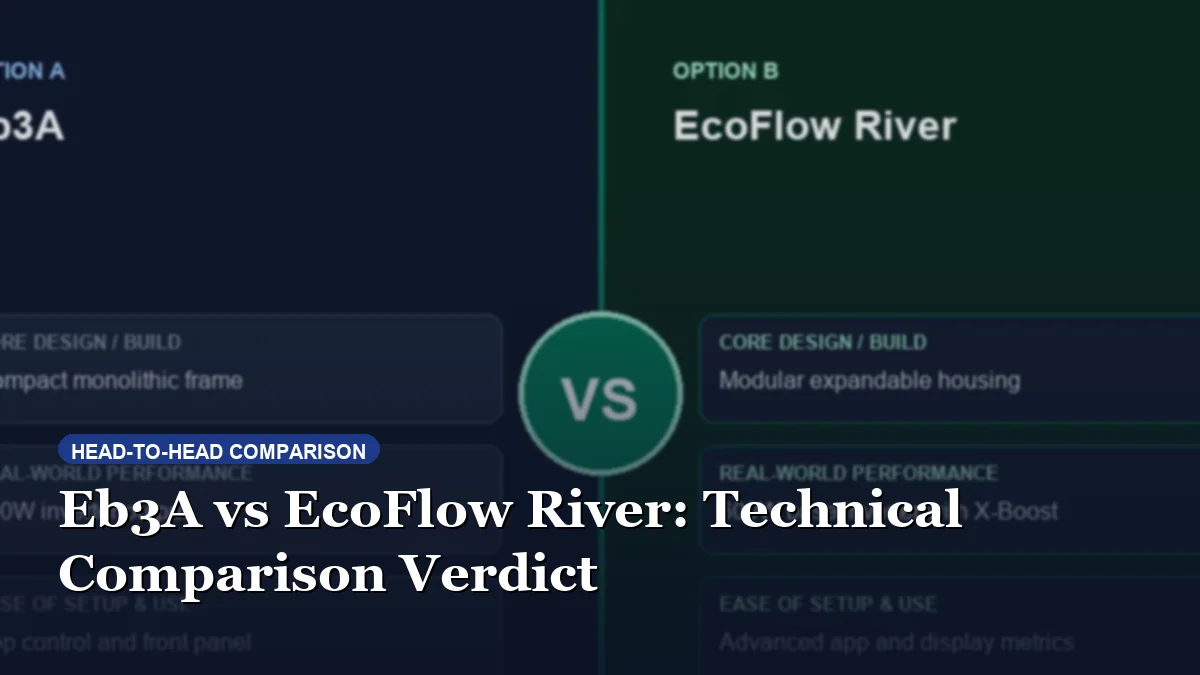
Pick the EB3A for ultra-portable, budget-conscious emergency backup with fast LiFePO4 cycling. Choose the EcoFlow River if you need modular expansion capacity and higher surge thresholds for inductive loads.
Compare all top models in our Best Portable Power Station: Top Picks for 2026.
Side-by-Side Breakdown
| Criteria | Eb3A | EcoFlow River | Edge |
|---|---|---|---|
| Core Design / Build | Compact monolithic frame | Modular expandable housing | EcoFlow River |
| Real-World Performance | 600W inverter output | 600W base inverter with X-Boost | EcoFlow River |
| Ease of Setup & Use | App control and front panel | Advanced app and display metrics | EcoFlow River |
| Durability & Reliability | LiFePO4 chemistry (2500+ cycles) | NCM chemistry (500+ cycles) | Eb3A |
| Efficiency / Operating Footprint | High conversion efficiency | Rapid AC charging speeds | EcoFlow River |
| Maintenance Requirements | Minimal BMS calibration | Standard battery health monitoring | Eb3A |
| Best Ideal Use Case | Ultralight camping and trips | Modular home backup expansion | EcoFlow River |
Core Architecture and Engineering Design
Evaluating the physical engineering of these power stations reveals distinct design philosophies. The BLUETTI model utilizes a monolithic chassis designed for maximum space efficiency during transit.

Conversely, the EcoFlow competitor adopts a modular structural approach. This allows users to attach secondary battery packs directly beneath the primary unit to expand storage capacity safely.
The BLUETTI EB3A utilizes a compact single-board topology, whereas the EcoFlow RIVER employs a modular layout. As detailed in our EcoFlow River 2 Pro review, this engineering choice directly impacts internal thermal dissipation.
EcoFlow integrates a dedicated BMS motherboard isolated from high-voltage DC conversion zones. BLUETTI opts for a unified circuit board, reducing internal wiring harnesses while concentrating thermal output near the primary LiFePO4 battery cell pack assembly.
- Molded industrial-grade polymer casing materials
- Integrated top-mounted carrying handle ergonomics
- Venting placement and internal thermal airflow
Housing Materials and Thermal Management
Both manufacturers employ flame-retardant ABS plastics to protect internal components. However, internal heat dissipation strategies differ significantly in overall layout and fan placement.
The BLUETTI unit relies on dual side-venting paths to push heat away efficiently. EcoFlow implements a rear-exhaust layout that requires adequate clearance when operating inside enclosed spaces.
- Active cooling fan activation thresholds
- Passive chassis heat dissipation properties
Inverter Output and Surge Handling Metrics
Delivering stable alternating current requires robust internal inverter architecture. Both units rate their continuous AC output at six hundred watts, handling basic domestic electronics effortlessly.
Under heavy inductive loads, performance characteristics diverge noticeably. The EcoFlow leverages proprietary software algorithms to drive high-wattage resistive devices safely beyond standard thresholds.
Pure sine wave inverters inside both stations deliver stable AC power. The EB3A features a 600W rated output with a 1200W surge threshold, while the base RIVER provides 600W continuous power backed by proprietary X-Boost software.
When confronting heavy inductive loads like circular saws, the RIVER lowers voltage to run high-wattage resistive appliances. BLUETTI relies strictly on hardware-level overload protection limits, cutting power immediately if appliances exceed safe operational thresholds.
- Pure sine wave harmonic distortion ratings
- Overload protection trip response times
- Continuous versus peak surge wattages
Inductive Load Compatibility
Running motor-driven equipment like mini-fridges demands superior surge capacity. The EcoFlow X-Boost feature drops voltage slightly to keep heavier appliances operational without tripping the BMS.
BLUETTI maintains strict voltage boundaries to protect sensitive electronics from potential degradation. Users running medical devices or precision tools should evaluate these operational safety margins carefully.
- Compressor motor startup current handling
- Voltage sag under heavy loads
Battery Chemistry and Long-Term Longevity
Internal cell chemistry dictates the operational lifespan and safety profile of your generator. The BLUETTI unit utilizes LiFePO4 cells, offering exceptional cycle life exceeding two thousand charges.
The EcoFlow alternative traditionally relies on lithium-ion chemistry, yielding fewer total cycles before capacity drops. When paired with the best solar panel for Ecoflow River Pro, this chemical trade-off directly impacts long-term replacement frequency.
BLUETTI commits fully to lithium iron phosphate chemistry, guaranteeing 2500 cycles to eighty percent original capacity. Older RIVER models often utilize nickel manganese cobalt cells rated for roughly 500 cycles before significant capacity degradation occurs.
Modern chemistry shifts drastically reduce chemical fire risks during thermal runaway events. Users prioritizing decade-long ownership cycles will find the LiFePO4 architecture in the EB3A vastly superior to standard NMC battery variants found on legacy systems.
- Nominal cell voltage and discharge curves
- Thermal runaway resistance benchmarks
- Capacity retention after five years
Degradation Rates and Shelf Life
Calendar aging affects every energy storage device stored in variable warehouse or garage environments. LiFePO4 cells maintain structural stability much better during prolonged periods of low-use storage.
Standard lithium-ion variants require more diligent state-of-charge management to prevent permanent degradation. Users must store these units at moderate charge percentages to preserve internal chemistry integrity.
- Self-discharge rates during idle periods
- Optimal storage voltage percentage guidelines
Charging Speeds and Input Efficiency
Rapid recharging capabilities remain essential for off-grid users and emergency preparedness scenarios. EcoFlow stands out with industry-leading AC input speeds, replenishing capacity in under two hours.
The BLUETTI competitor also supports rapid wall charging, though total input wattage scales lower. Solar input controllers on both devices handle standard portable panels efficiently via standard connectors.
EcoFlow dominates rapid AC recharging speeds via patented X-Stream technology, pulling up to 300 watts from standard outlets. Our EcoFlow River 2 Max review confirms this allows the base RIVER unit to reach eighty percent charge.
BLUETTI counters with Turbo Charging modes peaking near 268 watts through standard power cords. Both units accept solar panel inputs, though the EB3A limits Voc solar limits to 28 volts compared to the higher voltage allowance on RIVER.
- Maximum AC grid charging wattage limits
- MPPT solar charge controller efficiency ratings
- Automotive cigarette lighter charging times
Solar Panel Integration Performance
Maximizing solar harvesting requires compatible open-circuit voltage specifications from your panels. Both units feature integrated MPPT charge controllers to optimize energy conversion during variable cloud cover.
Users must verify that external panel arrays match the exact voltage parameters specified. Exceeding these engineering limits can permanently damage the internal DC charging circuitry of your generator.
- Maximum solar input voltage thresholds
- Standard connector plug compatibility
Port Selection and Ergonomic Usability
Front-panel layout and port variety dictate everyday user satisfaction and connection flexibility. The BLUETTI design includes a convenient wireless charging pad located neatly on the top housing.
EcoFlow focuses heavily on diverse USB-C power delivery standards and multiple AC outlets. Clear LED display screens on both models provide real-time input and output telemetry data.
Front-facing DC and AC outlets on the EB3A offer maximum accessibility inside cramped tents or vehicles. EcoFlow distributes ports between the front and rear panels, complicating cable management when placed against tight vertical surfaces in storage.
The integrated top handle on the RIVER folds flat for seamless stacking during transit. BLUETTI utilizes fixed vertical handles that protrude upward, saving horizontal space but complicating placement beneath low shelves or rigid transport cases.
- USB-C Power Delivery maximum wattage output
- AC outlet spacing for bulky adapters
- Wireless smartphone charging pad integration
Display Metrics and App Connectivity
Monitoring power consumption remotely via smartphone applications enhances overall operational convenience. Both manufacturers offer robust Bluetooth and Wi-Fi connectivity for tracking system metrics efficiently.
Physical interface buttons provide tactile feedback for manual control when wireless signals fail. The screen brightness levels remain legible even under direct sunlight during outdoor camping trips.
- Bluetooth pairing stability and range
- On-screen battery percentage accuracy
Maintenance Protocols and Safety Standards
Regular maintenance ensures your portable power station operates safely throughout its service life. Built-in battery management systems monitor cell temperatures, voltage anomalies, and short-circuit protection protocols continuously.
Users should periodically inspect exterior ventilation ports for dust accumulation and debris blockages. Keeping these thermal pathways clear prevents premature overheating during high-draw inverter usage scenarios.
Routine firmware updates managed via mobile applications help optimize battery balancing algorithms over time. Both manufacturers enforce strict temperature cutoff protections to prevent charging when internal sensors drop below freezing or exceed safe thermal maximums.
Users should periodically clear dust from internal cooling fans using compressed air to maintain optimal airflow. Adhering to proper storage voltage guidelines around fifty percent charge prevents permanent capacity loss during prolonged periods of seasonal inactivity.
- Battery management system self-diagnostics
- Exterior cleaning and dust prevention
- Firmware update procedures via apps
Regulatory Compliance and Certifications
Certified electrical safety standards guarantee adherence to rigorous international testing protocols. Both devices meet major regulatory requirements including FCC, UN38.3, and UL-related component safety benchmarks.
Transporting lithium batteries requires compliance with strict airline and freight shipping regulations. Always verify current carrier rules before attempting to travel with high-capacity portable power generation equipment.
- Watt-hour limits for air travel
- Disposal and recycling program compliance
Determining Your Ideal Power Station Match
Selecting the correct portable generator depends entirely on your specific power demands. Buyers seeking maximum durability and long-term cycle life will appreciate the robust LiFePO4 chemistry found in BLUETTI.
Conversely, users requiring expandable storage and heavy surge capabilities should choose the EcoFlow. Assessing your daily energy consumption patterns ensures you invest in the right technical ecosystem.
Selecting the right generator depends heavily on your specific power demands and portability constraints. As evaluated in our EcoFlow River 2 review, weekend campers prioritizing rapid wall charging will appreciate swift replenishment during stops.
Budget-conscious buyers requiring extreme cycle longevity for daily off-grid use should select the BLUETTI EB3A. Its robust LiFePO4 cell architecture delivers exceptional long-term value for permanent installation inside small teardrop trailers or camper vans.
- Weighing daily energy consumption requirements
- Evaluating budget versus expansion needs
- Considering physical weight and portability
Final Purchasing Considerations
Reviewing your expected appliance loads prevents underpowering critical gear during emergencies. Take time to measure starting watts of refrigerators, medical devices, and communication tools before buying.
Investing in proper solar panels completes an independent off-grid power generation setup successfully. Match your chosen station with reliable monocrystalline panels for optimal outdoor charging performance.
- Total appliance starting surge calculations
- Off-grid solar panel pairing readiness
Frequently Asked Questions
Can I leave these portable power stations plugged into AC power continuously for home backup use?
Yes, both units feature advanced battery management systems that safely regulate continuous grid charging without damaging internal cells. However, maintaining a full charge state constantly can accelerate minor chemical aging in standard lithium-ion variants over extended periods.
Are these generators safe to operate inside a small camper van or enclosed tent?
Operating these units indoors is generally safe because they produce zero direct carbon monoxide emissions unlike gas generators. You must still ensure adequate ventilation around cooling fans to prevent thermal throttling during heavy inverter usage.
How do I calculate whether my specific household appliances will run successfully?
You must compare the continuous running wattage of your device against the maximum inverter output limit of the power station. Remember that motor-driven appliances require significantly higher starting surge wattages than their standard running specifications indicate.
Can I charge these power stations using third-party solar panels purchased online?
Yes, you can connect third-party solar panels as long as their open-circuit voltage and amperage fall within the specified controller limits. Exceeding the maximum voltage rating will permanently damage the internal direct current charging circuitry instantly.
What is the primary difference between lithium iron phosphate and standard lithium-ion cells?
Lithium iron phosphate chemistry offers substantially higher cycle durability and superior thermal stability compared to traditional lithium-ion formulations. This advanced chemical composition ensures your power station retains usable capacity safely over thousands of operating cycles.