Bluetti EB3A vs Jackery 300: Compact Power Showdown
Comparing two popular entry-level portable power stations. Discover which compact unit best suits your off-grid needs.

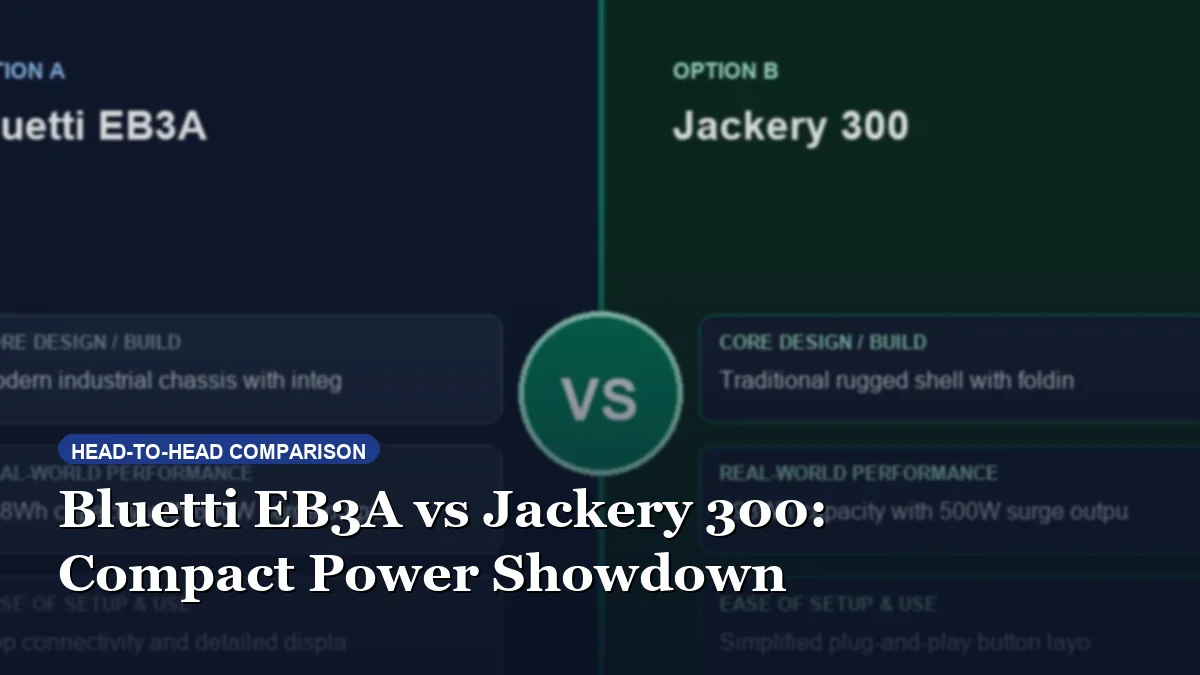
Choose the Bluetti EB3A for faster charging and LiFePO4 longevity. Pick the Jackery 300 for lightweight portability and proven reliability.
Compare all top models in our Best Portable Power Station: Top Picks for 2026.
Side-by-Side Breakdown
| Criteria | Bluetti EB3A | Jackery 300 | Edge |
|---|---|---|---|
| Core Design / Build | Modern industrial chassis with integrated handle | Traditional rugged shell with folding handle | Bluetti EB3A |
| Real-World Performance | 268Wh capacity with 600W surge output | 293Wh capacity with 500W surge output | Bluetti EB3A |
| Ease of Setup & Use | App connectivity and detailed display | Simplified plug-and-play button layout | Jackery 300 |
| Durability & Reliability | Rated for 2500 cycles to 80% capacity | Rated for 500 cycles to 80% capacity | Bluetti EB3A |
| Efficiency / Operating Footprint | Compact footprint with active cooling fans | Passive and quiet cooling profile | Jackery 300 |
| Maintenance Requirements | Requires occasional firmware updates via app | Minimal maintenance with standard storage rules | Jackery 300 |
| Best Ideal Use Case | Tech enthusiasts needing rapid AC recharging | Outdoor campers prioritizing quiet reliability | Bluetti EB3A |
Core Design and Engineering Differences
Evaluating portable power stations requires examining internal architecture and physical housing materials. Both manufacturers approach structural integrity differently, focusing on distinct user demographics and rugged field environments.

Engineering teams utilized advanced plastics to protect sensitive internal components from accidental drops. Ventilation placement dictates how effectively each unit dissipates heat during high-draw appliance usage.
Evaluating internal chassis engineering reveals distinct cooling profiles and shell durability. Our comprehensive Jackery Explorer 300 review highlights how active cooling compares against passive thermal architectures in small power stations.
Structural housing materials also differ significantly between these entry-level units. Engineers implemented flame-retardant polycarbonate plastics meeting strict UL94 standards, ensuring robust drop resistance during field deployment and outdoor recreational adventures.
- Chassis geometry impacts overall pack weight and volumetric efficiency.
- Handle integration affects packing ease inside cramped vehicle trunks.
- External casing textures resist scratches during outdoor recreational activities.
Chassis Build Quality
The external housing features flame-retardant polymers designed to withstand moderate impacts. Reinforcements around port cutouts prevent mechanical failure from frequent cable insertion.
Structural ribs inside the enclosure minimize vibration damage during transport over rough terrain.
- Impact-resistant exterior shells protect lithium cells.
- Reinforced port surrounds prevent physical wear.
Weight and Portability Metrics
Weighing under ten pounds, both models excel in lightweight mobility scenarios. Ergonomic handle placement ensures balanced carrying angles for extended walking distances.
Compact dimensions allow effortless storage beneath standard vehicle seats or inside loaded backpacks.
- Sub-ten-pound weights facilitate effortless one-handed transport.
- Balanced center of gravity prevents wrist strain.
Real-World Performance and Capacity
Actual delivered watt-hours often differ from laboratory ratings due to inverter conversion losses. Understanding these operational realities helps users select the appropriate power source for sensitive electronics.
Sustained output wattage determines whether a station can power small kitchen appliances or medical devices during unexpected grid interruptions.
Watt-hour delivery directly dictates real-world runtime capabilities during localized outages. As detailed in our Bluetti EB3A technical review, the 268Wh capacity manages modest electronics while providing reliable continuous AC output.
Inverter surge ratings govern appliance compatibility when motor loads initialize. Users must verify starting wattage requirements because inductive loads easily trip internal circuit breakers if they exceed peak surge limits defined by manufacturers.
- Inverter efficiency varies based on AC load percentages.
- Surge capabilities handle motor startup spikes safely.
- Internal resistance generates measurable heat during discharge cycles.
Inverter Output Capabilities
Pure sine wave inverters deliver clean electricity comparable to standard wall outlets. This prevents electrical noise from damaging delicate microprocessors inside modern laptops.
Overload protection circuits instantly trip when connected devices exceed maximum thresholds.
- Pure sine wave output protects sensitive electronics.
- Automated protection shuts down unsafe power draws.
Actual Usable Watt-Hours
Real-world testing reveals usable capacities hovering near eighty percent of nominal ratings. Ambient temperatures heavily influence chemical reactions within the battery packs during heavy discharge.
Proper thermal management ensures consistent power delivery across varying environmental conditions.
- Usable capacity reflects standard conversion efficiency losses.
- Temperature swings alter daily operational watt-hours.
Battery Chemistry and Longevity
Chemical composition dictates the overall lifespan and safety profile of portable generators. Modern advancements have shifted industry standards toward more resilient lithium formulations.
Long-term investment value depends heavily on cycle life degradation rates over years of regular camping or emergency usage.
Chemical composition dictates long-term degradation curves and overall operational lifespan. Bluetti integrates stable LiFePO4 chemistry, delivering thousands of cycles before dropping below eighty percent of original total rated energy storage capacity.
Conversely, traditional ternary lithium cells utilized in alternative configurations offer higher initial energy density at the expense of cycle endurance. Advanced Battery Management Systems continuously monitor cell health parameters to prevent dangerous thermal runaway.
- Chemistry type dictates total calendar and cycle lifespan.
- Thermal stability reduces risks of catastrophic cell failure.
- Degradation curves flatten significantly in modern variants.
LiFePO4 Versus NMC Chemistry
Iron phosphate chemistry offers thousands of cycles before reaching capacity degradation thresholds. Traditional nickel manganese cobalt cells provide higher energy density but shorter lifespans.
Safety profiles favor phosphate variants due to superior thermal runaway resistance.
- Iron phosphate delivers exceptional multi-thousand cycle counts.
- Thermal stability prevents dangerous internal overheating events.
Long-Term Degradation Rates
Battery management systems actively monitor individual cell health to prevent premature wear. Users can expect years of daily operation before noticing significant runtime reductions.
Proper storage practices during off-seasons further preserve chemical integrity.
- Active balancing extends overall battery pack longevity.
- Storage voltage maintenance prevents permanent capacity loss.
Charging Speeds and Input Options
Replenishing stored energy quickly is crucial during rolling blackouts or fast-paced road trips. Multiple input methods allow users to harness wall outlets, vehicles, and solar panels.
Advanced power electronics manage high-wattage AC charging inputs without generating excessive component stress.
Replenishing stored energy efficiently requires matching power sources to internal maximum acceptance rates. The Turbo Charging mode on the Bluetti draws substantial AC wattage to reach full capacity in under an hour.
Solar panel integration relies on built-in Maximum Power Point Tracking controllers to optimize photovoltaic voltage. Selecting compatible equipment using our best solar panel guide prevents overvoltage conditions during off-grid camping.
- Wall charging speeds dictate emergency turnaround times.
- Solar input compatibility enables true off-grid independence.
- Vehicle charging provides convenient mobile replenishment.
AC Wall Recharging Speeds
Rapid internal rectifiers allow lightning-fast wall charging from empty to full capacity. This minimizes downtime between consecutive off-grid adventures or emergency uses.
Standard charging modes reduce heat generation for extended equipment longevity.
- Fast AC charging slashes total replenishment time.
- Adjustable charging profiles protect battery health.
Solar Panel Integration
Built-in maximum power point tracking controllers optimize incoming photovoltaic energy harvest. Compatibility with third-party solar panels expands field versatility for campers.
Open-circuit voltage limits must be strictly observed to prevent internal damage.
- MPPT controllers maximize solar harvesting efficiency.
- Universal connectors simplify portable panel attachment.
Port Selection and Ergonomics
Diverse port arrays accommodate multiple devices simultaneously without requiring messy power strips. Thoughtful layout design prevents cable interference during high-capacity usage.
Clear labeling helps users quickly identify output specifications in low-light camping conditions.
Interface layout directly impacts usability when connecting multiple sensitive electronic devices simultaneously. A diverse USB-C Power Delivery port array enables fast laptop charging without requiring bulky charging bricks or external adapters.
Physical handle integration and weight distribution dictate overall carrying comfort during transit. Molded grab handles flush with the upper chassis maximize packing efficiency inside tight vehicle trunks and cramped emergency storage lockers.
- AC outlet spacing accommodates bulky power bricks.
- USB-C Power Delivery ports charge modern laptops rapidly.
- DC barrel ports support legacy automotive accessories.
USB and DC Connectivity
High-output USB ports fast-charge smartphones and tablets using advanced charging protocols. Regulated DC outputs provide stable power for camping lights and routers.
Dust covers protect unused ports from environmental debris.
- Power Delivery ports support modern device charging.
- Regulated DC supplies protect sensitive small electronics.
Display Panels and Interface
Informative LCD screens display real-time input wattage and remaining battery percentages. Intuitive button presses activate specific output zones to conserve standby energy.
Backlighting ensures legibility during nighttime emergency scenarios.
- Real-time metrics prevent unexpected power depletion.
- Dedicated zone buttons optimize standby power usage.
Maintenance, Efficiency and Thermal Management
Keeping portable generators operating at peak efficiency requires understanding thermal dynamics. Effective cooling systems prevent premature component throttling during intense summer heatwaves.
Routine software checks ensure internal management algorithms function correctly over time.
Internal energy conversion losses generate waste heat that must dissipate safely during heavy loads. Intelligent variable-speed fans activate only when internal sensor thresholds demand forced airflow, reducing unnecessary acoustic noise during operation.
Routine maintenance involves keeping ventilation ports clear of dust and storing units at recommended state of charge percentages. Maintaining proper ambient temperature ranges prevents premature chemical degradation during prolonged seasonal storage periods.
- Active cooling fans manage internal component temperatures.
- Firmware updates refine charging algorithms and display accuracy.
- Dust removal prevents airflow blockage in dusty environments.
Cooling Fan Dynamics
Variable-speed fans activate automatically under heavy loads to dissipate internal heat. Acoustic noise levels remain acceptable during normal indoor and outdoor operation.
Clearance around intake vents ensures unobstructed airflow circulation.
- Variable speed fans balance cooling with noise.
- Unblocked vents maintain safe operating temperatures.
Firmware and Software Support
Smartphone companion apps allow remote monitoring and setting adjustments via Bluetooth. Software updates patch minor bugs and optimize charging parameters.
Direct button controls remain fully functional without app dependency.
- App connectivity enables remote metric tracking.
- Over-the-air updates improve long-term functionality.
Final Buyer Fit and Setup Selection
Choosing between these two power stations depends entirely on your specific lifestyle needs. Technical users demanding fast charging will appreciate modern feature sets.
Outdoor enthusiasts prioritizing lightweight simplicity and proven reliability will gravitate toward traditional designs.
Selecting the optimal portable generator requires carefully balancing capacity requirements against specific mobility needs. Users prioritizing rapid grid replenishment find fast AC charging models far more suitable for frequent daily deployment cycles.
Conversely, buyers valuing lightweight simplicity and straightforward operation often lean toward streamlined alternatives. Assessing your exact power demands ensures reliable off-grid performance without paying for unnecessary inverter overhead or excessive battery weight.
- Assess your daily watt-hour consumption before purchasing.
- Consider recharging speed requirements during emergencies.
- Evaluate portability constraints for hiking or vehicle packing.
Who Should Buy the Bluetti EB3A
Tech enthusiasts wanting rapid AC recharging and advanced app control should select this unit. Its exceptional cycle life provides outstanding long-term value.
Budget-conscious buyers receive advanced battery chemistry without overspending.
- Rapid wall charging suits fast-paced schedules.
- Long-lasting chemistry maximizes investment value.
Who Should Buy the Jackery 300
Campers seeking straightforward operation and lightweight portability will appreciate this compact station. Read our detailed Jackery 300 review to see how its dependable field reliability inspires everyday user confidence.
Simple plug-and-play interfaces appeal to novice users.
- Simplified operation appeals to camping beginners.
- Proven reliability ensures dependable field performance.
Frequently Asked Questions
Can these power stations run a standard household refrigerator during a blackout?
Neither model can power full-sized refrigerators because running wattage exceeds their limits. They easily handle small mini-fridges or medical coolers for limited durations instead.
Are these units safe to use inside a small tent or enclosed vehicle?
Both models produce zero toxic emissions and lack internal combustion engines. This makes them completely safe for indoor or tent use without ventilation concerns.
How long do these power stations hold a charge in storage?
Lithium batteries naturally self-discharge very slowly over several months. You should check the charge level every three to six months to maintain readiness.
Can I charge these units while simultaneously powering my devices?
Both power stations support pass-through charging functionality seamlessly. This allows you to replenish the internal battery while running essential equipment concurrently.
Do I need specialized cables to connect portable solar panels?
Most units use standardized solar connectors like MC4 adapters. Always verify your panel output voltage matches the station input specifications before connecting.