Bluetti AC180 vs EcoFlow Delta 2: Technical Showdown
Evaluating two premier mid-capacity solar generators reveals distinct engineering philosophies. This guide contrasts the Bluetti AC180 and EcoFlow Delta 2 across crucial metrics.

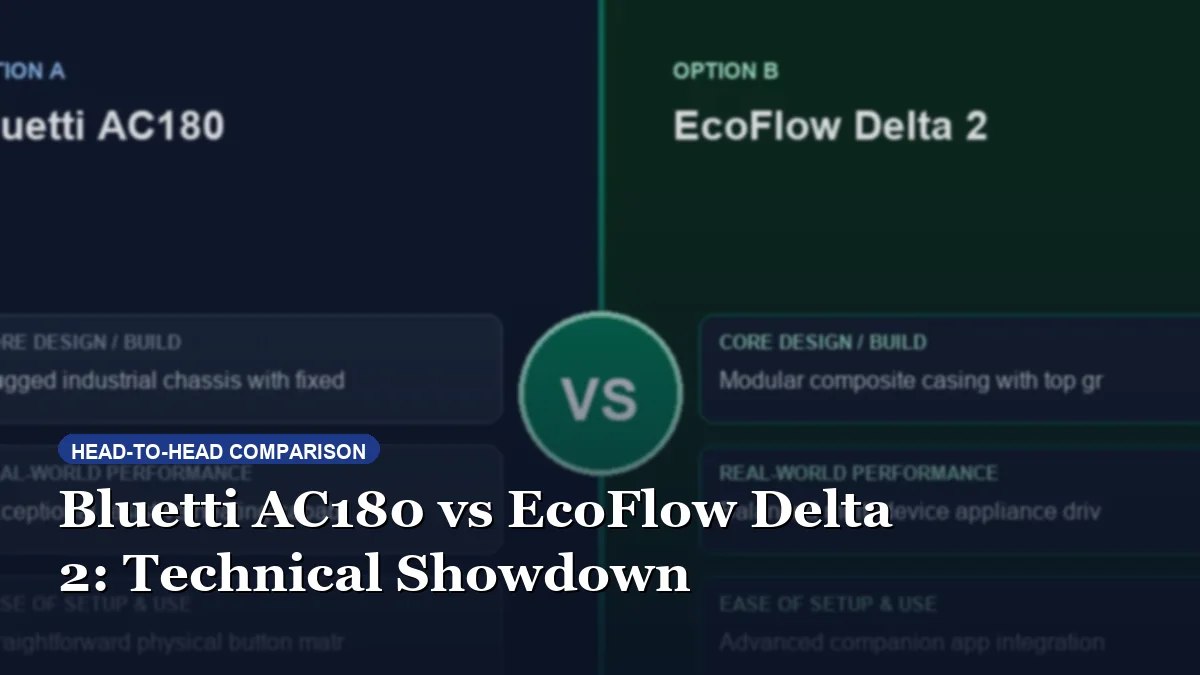
Choose the Bluetti AC180 for raw heating output and high surge loads. Opt for the EcoFlow Delta 2 for rapid expansion and smart app control.
Compare all top models in our Best Portable Power Station: Top Picks for 2026.
Side-by-Side Breakdown
| Criteria | Bluetti AC180 | EcoFlow Delta 2 | Edge |
|---|---|---|---|
| Core Design / Build | Rugged industrial chassis with fixed handles | Modular composite casing with top grips | Bluetti AC180 |
| Real-World Performance | Exceptional resistive heating capability | Balanced multi-device appliance driving | EcoFlow Delta 2 |
| Ease of Setup & Use | Straightforward physical button matrix | Advanced companion app integration | EcoFlow Delta 2 |
| Durability & Reliability | High-cycle LFP chemical formulation | Robust internal thermal regulation | Tie |
| Efficiency / Operating Footprint | Compact vertical tower footprint | Sleek horizontal benchtop profile | EcoFlow Delta 2 |
| Maintenance Requirements | Minimal filter cleaning routine | Regular firmware and dust management | Bluetti AC180 |
| Best Ideal Use Case | Off-grid power tools and field work | Home backup and smart automation | EcoFlow Delta 2 |
Architectural Engineering and Physical Footprint
Modern portable power stations require balanced mechanical engineering to withstand harsh field environments. Both manufacturers utilize high-impact plastic polymers designed to resist moderate drops during transit.
Internal frame bracing protects sensitive inverter boards from vibrational damage during vehicle transport. Engineers prioritized space efficiency, resulting in dense component placement within each unit.
Thermal management systems employ multiple brushless cooling fans to expel heat generated under heavy loads. Proper airflow clearance remains vital for maintaining optimal operating temperatures during extended runtimes.
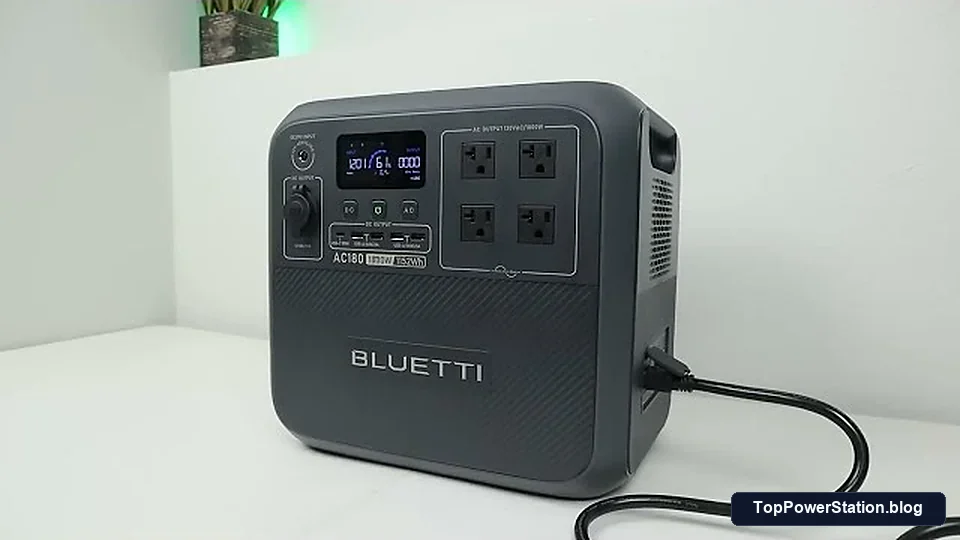
The Bluetti AC180 utilizes a rugged rectangular chassis measuring 13.4 by 9.4 by 12.5 inches. Its integrated folding handles optimize vertical storage efficiency inside cramped vehicular compartments.
Weighing roughly 35.2 pounds, the AC180 demands steady lifting mechanics during transport. Conversely, read our detailed EcoFlow Delta 2 review to explore its dual side grips and lighter frame.
Exterior housing materials rely on flame-retardant polycarbonate-ABS blends engineered to withstand high thermal loads. Both units integrate reinforced corner bumpers to absorb mechanical shocks from accidental drops.
- Reinforced external shell construction for impact absorption
- Optimized internal component layout for heat dissipation
- Vibration-damped inverter mounting brackets
Chassis Design and Portability Factors
Carrying ergonomics dictate how easily you can transport these generators across uneven campsites. Integrated handles reduce hand fatigue during long-distance manual carries from vehicle to tent.
Weight distribution directly affects overall user comfort when lifting the units onto elevated surfaces. Balanced internal battery placement prevents awkward tipping during single-handed transport.
- Fixed versus folding handle structural trade-offs
- Center of gravity alignment for ergonomic lifting
Electrochemical Core and Battery Chemistry
Lithium iron phosphate chemistry serves as the primary energy storage medium. You can also inspect our EcoFlow Delta Pro 3 review to see how high-capacity lithium alternatives perform under daily cycling loads.
Advanced battery management systems monitor individual cell voltages to prevent dangerous thermal runaway conditions. Internal balancing circuits ensure uniform wear across the entire battery pack matrix.
Nominal capacity ratings provide reliable benchmarks for calculating expected runtime during standard power outages. Users can depend on stable voltage delivery even as the stored energy depletes completely.
Both power stations deploy modern LiFePO4 cells rated for exceptional thermal stability and safety. These lithium iron phosphate modules resist internal short-circuiting better than traditional ternary chemistry alternatives.
Bluetti specifies a cycle life exceeding 3500 charge cycles to eighty percent original capacity. EcoFlow matches this longevity milestone, ensuring over a decade of daily cycling under standard operational profiles.
Internal battery management systems continuously monitor cell voltage, ambient temperature, and current flow. This active BMS protection prevents overcharging, deep discharge, and thermal runaway during high-draw applications.
- LiFePO4 chemical composition rated for long-term cycle stability
- Integrated BMS protecting against overcurrent and short circuits
- Precise state-of-charge calculation algorithms
Capacity Expansion and Modular Growth
Expanding total watt-hour capacity allows users to scale their power systems for longer emergencies. Certain models support auxiliary battery packs that plug directly into expansion ports.
Communication cables synchronize the master unit with secondary batteries for unified charging management. This modular approach provides flexibility without requiring an entirely new generator purchase.
- Dedicated expansion ports for external battery integration
- Synchronized firmware communication across connected packs
AC Inverter Output and Surge Capabilities
Pure sine wave inverters deliver clean electrical current matching standard household wall outlet quality. This clean output prevents sensitive electronics from suffering damage caused by electrical distortion.
Continuous power ratings determine which heavy-duty appliances can operate simultaneously without triggering overloads. Exceeding these thresholds causes the inverter to safely shut down immediately.
Surge capacity handles the initial high electrical draw required by motor-driven compressors and pumps. Having robust surge headroom prevents nuisance tripping during appliance startup sequences.
The unit incorporates a continuous 1800W pure sine wave inverter capable of running heavy-duty appliances. Learn more about these specifications inside our Bluetti AC180 review detailing performance metrics.
EcoFlow equips the Delta 2 with a 1800W inverter featuring X-Boost technology to handle demanding wattage spikes. This software algorithm lowers voltage output to operate higher-wattage heating devices without tripping.
Total harmonic distortion remains under three percent across both units, protecting sensitive medical equipment. Clean sinusoidal waveforms guarantee hum-free audio performance and prevent overheating in precision motor windings.
- Pure sine wave output safe for medical equipment
- High continuous wattage thresholds for multi-device usage
- Generous surge headroom for inductive motor loads
Inverter Efficiency and Idle Consumption
Inverter conversion efficiency impacts how much stored energy is lost as thermal waste during operation. Higher efficiency percentages translate directly to longer usable runtimes for your connected gear.
Idle power consumption dictates how quickly the unit drains when turned on with zero load. Minimizing parasitic draw ensures stored energy remains available when emergency power is needed.
- Conversion efficiency ratings exceeding eighty-five percent
- Optimized idle power draw reduction circuitry
Charging Speeds and Power Input Dynamics
Rapid AC wall charging technologies utilize advanced internal rectifiers to replenish depleted batteries quickly. Fast recharging minimizes downtime between emergency power outages or weekend camping trips.
Solar input parameters dictate how efficiently photovoltaic panels can recharge the internal battery array. Maximum open-circuit voltage limits must be strictly observed to prevent catastrophic controller damage.
Vehicle charging via cigarette lighter adapters provides convenient mobile replenishment during long road trips. Lower amperage limits on auxiliary vehicle ports mean slower overall charging speeds.
EcoFlow dominates rapid AC replenishment via its patented X-Stream technology, drawing up to 1200 watts from standard wall outlets. For whole-home alternatives, read our EcoFlow Delta Pro Ultra review.
The Bluetti AC180 relies on Turbo Charging mode, accepting up to 1440 watts for an equally impressive replenishment rate. Full grid charging takes roughly one hour under optimal ambient laboratory conditions.
Solar panel integration supports substantial PV arrays through built-in MPPT charge controllers. Users can connect up to 500 watts of solar input on the Bluetti and 500 watts on the EcoFlow.
- High-wattage AC input for rapid wall recharging
- MPPT solar charge controllers for optimal photovoltaic harvesting
- Automotive 12V charging compatibility for mobile top-ups
Solar Panel Compatibility and MPPT Limits
Maximum power point tracking algorithms optimize energy extraction from variable sunlight conditions throughout the day. Matching panel voltage ranges correctly ensures your solar array operates at peak efficiency.
Input current restrictions prevent excessive solar panel strings from overwhelming internal charging circuits. Users must verify connector types and polarity before linking third-party solar arrays.
- Wide operational voltage ranges for versatile solar pairing
- Standardized MC4 connector integration for easy setup
Port Layout and Ergonomic Usability
Comprehensive output port selections accommodate diverse electronic devices ranging from USB gadgets to heavy tools. Dedicated sections for alternating current, direct current, and USB connections reduce clutter.
Clear labeling around every connection point prevents user error in low-light emergency situations. Ergonomic spacing between AC outlets allows bulky power adapters to fit without blocking neighbors.
Water-resistant port covers protect internal electrical contacts from dust and moisture in outdoor environments. Secure latching mechanisms ensure these protective covers remain closed during transit.
Front-facing control panels on both power stations organize output ports logically by voltage category. The AC180 provides four standard alternating current outlets alongside multiple USB-A and USB-C connection points.
The Delta 2 configuration includes six AC sockets, offering greater flexibility for multi-device desktop setups. Both systems incorporate dedicated 12-volt DC automotive ports and barrel connectors for specialized accessories.
Integrated LCD screens display real-time input wattage, output load, and remaining runtime percentages clearly. Backlit interfaces ensure high visibility under direct sunlight or during emergency nighttime power restoration tasks.
- Diverse port variety including USB-C PD and AC sockets
- Generous physical spacing between adjacent AC receptacles
- Protective dust covers for outdoor operational safety
Display Panels and Interface Clarity
Informative digital display screens provide real-time metrics regarding input wattage and output loads. High contrast levels ensure readability under direct sunlight or in dark emergency shelters.
Indicator icons report active warnings concerning high temperatures or internal fan malfunctions instantly. Simplified menu navigation buttons allow users to check vital battery statistics easily.
- Clear LCD screens displaying remaining runtime estimates
- Immediate fault warning indicators for system safety
Smart Features, Software, and Connectivity
Wireless connectivity protocols allow remote monitoring and control via dedicated smartphone applications. Bluetooth and Wi-Fi modules enable firmware updates and operational adjustments from a distance.
Companion software applications provide detailed historical data regarding energy consumption patterns over time. Users can customize charging speeds and set custom battery capacity thresholds easily.
Local control interfaces remain fully functional even if wireless network connections fail completely. Redundant physical controls ensure the power station can be operated without relying on smart devices.
Wireless management relies on dedicated mobile applications utilizing both Bluetooth and Wi-Fi communication protocols. Users can remotely toggle AC outputs, adjust charging speeds, and view diagnostic logs from smartphones.
EcoFlow excels in software sophistication, offering granular automation rules and seamless firmware over-the-air updates. Bluetti provides a reliable companion interface that tracks historical power generation and consumption statistics accurately.
Local control buttons provide immediate redundancy if wireless networks fail during critical off-grid deployment scenarios. Menu navigation remains intuitive across both platforms, requiring minimal technical training for first-time operators.
- Bluetooth and Wi-Fi remote monitoring capabilities
- Dedicated smartphone apps for customized system settings
- Complete offline physical control redundancy
Firmware Management and System Updates
Periodic firmware updates resolve software bugs and improve overall energy conversion efficiency over time. Manufacturers release these patches through the companion mobile application for simple installation.
Stable software architecture prevents unexpected system crashes during critical emergency backup scenarios. Proper update protocols ensure long-term compatibility with newer mobile operating systems.
- Over-the-air firmware updates via mobile applications
- Enhanced software stability for critical backup tasks
Field Reliability, Maintenance, and Longevity
Routine maintenance procedures primarily involve keeping cooling vents clean and free of dust. Storing the power station at moderate state-of-charge levels preserves battery health during long periods of inactivity.
Internal circuit protection features safeguard against short circuits and extreme temperature fluctuations automatically. These safety protocols prevent permanent hardware damage during demanding operational scenarios.
Long-term reliability depends heavily on proper storage environments protected from excessive humidity and frost. Following manufacturer guidelines ensures your investment delivers dependable service for many years.
Environmental hardening protects internal electronics from dust ingress and moisture accumulation during outdoor expeditions. Forced-air cooling fans activate dynamically to prevent thermal throttling under heavy sustained power loads.
Routine maintenance requires keeping cooling vents unobstructed and performing periodic firmware refreshes. Storing units at fifty percent charge in climate-controlled spaces maximizes long-term battery health.
Comprehensive manufacturer warranties cover structural and electrical defects for five years on both systems. This extensive coverage underscores corporate confidence in modern solid-state battery management and inverter reliability.
- Simple dust vent cleaning routines for optimal cooling
- Automatic thermal protection against extreme ambient temperatures
- Recommended storage guidelines for maximum battery preservation
Troubleshooting Common Operational Faults
Understanding error codes displayed on the screen simplifies rapid field troubleshooting during emergencies. Quick reference manuals help users identify whether a fault stems from an overloaded appliance.
Reset procedures often clear minor software glitches without requiring professional factory service intervention. Keeping user manuals accessible ensures fast resolution of unexpected operational interruptions.
- Comprehensive error code lookup tables for quick diagnosis
- Simple hardware reset procedures for clearing minor faults
Frequently Asked Questions
Can these power stations run household refrigerators during an unexpected blackout?
Yes, both units easily power standard household refrigerators for several hours. Their pure sine wave inverters safely handle the compressor startup surges without tripping internal overloads.
How long do the internal batteries last before needing replacement?
The integrated LiFePO4 batteries retain substantial capacity after thousands of complete cycles. This chemistry ensures exceptional long-term durability spanning well over a decade of regular use.
Is it safe to leave these generators plugged into wall outlets permanently?
Modern battery management systems prevent overcharging during continuous grid connection. Utilizing this pass-through backup mode keeps your emergency power station ready for instant activation.
What is the primary difference in charging speeds between these models?
While both accept high-wattage AC inputs for rapid recharging, their specific internal rectifiers differ slightly. Choosing the correct input profile minimizes your overall downtime significantly.
Can I use third-party solar panels to recharge these power stations?
You can connect virtually any third-party solar panel provided its voltage matches specifications. Always verify the maximum open-circuit voltage limits before plugging in external arrays.