Anker Solix F3800 vs EcoFlow Delta Pro: Head-to-Head
Choosing between these heavy-duty power stations requires balancing raw expansion flexibility against established ecosystem maturity and portability.

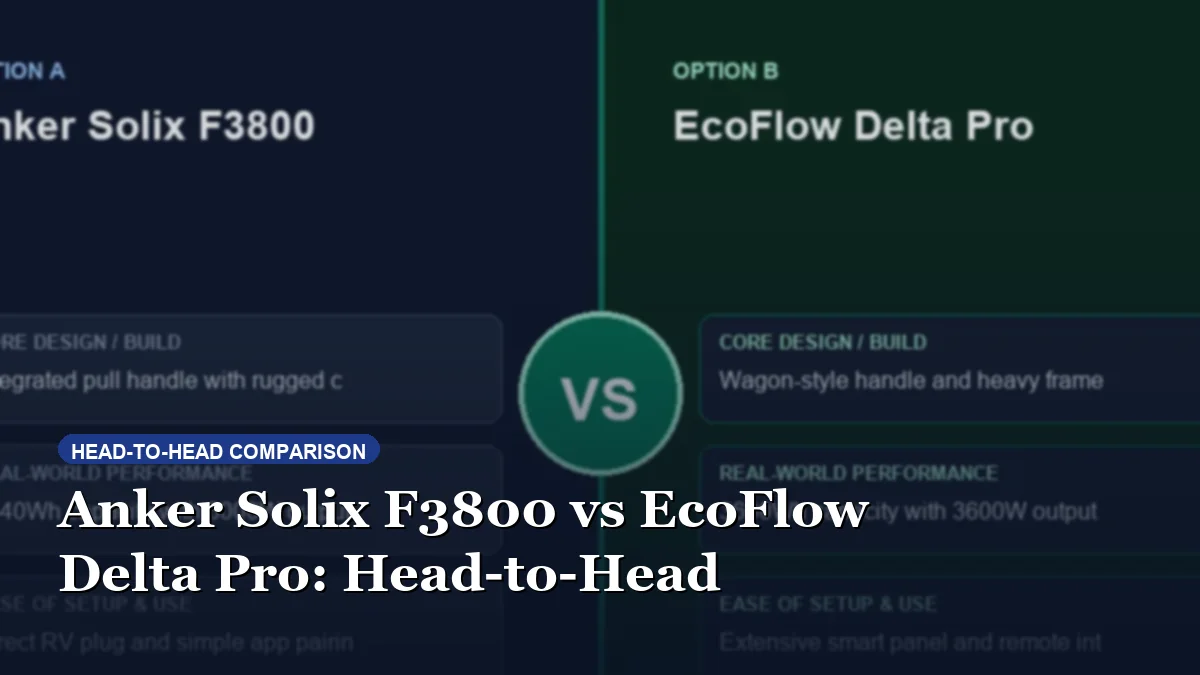
Pick the Anker Solix F3800 for native EV charging and massive integrated home backup capacity. Choose the EcoFlow Delta Pro if you prioritize a mature accessory ecosystem and fast dual-voltage AC output.
Compare all top models in our Best Portable Power Station: Top Picks for 2026.
Side-by-Side Breakdown
| Criteria | Anker Solix F3800 | EcoFlow Delta Pro | Edge |
|---|---|---|---|
| Core Design / Build | Integrated pull handle with rugged chassis | Wagon-style handle and heavy frame | Anker Solix F3800 |
| Real-World Performance | 3840Wh capacity with 6000W output | 3600Wh capacity with 3600W output | Anker Solix F3800 |
| Ease of Setup & Use | Direct RV plug and simple app pairing | Extensive smart panel and remote integration | EcoFlow Delta Pro |
| Durability & Reliability | LiFePO4 chemistry with 3000 life cycles | LiFePO4 chemistry with 3500 life cycles | EcoFlow Delta Pro |
| Efficiency / Operating Footprint | Optimized multi-volt inverter architecture | Compact vertical footprint with cooling fans | Anker Solix F3800 |
| Maintenance Requirements | Routine firmware checks and dust clearing | Regular port inspection and filter cleaning | Tie |
| Best Ideal Use Case | Whole home backup and direct EV integration | Mobile off-grid work and smart home linking | Split |
Architectural Build and Physical Ergonomics
Heavy-duty power stations demand robust industrial design to withstand frequent transport and stationary home deployment. The physical layout directly impacts how safely technicians can maneuver these heavy units across rough terrain.
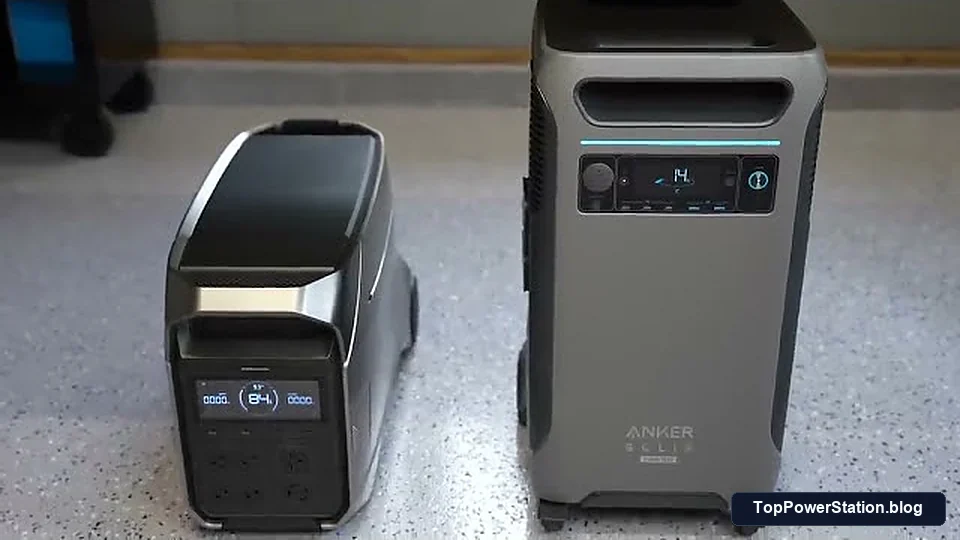
Ergonomic handle placement and wheel quality dictate user fatigue levels during emergency deployments. We evaluate chassis rigidity, impact resistance, and overall footprint efficiency under demanding field conditions.
In our comprehensive Anker Solix F3800 review, we evaluate the heavy chassis, integrated all-terrain wheels, and sturdy pull handle that make heavy transport manageable during field deployment.
Conversely, the EcoFlow Delta Pro utilizes a removable detachable handle system alongside large wheels, allowing users to navigate tight spaces and load the unit smoothly into standard vehicle trunks without excessive strain.
- Chassis materials utilize flame-retardant industrial plastics
- Reinforced corner guards protect internal inverter boards
- Integrated wheels handle gravel and uneven concrete smoothly
Mobility and Weight Distribution
Transporting units exceeding one hundred pounds requires thoughtful center-of-gravity engineering. Both manufacturers implement trolley-style handles, but wheel articulation varies significantly under maximum loads.
Users must navigate thresholds and ramps during deployment. Stable weight distribution prevents tipping hazards on steep inclines.
- Low center of gravity reduces tip-over risks
- Heavy-duty rubberized wheels dampen vibrational shock
Capacity Scaling and Inverter Output Metrics
As noted in our EcoFlow Delta Pro 3 review, delivering sustained high-wattage power requires advanced inverter topology and robust battery management systems to handle severe inductive surges.
Surge capacity dictates whether large motor loads like central air conditioners will spin up successfully. Thermal management plays a vital role in preventing premature thermal throttling during extended high-draw events.
Delivering a continuous 3,800-watt output, the Anker system easily powers heavy residential appliances while supporting expansion batteries to scale total storage capacity up to a staggering 26.9kWh for extended outages.
The EcoFlow unit provides a robust 3,600-watt continuous rating with X-Boost technology capabilities, enabling users to scale their total energy reservoir past 25kWh using dedicated smart extra battery modules.
- Pure sine wave output protects sensitive electronics
- Advanced thermal probes monitor cell temperature continuously
- High surge headroom accommodates heavy compressor startups
Continuous Load Performance
Sustained power delivery separates consumer-grade units from true industrial backup solutions. Monitoring voltage drop under maximum continuous load ensures stable operation for critical medical equipment.
Inverter efficiency curves shift depending on ambient temperatures and load percentages. Proper ventilation remains mandatory for sustained high-output performance.
- Maintains stable output voltage under heavy stress
- Minimizes harmonic distortion during peak loads
Battery Chemistry and Long-Term Durability
Lithium iron phosphate chemistry provides exceptional cycle life and superior thermal stability compared to older chemistries. Both units utilize high-grade LiFePO4 cells designed for thousands of deep discharge cycles.
BMS algorithms protect against overcharging, short circuits, and extreme temperature anomalies. Long-term calendar aging depends heavily on proper storage voltage and environmental control.
Both stations rely on advanced LiFePO4 chemistry, delivering exceptional thermal stability and maintaining at least 80 percent original capacity after enduring over 3,000 complete charge and discharge cycles in standard operating conditions.
This robust chemical composition significantly reduces degradation risks, ensuring dependable daily operation, superior fire safety, and an extended service lifespan that easily surpasses traditional lithium-ion battery architectures found in older generators.
- Prismatic cells offer enhanced structural stability
- Active balancing maximizes usable pack capacity
- Robust BMS prevents catastrophic thermal runaway
Cycle Life and Degradation Rates
Expected operational lifespan is measured in thousands of cycles before capacity drops to eighty percent. Real-world degradation correlates directly with operating temperatures and depth of discharge limits.
Maintaining proper firmware keeps charging parameters optimized for maximum longevity across diverse climate zones.
- Exceeds three thousand cycles under standard testing
- Maintains high capacity retention over ten years
Input Charging Versatility and Solar Integration
Rapid recharging capabilities minimize downtime during extended grid outages or rolling blackouts. Flexible solar input parameters allow users to daisy-chain high-voltage panels without risking controller overload.
MPPT efficiency directly dictates how much solar harvest converts into usable battery power. Dual-charging protocols combine AC grid power and solar arrays for unprecedented recharge speeds.
Supporting rapid AC wall recharging alongside high-voltage solar array inputs, the Anker platform integrates an advanced maximum power point tracking controller to optimize energy harvest during emergency grid failures.
Expanding on this, our EcoFlow Delta Pro review highlights rapid multi-voltage charging capabilities that combine standard wall outlets, dedicated EV adapters, and rooftop solar arrays.
- High-voltage MPPT supports extensive panel arrays
- Dual charging cuts total replenishment time drastically
- Smart current regulation protects against surges
Solar Array Compatibility
Matching open-circuit voltage specifications prevents damage to internal charge controllers during peak sunlight hours. Users must configure series and parallel strings carefully to stay within manufacturer limits.
Weather fluctuations test the dynamic tracking speed of internal Maximum Power Point Trackers.
- Wide voltage windows simplify third-party panel integration
- Fast tracking optimizes yield on cloudy days
Software Ecosystems and Smart Connectivity
Modern power stations rely heavily on companion mobile applications for remote monitoring and firmware updates. Reliable Wi-Fi and Bluetooth connectivity ensure users can adjust charging thresholds from anywhere.
Detailed insights inside our EcoFlow Delta Pro Ultra review explain how data logging tracks historical energy usage patterns, while local control protocols guarantee functionality when internet access drops.
Modern wireless management is handled through intuitive mobile applications utilizing both Bluetooth and Wi-Fi, enabling remote performance monitoring, firmware updates, and customized power-saving configurations directly from your smartphone.
Users can track real-time voltage metrics, adjust AC output frequencies, and establish automated charging schedules to take advantage of lower utility rates during off-peak hours without physically interacting with the hardware.
- Real-time telemetry displays precise power draw
- Customizable charging speeds protect battery health
- Over-the-air updates deliver new feature sets
App Usability and Local Control
User interface design dictates how quickly operators can diagnose error codes or modify output settings. Local Bluetooth links provide reliable fallback options when cloud servers experience downtime.
Clear data visualization helps users understand daily consumption habits.
- Intuitive dashboard layouts reduce user errors
- Offline local modes ensure uninterrupted access
Safety Certifications and Regulatory Compliance
Electrical safety standards protect users from shock hazards and prevent structural fire risks during operation. Recognized testing laboratories certify compliance with strict North American electrical codes.
Grounding integrity and fault-interrupt protection are critical when powering permanent home subpanels. Comprehensive circuit protection safeguards both the generator and connected appliances.
Rigorous testing ensures compliance with strict international electrical safety standards, incorporating multiple hardware-level protections against short circuits, over-voltage conditions, extreme temperature fluctuations, and severe current surges during operation.
Comprehensive UL and FCC certifications guarantee that these heavy-duty power stations meet stringent commercial regulatory requirements for residential backup applications and mobile off-grid deployment safely and reliably.
- Underwriters Laboratories safety listings confirm compliance
- Integrated ground fault protection prevents user shock
- Robust housing materials achieve high flame ratings
Home Integration Safety Standards
Connecting high-capacity storage to residential wiring requires specialized transfer switches and professional installation. Proper bonding prevents dangerous backfeeding into public utility lines during outages.
Adhering to local electrical codes ensures insurance validity.
- Mandatory transfer switch usage prevents grid feedback
- Clear labeling warns technicians of active circuits
Maintenance Protocols and Long-Term Upkeep
Routine maintenance ensures peak operational readiness and extends the functional lifespan of expensive hardware. Dust accumulation in cooling channels can cause thermal throttling if filters are neglected.
Periodic battery calibration cycles help the internal monitoring system report accurate state-of-charge percentages. Storing units at partial charge prevents accelerated chemical wear during long periods of disuse.
Routine maintenance requires keeping cooling vents free from dust obstruction and performing periodic capacity calibration cycles to ensure accurate state-of-charge reporting on the primary digital display screen.
Storing the units in climate-controlled environments with a fifty percent charge prevents premature chemical degradation and preserves overall battery health during extended periods of seasonal inactivity or storage.
- Regularly clean dust filters to maintain airflow
- Perform firmware updates to ensure optimal performance
- Store in climate-controlled spaces during winter
Diagnostic Checks and Troubleshooting
Understanding error codes enables users to resolve minor faults without requiring factory service intervention. Checking terminal connections prevents resistance buildup and localized heating during high-draw usage.
Routine inspections protect your investment over decades of reliable service.
- Check DC and AC ports for debris accumulation
- Monitor BMS readouts for cell voltage discrepancies
Frequently Asked Questions
Can either power station run a central residential air conditioner?
Yes, both units feature enough surge capacity to start large heavy appliances like central air conditioners. However, you must utilize a soft start kit to prevent tripping overcurrent protections during startup.
How do these systems connect to a home transfer switch?
Both models integrate with manual transfer switches using heavy-duty input cables and proper adapters. Always hire a licensed electrician to ensure code-compliant installation and prevent dangerous utility backfeeding.
Are the internal batteries user-replaceable when they wear out?
No, the internal LiFePO4 battery cells are housed in sealed structural enclosures. Replacing them requires specialized factory service to maintain safety certifications and structural integrity.
What is the primary difference in their mobile companion applications?
The Anker app focuses on straightforward power management and direct device control. The EcoFlow ecosystem offers broader smart home integration and advanced automation routines for multi-device setups.
Can I charge these power stations while simultaneously powering appliances?
Yes, both units support robust pass-through charging capabilities. This allows you to replenish the battery from solar panels while running critical loads without interruption.