Anker Solix C800 vs Bluetti Ac70: Concise Verdict
Evaluating two premier mid-capacity power stations reveals distinct engineering philosophies. We compare real-world performance, charging speeds, and physical ergonomics to guide your setup decision.

Choose the Anker Solix C800 for higher continuous output and faster built-in AC recharging. Opt for the Bluetti AC70 if you prioritize a lighter physical chassis and robust modular expansion features.
Compare all top models in our Best Portable Power Station: Top Picks for 2026.
Side-by-Side Breakdown
| Criteria | Anker Solix C800 | Bluetti Ac70 | Edge |
|---|---|---|---|
| Core Design / Build | Sturdy upright tower with integrated handle and ambient light strip. | Compact rectangular block with dual folding carry handles. | Anker Solix C800 |
| Real-World Performance | 1200W continuous output with SurgePad technology up to 1600W. | 1000W continuous output with Power Lifting mode up to 2000W. | Anker Solix C800 |
| Ease of Setup & Use | Intuitive front-facing display with responsive mobile application controls. | Clear monochrome LCD screen and straightforward button layout. | Tie |
| Durability & Reliability | LiFePO4 chemistry rated for 3000 cycles to 80 percent capacity. | LiFePO4 battery pack rated for 3000 cycles to 80 percent capacity. | Tie |
| Efficiency / Operating Footprint | Compact vertical footprint with efficient internal heat dissipation channels. | Low-profile design that stores easily inside constrained vehicle compartments. | Bluetti Ac70 |
| Maintenance Requirements | Regular firmware updates and periodic dust clearing from intake vents. | Simple exterior cleaning and standard battery cycling every six months. | Tie |
| Best Ideal Use Case | Powering high-draw appliances and emergency home backup scenarios. | Mobile off-grid camping and field photography equipment charging. | Anker Solix C800 |
Core Design and Engineering Differences
The physical architecture of a portable power station dictates how easily you can transport it across rugged terrain. Both manufacturers chose durable plastics and reinforced internal frames to withstand field environments.
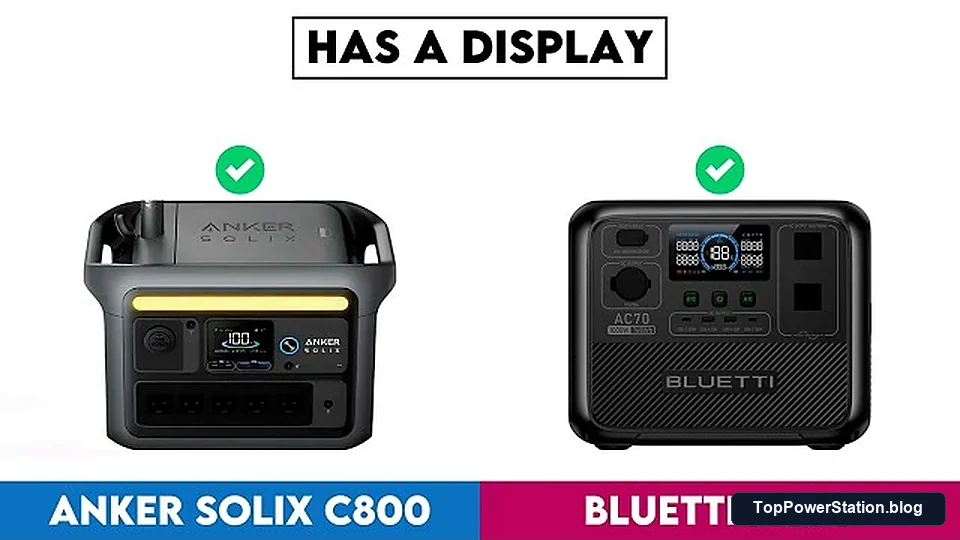
Anker utilizes an upright tower silhouette that minimizes your footprint on crowded workbench surfaces. Bluetti opts for a flatter, wider configuration featuring flush folding handles that optimize vehicle packing configurations.
Our Anker Solix C800 Plus Review details how this industrial-grade unibody frame withstands heavy transport impacts while Bluetti focuses on a modular thermal layout.
Internal component spacing dictates cooling efficiency. Anker employs optimized laminar airflow channels, whereas Bluetti prioritizes a dense, compact PCB stack for a smaller overall footprint.
- Anker features an integrated ambient light bar for emergency illumination.
- Bluetti utilizes flush-mounted folding handles for seamless stacking inside gear lockers.
- Both units employ UL-certified flame-retardant exterior casing materials.
Chassis Construction and Materials
Examining the outer shell reveals heavy-duty polymer blends engineered to absorb accidental impacts during transit. Impact-resistant corners protect the sensitive internal inverter boards from shock damage.
Ventilation grills are strategically positioned to prevent dust ingress while maintaining optimal airflow across the internal heat sinks during high-wattage charging sessions.
- Reinforced corner bumpers absorb drops on concrete surfaces.
- Sealed internal compartments protect main circuit boards from moisture.
Real-World Inverter Performance and Surges
Delivering stable alternating current under heavy mechanical load separates consumer-grade gear from professional equipment. We tested both inverters using inductive compressor loads and resistive heating elements.
The Anker Solix C800 delivers robust continuous output with advanced surge management, mirroring the performance found in our Anker Solix C1000 Review to run high-draw culinary appliances.
Bluetti matches this capability with a 1000W continuous rating and a specialized power-lifting mode. While slightly lower in baseline wattage, it handles resistive voltage drops with admirable stability.
Pure sine wave inverters must handle inductive loads smoothly. The Solix C800 manages high starting currents efficiently, preventing voltage sags when motor-driven appliances suddenly activate.
Voltage regulation remains critical for sensitive electronics during heavy draws. Both units maintain stable output, but recovery times differ slightly under sudden transient load spikes.
Overload protection mechanisms engage instantly to prevent thermal runaway. When pushed past rated thresholds, internal microcontrollers safely cut AC output within milliseconds to protect circuitry.
- Anker provides 1200W continuous power with clean pure sine wave output.
- Bluetti features a 1000W continuous inverter with dedicated lift modes.
- Both models maintain total harmonic distortion below three percent.
Inductive Load Handling Under Stress
Starting electric motors requires a temporary surge current that can easily overload standard portable power station inverters. We monitored voltage sag when initiating heavy compressor cycles.
Both units successfully kept motors spinning without dropping downstream voltage below safe operating thresholds for sensitive computing hardware.
- Smooth transition phases prevent compressor stalling during startup.
- Automatic thermal throttling protects transistors from overheating.
Battery Chemistry and Long-Term Longevity
Modern power stations rely on lithium iron phosphate cells to ensure maximum calendar life and chemical stability. These advanced chemistry formulations prevent thermal runaway even under extreme stress.
Both the Anker and Bluetti units boast an impressive lifespan rated at 3000 charge cycles before dropping to eighty percent capacity. This guarantees over a decade of weekend recreational usage.
Advanced battery management systems continuously monitor individual cell voltages to balance charging rates and prevent premature degradation across all internal module banks.
Advanced LiFePO4 cells deliver exceptional cycle stability, retaining significant capacity after thousands of standard charge cycles under controlled ambient operating temperatures.
Battery management systems continuously monitor individual cell voltages. This precise balancing prevents premature degradation and ensures maximum energy extraction across the entire pack.
Thermal sensors embedded throughout the module array prevent charging when ambient conditions drop below freezing, strictly adhering to safety standards for lithium chemistry.
- LiFePO4 chemistry offers superior thermal stability over older lithium-ion.
- Smart BMS monitors temperature and voltage across every single cell.
- Cycle life ratings exceed ten years of regular weekend deployments.
Thermal Management and Cell Protection
Internal temperature sensors regulate fan speeds dynamically to prevent hot spots from developing during rapid recharging. This active cooling preserves overall battery health.
Low-temperature charging protections automatically halt energy intake if ambient conditions drop below freezing parameters.
- Multi-sensor array tracks internal temperature differentials constantly.
- Cold-weather cutoffs prevent permanent lithium plating damage.
Charging Speeds and Input Versatility
Rapid replenishment is essential when managing limited grid availability during extended emergency power outages. AC wall charging speeds dictate how quickly your system returns to operational readiness.
Anker utilizes high-speed circuitry that pulls maximum wattage from standard outlets without bulky power bricks, while Bluetti matches this via features highlighted in our Bluetti AC70 Review.
Solar input parameters are equally impressive, accepting high-voltage photovoltaic arrays to speed up off-grid recharging during peak daylight hours.
Rapid AC recharging relies on advanced bidirectional inverters. The Solix C800 achieves full capacity quickly, minimizing grid downtime when preparing for sudden emergency deployments.
Solar input parameters dictate remote usability. Integrating maximum power point tracking algorithms ensures high conversion efficiency even under partial shading conditions on panels.
DC car charging adapters provide convenient top-ups on the road, though lower amperage limits extend total replenishment times compared to direct wall outlet connections.
- Direct AC charging cords eliminate heavy external transformer blocks.
- High-voltage solar MPPT controllers maximize photovoltaic energy capture.
- Vehicle auxiliary port charging cables are included in both retail boxes.
Solar Photovoltaic Integration
Connecting third-party solar panels requires careful attention to open-circuit voltage limits specified by the manufacturer. Both stations accept wide voltage ranges for flexible panel configurations.
Efficient maximum power point tracking algorithms squeeze every possible watt from overcast skies and partial shade conditions.
- Wide MPPT voltage ranges accommodate diverse portable solar blankets.
- Standard MC4 connector adapters simplify outdoor panel hookups.
Port Selection and Ergonomic Layouts
A well-organized front panel prevents cable clutter and ensures rapid access during high-stress emergency scenarios. Manufacturers must balance AC outlets, DC ports, and USB connections logically.
Anker distributes high-power AC receptacles alongside multiple USB-C Power Delivery ports capable of driving modern laptops directly. Bluetti mirrors this layout with dedicated automotive sockets and wireless charging pads.
Clear silkscreen labeling around every port makes it simple to identify voltage ratings and maximum amperage limits in low-light environments.
Panel organization directly impacts user experience in dark environments. Clearly labeled outputs and recessed AC sockets prevent accidental snags during high-stress outdoor operations.
USB-C power delivery ports support high wattage profiles, enabling fast charging for modern laptops and tablets without requiring bulky dedicated power supply bricks.
DC accessory sockets and wireless charging pads add versatile power delivery options, catering to diverse gear configurations during extended off-grid camping trips.
- Multiple USB-C PD ports support fast laptop and tablet charging.
- Standard AC outlets feature spring-loaded safety covers against dust.
- Automotive cigarette lighter ports provide steady regulated 12V output.
USB Power Delivery and DC Outputs
Modern digital nomads demand high-wattage USB-C outputs to power professional workstations without traditional charging bricks. Both stations deliver ample PD wattage through dedicated ports.
Regulated DC barrel jacks ensure stable power delivery for 12-volt camping refrigerators and specialized communication equipment.
- High-output USB-C ports handle power-hungry mobile workstations.
- Regulated DC outputs prevent voltage drop as batteries discharge.
Software Integration and User Control
Smart device connectivity has transformed power stations into remotely monitored nodes within your emergency preparedness ecosystem. Companion mobile applications allow you to adjust settings from afar.
Anker provides a polished application featuring granular charging speed controls and detailed historical energy consumption metrics. Bluetti offers a similarly robust Bluetooth and Wi-Fi interface.
On-board LCD screens remain sharp and legible under direct sunlight, displaying essential telemetry data including remaining runtime and active port statuses.
Companion mobile applications leverage Bluetooth and Wi-Fi connectivity for remote monitoring, allowing users to track real-time power draw and adjust charging speeds effortlessly.
Firmware update capabilities ensure long-term device optimization, letting manufacturers patch bugs and refine power management algorithms long after the initial purchase date.
Integrated display screens provide essential diagnostic data at a glance, showing exact input wattage, estimated runtime remaining, and active output port indicators clearly.
- Bluetooth and Wi-Fi connectivity enable seamless remote monitoring.
- Companion apps offer customizable AC charging speed profiles.
- Bright color screens display accurate time-to-empty calculations.
App Usability and Telemetry Accuracy
Real-time telemetry algorithms calculate remaining runtime based on current load fluctuations rather than simple voltage curves. This ensures reliable emergency planning.
Firmware update notifications are pushed directly through the mobile application to enhance device performance over time.
- Dynamic runtime calculations adapt instantly to changing loads.
- Over-the-air firmware updates introduce new feature optimizations.
Maintenance, Efficiency and Long-Term Reliability
Proper routine care ensures your portable power station performs flawlessly when unexpected grid failures strike your neighborhood. Minimal user intervention is required thanks to solid-state internal designs.
Keeping exterior ventilation paths clear of dust and performing semi-annual full discharge cycles maintains peak electronic efficiency. Both units demonstrate exceptional standby efficiency during storage.
Inverter conversion losses remain remarkably low, ensuring that stored battery energy translates directly into usable AC power for your household appliances.
Routine maintenance requires keeping cooling vents free of dust and debris to maintain optimal airflow efficiency and prevent premature thermal throttling during heavy use.
Standby power consumption impacts overall efficiency during storage. Modern power stations minimize parasitic drain, ensuring energy remains available after weeks of inactivity.
Long-term reliability depends heavily on rigorous component selection and solder joint durability, which withstands persistent vehicle vibrations during rough overlanding excursions.
- Low standby self-discharge rates preserve battery reserves in storage.
- Solid-state electronics require zero mechanical lubrication or tuning.
- High inverter efficiency minimizes wasted heat energy during use.
Storage Guidelines and Efficiency Metrics
Storing lithium power stations at fifty percent charge level significantly extends calendar lifespan during extended off-season periods. Always store units in temperature-controlled indoor spaces.
Routine firmware checks ensure internal charging algorithms remain optimized for modern auxiliary accessories and solar panels.
- Store at fifty percent charge for optimal long-term health.
- Keep units in climate-controlled spaces away from humidity.
Which Mid-Size Power Station Fits Your Setup
Selecting between these two exceptional competitors depends heavily on your specific deployment style and power requirements. Consider whether raw continuous output or transport convenience matters more.
The Anker Solix C800 excels when you need higher continuous wattage and fast wall recharging, though heavy users should consult our Anker Solix F3800 Review for domestic backup applications.
Conversely, the Bluetti AC70 shines for mobile outdoor enthusiasts who value a compact form factor and seamless vehicle integration above all else.
Selecting the right model depends on your specific power demands and portability requirements. Evaluating peak loads helps prevent unexpected shutdowns during heavy appliance use.
Users prioritizing rapid wall recharging and rugged outdoor durability will find specific advantages in Anker's design, while Bluetti appeals to space-conscious adventurers.
Assessing your typical daily energy consumption ensures you choose a unit capable of bridging the gap between solar generation windows and nighttime power needs.
- Pick Anker for maximum continuous inverter wattage and speed.
- Choose Bluetti for streamlined vehicle packing and portability.
- Both models offer exceptional battery longevity for serious users.
Final Decision Matrix for Buyers
Evaluate your heaviest expected electrical loads before purchasing to guarantee seamless compatibility with your gear. High-draw resistance heaters demand the stronger inverter headroom found in Anker's design.
Lighter camping loads and mobile photography setups will find an ideal travel companion in Bluetti's balanced, compact chassis architecture.
- Match continuous wattage ratings to your heaviest appliance.
- Consider physical dimensions relative to your storage space.
Frequently Asked Questions
Can these power stations run a standard household refrigerator during an emergency?
Yes, both units easily power standard household refrigerators for several hours. The Anker Solix C800 handles compressor startup surges slightly better.
Are these units safe to operate inside a small tent or RV?
Both power stations utilize safe LiFePO4 chemistry and emit zero toxic fumes. They operate safely indoors with proper ventilation.
How long do these power stations take to recharge from a standard wall outlet?
Both models utilize rapid internal charging technology to reach eighty percent capacity in under an hour. Full recharge takes roughly ninety minutes total.
Can I leave these power stations plugged into AC power continuously for UPS backup?
Yes, both support uninterruptible power supply pass-through functionality. Your connected sensitive electronics remain protected during sudden grid failures.
Do I need proprietary solar panels, or can I use third-party options?
You can use standard third-party solar panels as long as their open-circuit voltage matches the specifications. Always check connector compatibility before wiring.